Health & Medicine
Are Vaccines Safe and Effective?
The autism question, the rare real risks, and what the surveillance systems catch.
Science & Media Accuracy
Is Climate Change Real and Human-Caused?
The temperature records, the attribution science, and how news coverage compares with the science.
Science & Media Accuracy
How Dangerous Is Nuclear Power?
Deaths by source of electricity, the counted and projected tolls of its accidents, and the case against it.
What Is COVID-19, and Where Did It Come From?
What COVID-19 and the virus SARS-CoV-2 are, how the disease spread and how much harm it did, and where the virus came from, judged on the scientific studies and the official investigations.
Jump to the verdict ↓
What this covers
This page covers what COVID-19 and SARS-CoV-2 are, how the virus spreads, how deadly it was, and the evidence on where it came from. The COVID-19 vaccines are covered on a separate page, Are Vaccines Safe and Effective?
The virus and the disease
COVID-19 (coronavirus disease 2019) is the disease caused by SARS-CoV-2 (severe acute respiratory syndrome coronavirus 2). The World Health Organization (WHO) named the disease, and the International Committee on Taxonomy of Viruses named the virus, both on 11 February 2020. SARS-CoV-2 is related to the virus behind the 2003 outbreak of severe acute respiratory syndrome (SARS), but it is a different virus, and their genome sequences are 79.6% identical.
The closest known relatives of SARS-CoV-2 are bat viruses. RaTG13, sampled from a bat in Yunnan province, China, in 2013, shares about 96% of its genome. BANAL-52, found in cave bats in northern Laos in 2020, shares 96.8%. WHO’s Scientific Advisory Group for the Origins of Novel Pathogens (SAGO) weighed the evidence on the origin from 2021 to 2025. It judged these bat viruses too distantly related to SARS-CoV-2 to be the direct source of the pandemic.
The virus enters human cells by binding its spike, a surface protein, to a receptor called ACE2. The spike also carries a furin cleavage site, a short stretch that furin, an enzyme plentiful in the lungs, can cut. The site makes it easier for the virus to infect human cells.
No other SARS-like coronavirus is known to have such a site. But similar sites are common in other coronaviruses, including the virus that causes Middle East respiratory syndrome (MERS). The site has been a focus of the debate over the origin.
Infection can pass with no symptoms, cause a mild illness or kill. WHO lists fever, chills and sore throat as the commonest symptoms of the variants now circulating, and most people recover without treatment. Severe COVID-19 can bring respiratory failure, sepsis, blood clots and the failure of several organs. Older adults, people with conditions such as diabetes, obesity or heart or lung disease, and people who are not vaccinated are at higher risk of severe COVID-19.
The virus spreads through the air, in particles that an infected person breathes, talks, coughs or sneezes out. Catching it is likeliest close to that person or in a closed space shared with them. People can pass it on before their symptoms start, or without having any.
The virus has changed as it spread. WHO has tracked five variants of concern: Alpha, Beta, Gamma, Delta and Omicron. Omicron made up over 98% of the virus genomes shared publicly from February 2022 to March 2023, and Omicron strains still make up the vast majority in circulation.
Some people stay ill for months, a condition called long COVID. The US National Academies of Sciences, Engineering, and Medicine define it as a chronic condition present for at least three months after infection. More than 200 symptoms and conditions have been reported with it. How common it is depends on what is counted. WHO puts it at about 6% of people with COVID-19. In a US survey in 2022, 6.9% of all adults said they had ever had it, and 3.4% had it when interviewed.
How it spread, and how many it killed
The earliest known cases clustered in Wuhan, China, in December 2019. On 31 December 2019, WHO was informed of a cluster of pneumonia of unknown cause there. WHO declared a global health emergency, formally a public health emergency of international concern, on 30 January 2020, and called COVID-19 a pandemic on 11 March 2020. It ended the emergency on 5 May 2023, calling COVID-19 an established and ongoing health problem.
By late 2025, more than 7.1 million deaths from COVID-19 had been reported to WHO. The real toll is higher. Deaths were missed because testing was limited, because many countries register deaths poorly, and because overwhelmed health systems caused deaths that were never recorded as COVID-19.
A fuller measure is excess deaths: how many more people died in the pandemic than would have died in a normal period. For 2020 and 2021, WHO estimated 14.83 million excess deaths, about 2.7 times the number reported as caused by COVID-19 in those two years. A separate analysis, by the Institute for Health Metrics and Evaluation (IHME), put the figure higher still. WHO has since estimated the true toll at more than 20 million deaths.
| Measure | Deaths, 2020–2021 |
|---|---|
| Reported as caused by COVID-19 (WHO) | 5.42 million |
| Excess deaths (WHO estimate) | 14.83 million |
| Excess deaths (IHME estimate) | 18.2 million (17.1–19.6) |
WHO (Msemburi and colleagues, 2023) and the Institute for Health Metrics and Evaluation (IHME; COVID-19 Excess Mortality Collaborators, 2022). IHME counted 5.94 million reported deaths for the same two years. The figure in brackets is IHME’s 95% uncertainty interval.
Some people counted as COVID-19 deaths died with the virus rather than from it, which pushes counts up. But because total deaths ran so far above normal, the larger error worldwide was undercounting, not overcounting.
How deadly the virus was depended overwhelmingly on age. The infection fatality rate is the share of infected people who die. Before vaccines, a systematic analysis estimated how it rose with age. It climbed from a few thousandths of a per cent in children to about one in five among the very old.
| Age | Infection fatality rate |
|---|---|
| 7 | 0.002% |
| 30 | 0.06% |
| 60 | 1.0% |
| 90 | 20% |
COVID-19 Forecasting Team, 2022, for 15 April 2020 to 1 January 2021, before vaccines. A separate analysis (Pezzullo and colleagues, 2023) put the median rate for people under 60 at 0.03%.
That made COVID-19 far deadlier than seasonal influenza, above all for older people. Seasonal flu kills an estimated 290,000 to 650,000 people a year worldwide. By the excess-death estimates, COVID-19 killed many times that number across its first two years.
The risk of dying fell sharply after 2021, as immunity from past infection and vaccination spread and as the Omicron variant took over. COVID-19 vaccines are covered on a separate page.
Where the virus came from
Two explanations are taken seriously by scientists and investigators. One is a natural spillover: the virus passed from animals to people, probably from bats through an intermediate animal, most likely in the wildlife trade. A second is an accident connected to research, such as a worker infected while studying or collecting a natural virus. A third idea, that the virus was built as a weapon and released on purpose, has no scientific support. The US intelligence agencies agree it was not developed as a biological weapon.
Several lines of evidence point to a natural spillover at the Huanan Seafood Wholesale Market in Wuhan. The earliest known cases of December 2019 clustered around it, including some people with no direct link to the market. Live mammals that can catch SARS-CoV-2, among them raccoon dogs, were sold there in late 2019.
The positive swabs from the market clustered near the stalls that sold those animals. In the positive samples from one wildlife stall, researchers found the DNA of raccoon dogs and other susceptible animals alongside the virus. The earliest viruses fall into two slightly different groups, called lineages, which one analysis reads as the virus jumping from animals to people at least twice. Both earlier coronavirus outbreaks reached people this way: SARS in 2003 through civets, and MERS through camels.
The natural case has real gaps. No infected animal has ever been found, in the market or anywhere else, so the chain from animal to human is not complete. The market may have been where the virus spread widely, not where it first reached a person. The clustering of early cases there may partly reflect where officials looked first. Statisticians have argued that the published analysis of that clustering does not prove the market was the origin.
The case for a research-related accident rests mostly on where the outbreak began and on what is not known. The Wuhan Institute of Virology, a world centre for bat-coronavirus research, is in the city where the pandemic started. US intelligence found that its researchers did some of this work at a modest biosafety level. It reported that several of them fell ill in autumn 2019 with symptoms that could fit COVID-19.
In 2018 a group including the institute had proposed, in a grant application called DEFUSE, to add furin cleavage sites to bat coronaviruses. Some see that as suggestive, because SARS-CoV-2 carries such a site. China has not released the Wuhan laboratories’ records, staff health files or safety audits that WHO and its expert group repeatedly asked for.
The lab case has its own gaps. No laboratory, in Wuhan or anywhere, is known to have held SARS-CoV-2 or a close ancestor before the pandemic, and investigators found no direct evidence of an accident. The reports of ill researchers are not diagnostic, because their symptoms matched ordinary winter illnesses too. Similar furin cleavage sites turn up naturally in other coronaviruses. The DEFUSE proposal was never funded, and the viruses it named are too distant to be the backbone of SARS-CoV-2.
What would settle the question is fairly clear. On the natural side, an infected animal, or a near-identical ancestor virus in the wildlife trade, would close the chain. On the lab side, a record that a Wuhan laboratory held SARS-CoV-2 or a close ancestor before the outbreak would show a research-related origin. Most of what could decide the question is held in China and has not been shared.
What the investigations concluded
WHO’s Scientific Advisory Group for the Origins of Novel Pathogens (SAGO) carried out the main scientific review. In June 2025 it concluded that most of the scientific evidence supports a natural spillover. It also said the origin will stay inconclusive until more data are shared, and that a lab-related accident cannot be ruled out. An earlier joint study by WHO and China, in 2021, had not been able to identify the origin. Within SAGO, three of the original members disagreed with even examining the lab hypothesis, holding that there was no evidence for it.
The US intelligence agencies have never agreed. In 2021 four of them, with the National Intelligence Council, favoured a natural origin, at low confidence. The Federal Bureau of Investigation (FBI) favoured a lab-associated incident, at moderate confidence, and three agencies could not decide. By 2023 the Department of Energy and the FBI leaned to a lab incident, while the Council and four agencies still leaned natural.
On several points the agencies agreed. The virus was not built as a weapon. Almost all judged that it had not been genetically engineered. And none found direct evidence of a lab accident.
The agencies have kept shifting. In January 2025 the Central Intelligence Agency said a research-related origin was more likely than a natural one, at low confidence, CNN reported. According to the same report, the judgement did not rest on new intelligence. In March 2025 the German newspapers Die Zeit and Süddeutsche Zeitung reported that Germany’s foreign intelligence service had judged a lab accident 80 to 95% likely. That 2020 assessment has not been published.
Scientists, asked directly, lean toward a natural origin. A 2024 survey put the question to 168 researchers across 47 countries. On average they gave a natural origin a 77% chance and a research-related accident a 21% chance. Such a survey measures opinion, not evidence.
In Congress, the two parties drew different conclusions. A US congressional subcommittee’s majority concluded in December 2024 that the virus most likely came from a Wuhan laboratory, without presenting new direct evidence. The subcommittee’s Democrats said the origin was still unknown.
Common beliefs, checked
Several popular beliefs about COVID-19 are wrong or overstated. That it was no worse than the flu is false: before vaccines it was several times deadlier on average, and far deadlier for older people. That the death counts were inflated is wrong in the opposite direction, because the true toll was undercounted. That the virus was built as a weapon has no credible support, and the US intelligence agencies found it was not.
The idea that the virus came from people eating bats is misleading. Bats are the original reservoir, but the likely natural route runs through the wildlife trade and an intermediate animal, not a meal.
Calling the lab-leak idea a debunked conspiracy theory is also wrong. It was dismissed that way in 2020, but it was never disproved, and the WHO’s own experts cannot rule it out. Yet the US government’s covid.gov address now redirects to a White House page that presents a lab leak as the true origin of the pandemic.
The verdict: what the evidence shows
The disease itself, and the harm it did, are settled. COVID-19 is caused by SARS-CoV-2, a bat-derived coronavirus that spreads through the air. It killed more than 7 million people by reported counts. By excess-death estimates the true toll passed 20 million, and the risk fell heavily on older people. It was far deadlier than seasonal flu. It was not built as a weapon, and no sign of genetic engineering has been found.
Where the virus came from is not settled. Most of the scientific evidence, and most surveyed scientists, favour a natural spillover from animals, probably through the wildlife trade near a Wuhan market. That rests on the earliest cases clustering at the market, the susceptible animals sold there, the sign of two separate jumps into people, and the way earlier coronaviruses reached humans.
But no infected animal and no near-identical ancestor virus has been found, and a research-related accident at a Wuhan laboratory cannot be ruled out. The records that could decide the question are held in China and have not been shared. Several intelligence agencies lean toward a lab accident, mostly at low confidence. The honest position, shared by the WHO’s own experts, is that a natural origin is best supported and the question is still open. Anyone claiming certainty either way is going beyond the evidence.
Six common claims, against the evidence
Claim“It was no worse than the flu.”
FalseBefore vaccines the share of infected people who died reached about 1% at age 60, and far higher in the very old. Seasonal flu kills far fewer people than COVID-19 did.
Claim“The death counts were inflated.”
Wrong the other wayExcess deaths, more than 20 million, ran well above the 7 million-plus reported, so the toll was undercounted, not inflated.
Claim“The virus was built as a weapon.”
No credible evidenceThe US intelligence agencies judge it was not developed as a biological weapon, and found no sign of genetic engineering.
Claim“Scientists proved it came from the Wuhan market.”
OverstatedEarly spread centred on the market, but no infected animal was found. The market may be where the virus spread, not where it first reached a person.
Claim“The lab-leak idea was a debunked conspiracy theory.”
NoIt was never disproved. The WHO’s experts cannot rule out a lab-related accident, though no direct evidence of one has been found.
Claim“The US funded the research that caused the pandemic.”
Not establishedUS money did support bat-coronavirus research at the Wuhan institute, but no laboratory there is known to have held SARS-CoV-2 or a close ancestor.
Download the conclusion
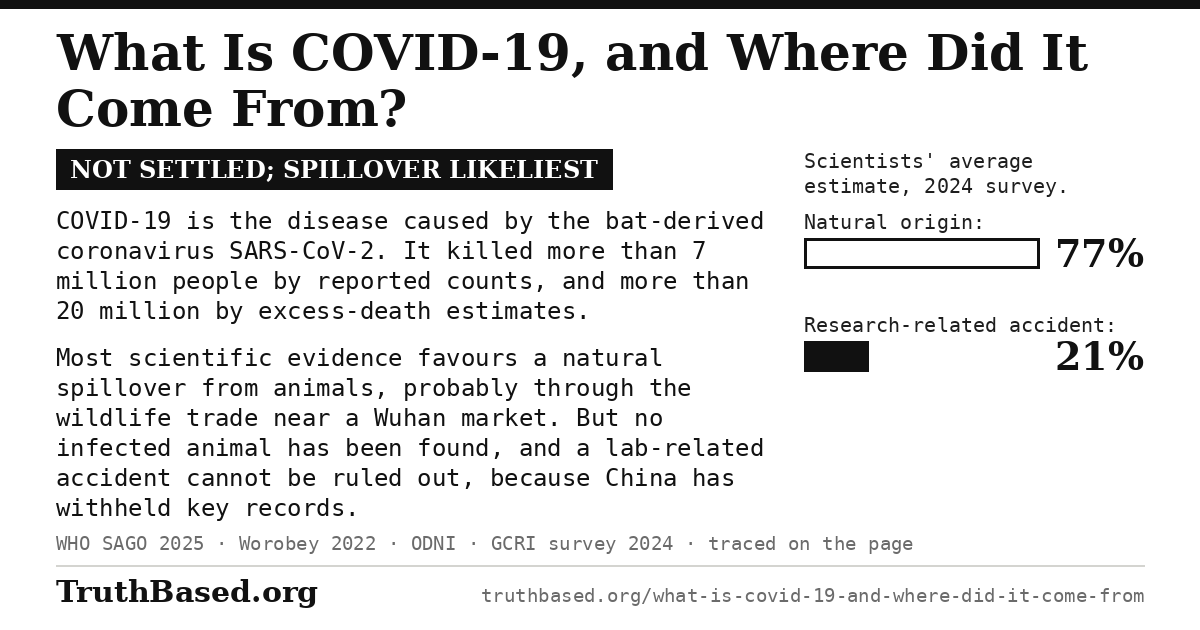
The verdict as one image. COVID-19 killed more than 7 million people by reported counts, and more than 20 million by excess-death estimates. Most scientific evidence favours a natural spillover from animals, but the origin is not settled, and a lab-related accident has not been ruled out. The bars are a 2024 survey of 168 scientists. On average they gave a natural origin a 77% chance and a research-related accident a 21% chance. The image is 1,200 by 630 pixels, and anyone may download it and post it.
What would change this conclusion
This article concludes that: COVID-19 was a severe, airborne disease that killed well over the reported 7 million; that its origin is unresolved; that a natural spillover is the best-supported explanation; and that a research-related accident cannot be ruled out.
These conclusions would be falsified by:
• An animal infected with SARS-CoV-2, or a near-identical ancestor virus, found in the wildlife trade that supplied Wuhan, which would confirm a natural origin
• A record that a laboratory in Wuhan held SARS-CoV-2 or a close ancestor before December 2019, which would point to a research-related origin
• Verified cases of COVID-19, confirmed by sequencing, outside China before December 2019, which would challenge the finding that a natural spillover near the Wuhan market is best supported
Sources
World Health Organization. Coronavirus disease (COVID-19) fact sheet. 27 November 2025. Source for COVID-19 being caused by SARS-CoV-2, the commonest current symptoms, airborne spread, higher risk in older and unvaccinated people and those with other conditions, the severe complications, the more than 7.1 million reported deaths, and the roughly 6% who develop long COVID. who.int
World Health Organization. Naming the coronavirus disease (COVID-19) and the virus that causes it. Source for the names COVID-19 and SARS-CoV-2, both announced on 11 February 2020, the disease by WHO and the virus by the International Committee on Taxonomy of Viruses, and for the kinship with the 2003 SARS virus. who.int
Zhou P, Yang X-L, Wang X-G, et al. A pneumonia outbreak associated with a new coronavirus of probable bat origin. Nature, 2020;579:270–273. Source for the 79.6% genome identity with the SARS virus, RaTG13 (from a bat in Yunnan, 2013) sharing about 96% of the genome, and SARS-CoV-2 using the ACE2 receptor to enter cells. nature.com pmc.ncbi.nlm.nih.gov
Temmam S, Vongphayloth K, Baquero E, et al. Bat coronaviruses related to SARS-CoV-2 and infectious for human cells. Nature, 2022;604:330–336. Source for BANAL-52, found in cave bats in northern Laos in 2020, sharing 96.8% of the genome, and for these bat viruses lacking a furin cleavage site. nature.com
Coutard B, Valle C, de Lamballerie X, Canard B, Seidah NG, Decroly E. The spike glycoprotein of the new coronavirus 2019-nCoV contains a furin-like cleavage site absent in CoV of the same clade. Antiviral Research, 2020;176:104742. Source for the furin cleavage site in the spike, absent in the other SARS-like coronaviruses, and for furin being plentiful in the lungs. doi.org pmc.ncbi.nlm.nih.gov
Scientific Advisory Group for the Origins of Novel Pathogens (SAGO). Independent assessment of the origins of SARS-CoV-2. World Health Organization, 27 June 2025. Source for SAGO’s review from 2021 to 2025; the bat viruses being too distant to be the direct source; the two early lineages; the raccoon-dog and other wildlife DNA at the market; the furin site occurring naturally; the conclusion that a natural spillover is best supported but the origin is inconclusive and a lab-related accident cannot be ruled out; China’s withholding of records; and the more than 20 million excess deaths. who.int
Venter M, Manuguerra J-C, Watson J, et al. (members of SAGO). COVID’s origins: what we do and don’t know. Nature, 2026;650:829–833. Source for SAGO’s plain-language summary, the three members who dissented from examining the lab hypothesis, the DEFUSE proposal’s details, and the point that the furin site does not confirm a lab origin. nature.com
World Health Organization. Statement on the update of WHO’s working definitions and tracking system for SARS-CoV-2 variants of concern and variants of interest. 16 March 2023. Source for the five variants of concern (Alpha, Beta, Gamma, Delta and Omicron) and Omicron making up over 98% of shared virus genomes from February 2022. who.int
National Academies of Sciences, Engineering, and Medicine. A Long COVID Definition: A Chronic, Systemic Disease State with Profound Consequences. Report Highlights, June 2024. Source for the definition of long COVID as a condition present for at least three months after infection, and for the more than 200 symptoms and conditions reported with it. nationalacademies.org
Adjaye-Gbewonyo D, Vahratian A, Perrine CG, Bertolli J. Long COVID in Adults: United States, 2022. NCHS Data Brief No. 480, September 2023. Source for 6.9% of US adults in 2022 reporting they had ever had long COVID and 3.4% having it when interviewed. cdc.gov
World Health Organization. Statement on the second meeting of the International Health Regulations (2005) Emergency Committee regarding the outbreak of novel coronavirus (2019-nCoV). 30 January 2020. Source for the declaration of a public health emergency of international concern on 30 January 2020. who.int
World Health Organization. WHO Director-General’s opening remarks at the media briefing on COVID-19 — 11 March 2020. Source for the characterisation of COVID-19 as a pandemic on 11 March 2020. who.int
World Health Organization. Statement on the fifteenth meeting of the International Health Regulations (2005) Emergency Committee regarding the COVID-19 pandemic. 5 May 2023. Source for the end of the emergency on 5 May 2023 and COVID-19 being called an established, ongoing health issue. who.int
Msemburi W, Karlinsky A, Knutson V, Aleshin-Guendel S, Chatterji S, Wakefield J. The WHO estimates of excess mortality associated with the COVID-19 pandemic. Nature, 2023;613:130–137. Source for WHO’s 14.83 million excess deaths for 2020–2021, about 2.7 times the 5.42 million reported, and for the reasons reported deaths undercount the toll. nature.com
COVID-19 Excess Mortality Collaborators (Institute for Health Metrics and Evaluation). Estimating excess mortality due to the COVID-19 pandemic: a systematic analysis of COVID-19-related mortality, 2020–21. The Lancet, 2022;399:1513–1536. Source for the IHME estimate of 18.2 million excess deaths (95% uncertainty interval 17.1–19.6) for 2020–2021, and its 5.94 million reported deaths for that period. thelancet.com pmc.ncbi.nlm.nih.gov
COVID-19 Forecasting Team. Variation in the COVID-19 infection-fatality ratio by age, time, and geography during the pre-vaccine era: a systematic analysis. The Lancet, 2022;399:1469–1488. Source for the pre-vaccine infection fatality rate by age: about 0.002% at age 7, 0.06% at 30, 1.0% at 60 and 20% at 90, for 15 April 2020 to 1 January 2021. thelancet.com pmc.ncbi.nlm.nih.gov
Pezzullo AM, Axfors C, Contopoulos-Ioannidis DG, Apostolatos A, Ioannidis JPA. Age-stratified infection fatality rate of COVID-19 in the non-elderly population. Environmental Research, 2023;216:114655. Source for the pre-vaccine median infection fatality rate of 0.03% for people under 60. sciencedirect.com pmc.ncbi.nlm.nih.gov
World Health Organization. Influenza (seasonal) fact sheet. Source for seasonal influenza causing an estimated 290,000 to 650,000 respiratory deaths a year worldwide. who.int
Worobey M, Levy JI, Malpica Serrano L, et al. The Huanan Seafood Wholesale Market in Wuhan was the early epicenter of the COVID-19 pandemic. Science, 2022;377:951–959. Source for the earliest cases clustering around the market, the live susceptible mammals sold there in late 2019, and the positive swabs being near the live-mammal vendors. science.org pmc.ncbi.nlm.nih.gov
Pekar JE, Magee A, Parker E, et al. The molecular epidemiology of multiple zoonotic origins of SARS-CoV-2. Science, 2022;377:960–966. Source for the two early lineages (A and B) and the inference of at least two separate jumps from animals to people. science.org pmc.ncbi.nlm.nih.gov
Crits-Christoph A, Levy JI, Pekar JE, et al. Genetic tracing of market wildlife and viruses at the epicenter of the COVID-19 pandemic. Cell, 2024;187:5468–5482. Source for the DNA of raccoon dogs and other susceptible animals found alongside the virus in the positive samples from one wildlife stall. cell.com pmc.ncbi.nlm.nih.gov
Liu WJ, Liu P, Lei W, et al. Surveillance of SARS-CoV-2 at the Huanan Seafood Market. Nature, 2024;631:402–408. Source for the Chinese CDC sampling after the market closed: 74 of 923 environmental samples positive, none of the animal samples, and lineage A in an environmental sample. nature.com
Stoyan D, Chiu SN. Statistics did not prove that the Huanan Seafood Wholesale Market was the early epicentre of the COVID-19 pandemic. Journal of the Royal Statistical Society Series A, 2024;187:710–719. Source for the argument that the published analysis does not prove the market was the origin, only an early centre. doi.org
Office of the Director of National Intelligence. Updated Assessment on COVID-19 Origins. Declassified, 2021. Source for the 2021 intelligence split: four elements and the National Intelligence Council favouring a natural origin at low confidence, the FBI a lab-associated incident at moderate confidence, and three undecided; and for the virus not being a weapon, most agencies judging it probably not engineered, and the ill-researcher reports not being diagnostic. archive.dni.gov
Office of the Director of National Intelligence. Report on Potential Links Between the Wuhan Institute of Virology and the Origins of COVID-19. 23 June 2023. Source for the 2023 positions (the Department of Energy and the FBI leaning to a lab incident, the Council and four agencies to a natural origin, the CIA undecided), for all agencies judging the virus was not a weapon and almost all not genetically engineered, for no direct evidence of a lab incident, and for the BSL-2 work on SARS-like coronaviruses. archive.dni.gov
CNN. CIA assesses lab leak most plausible source of Covid-19, though with low confidence. 25 January 2025. Source, named on the page as a news report, for the CIA’s January 2025 judgement that a research-related origin is more likely than a natural one, at low confidence and not on new intelligence. cnn.com
Agence France-Presse. Merkel denies covering up report on COVID-19 origins. March 2025. Source, named on the page as a news report, for Die Zeit and Süddeutsche Zeitung reporting that Germany’s Federal Intelligence Service had judged a Wuhan lab leak 80 to 95% likely in a 2020 assessment. gulfnews.com
Ackerman G, Behlendorf B, Baum S, Peterson H, Wetzel A, Halstead J. The Origin and Implications of the COVID-19 Pandemic: An Expert Survey. Global Catastrophic Risk Institute Technical Report 24-1, February 2024. Source for the survey of 168 scientists across 47 countries, who on average gave a natural origin a 77% chance and a research-related accident a 21% chance. gcrinstitute.org
Select Subcommittee on the Coronavirus Pandemic, US House of Representatives. After Action Review of the COVID-19 Pandemic. December 2024; and the subcommittee Democrats’ final report. Source for the subcommittee majority concluding the virus most likely came from a Wuhan laboratory without new direct evidence, and the Democrats saying the origin was unknown, both as summarised in SAGO’s 2025 assessment. oversight.house.gov
The White House. Lab Leak: The True Origins of Covid-19. (covid.gov redirect.) Source for the US government’s covid.gov address now presenting a lab leak as the true origin of the pandemic. whitehouse.gov
Cite this article
TruthBased.org. “What Is COVID-19, and Where Did It Come From?” October 2026. https://www.truthbased.org/what-is-covid-19-and-where-did-it-come-from