Health & Medicine
Is Ultra-Processed Food Bad for You?
Two controlled feeding trials, the cohort studies of death and disease, and the kinds of ultra-processed food most consistently linked to harm.
Science & Media Accuracy
Is Climate Change Real and Human-Caused?
The IPCC puts 2011–2020 about 1.1 °C above 1850–1900 on four temperature records, and its best estimate of the human share at all of the warming.
Health & Medicine
Are Supplements Worth It, or a Waste of Money?
Six in ten American adults take a supplement. The largest trials find little or no benefit for a healthy adult who is not short of anything.
Are Vaccines Safe and Effective?
The claims are that vaccines cause autism, overload children’s immune systems and kill people. This article sets them, and the side effects that are real, against the trials, the largest cohort studies and the safety-monitoring data.
Jump to the verdict ↓
The short answer
Yes. Vaccines prevent the diseases they target, and their serious side effects are rare. Modelling by the Centers for Disease Control and Prevention (CDC) estimates that vaccinating the U.S. children born from 1994 to 2023 will prevent about 1.1 million deaths over their lifetimes. The autism claim came from a 1998 paper that was found fraudulent and retracted, and studies of about two million children since have found no link. Real harms, such as myocarditis after mRNA vaccines and blood clots after Johnson & Johnson’s vaccine, were found by vaccine safety monitoring and acted on.
The autism claim
Wakefield’s 1998 paper
In February 1998, Andrew Wakefield and 12 co-authors published a case series in The Lancet of 12 children with bowel disease and developmental regression. In eight of them, the paper said, the parents linked the onset of symptoms to the measles, mumps and rubella (MMR) vaccine. Critics pointed out at the time that it was a small case series with no controls, relying on parents’ recall and beliefs.
In 2011 the journalist Brian Deer showed in the BMJ that the paper was a fraud. The paper called all 12 children “previously normal”, but five had documented developmental concerns before MMR. Some were reported to have shown their first symptoms within days of the vaccine, where their records put the start months later.
The children were recruited through anti-MMR campaigners, and the study was commissioned and funded for planned litigation. The lawyer behind that litigation had been paying Wakefield in confidence since two years before the paper appeared. Eight months before it appeared, Wakefield had filed a patent covering, among other things, a measles vaccine of his own.
Outcome
Ten of the 12 co-authors retracted the paper’s interpretation in 2004. On 28 January 2010 the UK General Medical Council’s Fitness to Practise Panel found that Wakefield had acted dishonestly. It also found he had shown “a callous disregard for the distress and pain” children might suffer. That finding concerned blood taken from children for his research at his son’s birthday party.
The Lancet retracted the paper in full on 2 February 2010. On 24 May 2010 the panel found his conduct to be serious professional misconduct and directed that his name be erased from the medical register.
The largest studies
The largest studies since, and the reviews that pool them, have found no link between vaccines and autism. The Cochrane review of the MMR vaccines covers 138 studies and 23 million children, on the vaccines’ effectiveness and a range of harms. Its autism evidence comes from two of those studies, with 1.19 million children between them, which found autism no more common in the vaccinated. The harms the review did find include febrile seizures, after about 1 in 1,150 to 1 in 1,700 doses.
| Study | Year | Sample Size | Finding |
|---|---|---|---|
| Madsen et al. (NEJM) | 2002 | 537,303 children | Adjusted RR 0.92 (95% CI 0.68–1.24). No increased autism risk. |
| Taylor et al. (Vaccine) meta-analysis | 2014 | 1,256,407 children | OR 0.99 (95% CI 0.92–1.06) for autism, from four of its five cohort studies. No link between MMR, thimerosal, or mercury and autism. |
| Jain et al. (JAMA) | 2015 | 95,727 children | Adjusted RR 0.56–1.09 across four comparisons, none significant. No link even where an older sibling had autism. |
| Hviid et al. (Ann Intern Med) | 2019 | 657,461 children | Adjusted HR 0.93 (95% CI 0.85–1.02). No increased risk in any subgroup. |
Why diagnoses rose
Autism diagnoses rose sharply from the 1990s onward. Part of that rise is known to come from changes in how autism is defined, screened for and diagnosed, and the studies above find no link to vaccines.
| Survey year | Children born in | Per 1,000 |
|---|---|---|
| 2000 | 1992 | 6.7 |
| 2002 | 1994 | 6.6 |
| 2004 | 1996 | 8.0 |
| 2006 | 1998 | 9.0 |
| 2008 | 2000 | 11.3 |
| 2010 | 2002 | 14.7 |
| 2012 | 2004 | 14.5 |
| 2014 | 2006 | 16.8 |
| 2016 | 2008 | 18.5 |
| 2018 | 2010 | 23.0 |
| 2020 | 2012 | 27.6 |
| 2022 | 2014 | 32.2 |
At the CDC’s surveillance sites, autism went from about 1 in 150 eight-year-olds in 2000 to 1 in 31 in 2022, a nearly fivefold rise. The diagnosis had also been widening. The American Psychiatric Association’s manual broadened its category for children meeting only some of the criteria in 1987, and added Asperger’s disorder in 1994. In 2013 it folded these and autistic disorder into one diagnosis, autism spectrum disorder.
In 2007 the American Academy of Pediatrics gave pediatricians a strategy for spotting autism early, noting that parents were now much more aware of the early signs. In California, people first diagnosed with intellectual disability were later being diagnosed with autism. That one change in diagnostic practice alone accounted for about a quarter of the rise in the state’s developmental services autism caseload between 1992 and 2005.
Removing thimerosal
Thimerosal (an ethylmercury-based preservative) was removed from most U.S. childhood vaccines by 2001. If thimerosal were a main cause of autism, rates should have fallen once it was gone.
Instead, in California the rate of children aged three to five receiving state developmental services for autism rose every quarter. It went from 0.6 per 1,000 live births in January 1995 to 4.1 in March 2007 (Schechter and Grether, Archives of General Psychiatry, 2008). That is a caseload, not general prevalence, and far below the CDC’s surveillance estimates at age eight. It shows the direction of travel after thimerosal was removed, not the level.
Denmark stopped using thimerosal in vaccines in 1992, and autism incidence kept rising there too, including among children born after the change (Madsen et al., Pediatrics, 2003).
The Institute of Medicine’s 2004 review of the epidemiological studies concluded that the evidence “favors rejection of a causal relationship” between thimerosal-containing vaccines and autism. It concluded the same for the MMR vaccine.
VAERS and V-safe
What VAERS is
The Vaccine Adverse Event Reporting System (VAERS) is a passive surveillance system co-managed by CDC and the Food and Drug Administration (FDA) since 1990. It is an early-warning system designed to detect potential safety signals, not to prove causation.
Anyone can submit a report: patients, parents, doctors, or manufacturers. VAERS accepts reports without proof that the vaccine caused the event. Knowingly filing a false VAERS report is a federal crime under 18 U.S. Code §1001. CDC states that “a report to VAERS does not mean the vaccine caused the event.”
Raw VAERS counts are not death or injury counts. They are unverified reports of events that happened after vaccination. A temporal relationship (A happened after B) is not evidence of causation.
VAERS has no denominator of its own. It does not know how many people were vaccinated or how many events went unreported, so its counts alone cannot show how often an event occurs.
How VAERS is used
CDC and FDA analysts look for unusual patterns, such as a cluster of a rare syndrome after a new vaccine. They study any signal further in systems such as the Vaccine Safety Datalink (VSD). That is how thrombosis with thrombocytopenia syndrome (TTS) after the Johnson & Johnson (J&J) vaccine and myocarditis after mRNA vaccines were found and measured.
V-safe
V-safe is CDC’s smartphone-based active surveillance system launched for COVID-19 vaccines. Unlike VAERS (passive), V-safe proactively contacts participants daily, then weekly for 6 weeks post-vaccination. Over 10 million people enrolled.
V-safe provides what VAERS cannot: denominator-based rates among its participants. In CDC monitoring of respiratory syncytial virus vaccines from May 2023 to April 2024 (MMWR 73(21)), 16,220 V-safe participants aged 60 and over completed at least one daily survey. Of these, 39.0% reported a symptom in the following week, and 7.8% said it kept them from their normal daily activities. Medical care was received by 0.4%. VAERS received 3,200 reports for the same age group over the same period, 91.2% of them non-serious.
The childhood vaccine schedule
Fewer antigens
The “immune system overload” concern is not supported by the data. The number of recommended vaccines has grown since the 1980s. But the number of antigens in them, the parts of a germ the immune system reacts to, has fallen by more than 90%:
| Schedule | Antigens |
|---|---|
| 1980 | 3,041 (the whole-cell whooping cough vaccine alone: about 3,000) |
| 2000 | 123 to 126 |
| Today, all vaccines in the first two years | Fewer than 200 |
By Offit and colleagues’ count, the fall between 1980 and 2000 was about 96%. Almost all of it came from replacing the whole-cell whooping cough vaccine with the acellular version, which has two to five antigens. Vaccines added since 2000 bring antigens of their own. But the Children’s Hospital of Philadelphia’s Vaccine Education Center says all the vaccines now given in the first two years contain fewer antigens than the old smallpox vaccine. That vaccine had about 200.
The whole schedule
The Institute of Medicine conducted a comprehensive review in 2013. It concluded the review “uncovered no evidence of major safety concerns associated with adherence to the childhood immunization schedule.” Its review found no evidence linking the schedule to autoimmune diseases, asthma, hypersensitivity, seizures or developmental disorders. It added that the long-term effects of the cumulative number of vaccines had not been studied.
A Vaccine Safety Datalink nested case-control study (193 cases, 751 controls) looked at infections the vaccines do not target, seen at emergency or hospital visits. Cumulative antigen exposure through 23 months showed no association with such infections at 24 to 47 months. The study’s matched odds ratio was 0.94 per 30-antigen increase (95% confidence interval 0.84–1.07).
Delayed schedules
No randomized trials have shown benefits of alternative schedules. The Institute of Medicine judged such a trial unethical and infeasible: children given fewer vaccines than the schedule, or none, would face a greater risk of disease. Observational data on seizures give no reason to delay. In a Vaccine Safety Datalink study of 323,247 children, the timing of infant vaccines made no difference to seizures afterwards. A first MMR dose given after 15 months carried a higher risk of seizures than one given on time.
Other countries
Schedules do vary between countries, the Institute of Medicine’s 2013 report notes, partly because patterns of disease differ, and the number and timing of doses differ too. A shorter schedule elsewhere is not evidence that the longer U.S. one does harm.
COVID-19 vaccines
Trial efficacy
The first COVID-19 vaccines were 94% to 95% effective against symptomatic disease in their trials.
| Vaccine | Trial Size | Efficacy | Cases: Vaccine vs. Placebo |
|---|---|---|---|
| Pfizer-BioNTech | 43,548 | 95.0% (CI 90.3–97.6) | 8 vs. 162 |
| Moderna | 30,420 | 94.1% (CI 89.3–96.8) | 11 vs. 185 |
| Against | Efficacy | Cases |
|---|---|---|
| Symptomatic COVID | 91.3% (CI 89.0–93.2) | 850 on placebo against 77 among the vaccinated |
| Severe disease | 96.7% (CI 80.3–99.9) | 30 of the 31 severe cases on placebo |
Waning protection
Protection fell as the virus evolved and as time passed.
| Doses | Effectiveness |
|---|---|
| Two, two to four weeks after the second dose | 65.5% |
| Two, after 25 weeks | 8.8% |
| A booster, two to four weeks after | 67.2% |
| A booster, after ten weeks | 45.7% |
Protection against hospitalization held up better. In CDC’s VISION network during the first Omicron wave, a third dose was 91% effective against hospitalization in the first two months, and 78% from four months on.
Real-world effectiveness
A study in Israel’s largest health care organization matched ~596,000 vaccinees to unvaccinated controls. From a week after the second dose, the Pfizer vaccine was 94% effective against symptomatic COVID, 87% against hospitalization and 92% against severe disease.
Myocarditis
| Exposure | Relative risk (95% CI) |
|---|---|
| After COVID-19 vaccination | 1.95 (1.44–2.65) |
| After COVID-19 infection | 14.82 (11.09–19.81) |
The meta-analysis
The meta-analysis pooled 55.5 million vaccinated and 2.5 million infected people: the relative risk of myocarditis was more than seven times higher after infection than after vaccination.
In Israel’s 5.44 million Pfizer recipients, myocarditis was most common in males aged 16 to 19 after the second dose. About 1 in 6,637 of them had a definite or probable case within 21 days (Mevorach and colleagues, NEJM, 2021). Of the 136 definite or probable cases after vaccination, 95% were judged mild and one was fatal.
In U.S. health records, among males aged 12 to 17, myocarditis followed a second dose in 22.0 to 35.9 per 100,000. It followed an infection in 50.1 to 64.9 per 100,000. The lower figure in each range is myocarditis within 7 days; the higher is myocarditis or pericarditis within 21 days (CDC, MMWR, April 2022).
Where this comparison does not hold
The meta-analysis pools whole populations, and across whole populations infection carries the higher myocarditis risk. That is not true in every subgroup.
The English national study of nearly 43 million people (Patone et al., Circulation, 2022) found vaccine-associated myocarditis risk lower than post-infection risk after every dose of every vaccine studied. The one exception was a second dose of Moderna. In men under 40 that dose was associated with about 97 extra hospital admissions or deaths from myocarditis per million, against 16 after a positive test before vaccination.
For teenage boys the estimates conflict. An article on the American College of Cardiology’s website (Stecker and Mullen, 2022) set vaccine rates as high as 107 per million. It compared them with an English post-infection rate of 7 per million. The U.S. health records above, however, found infection the riskier of the two.
Product and dose matter, which is why several countries, among them Canada, Sweden and Norway, preferred Pfizer’s vaccine to Moderna’s for young people. A longer gap between doses was also recommended, partly because it may lower the risk. The population-level conclusion survives the exception, though. For the overall population, the same English study found hospital admission or death from myocarditis remained more likely after infection than after vaccination.
Download this conclusion: myocarditis
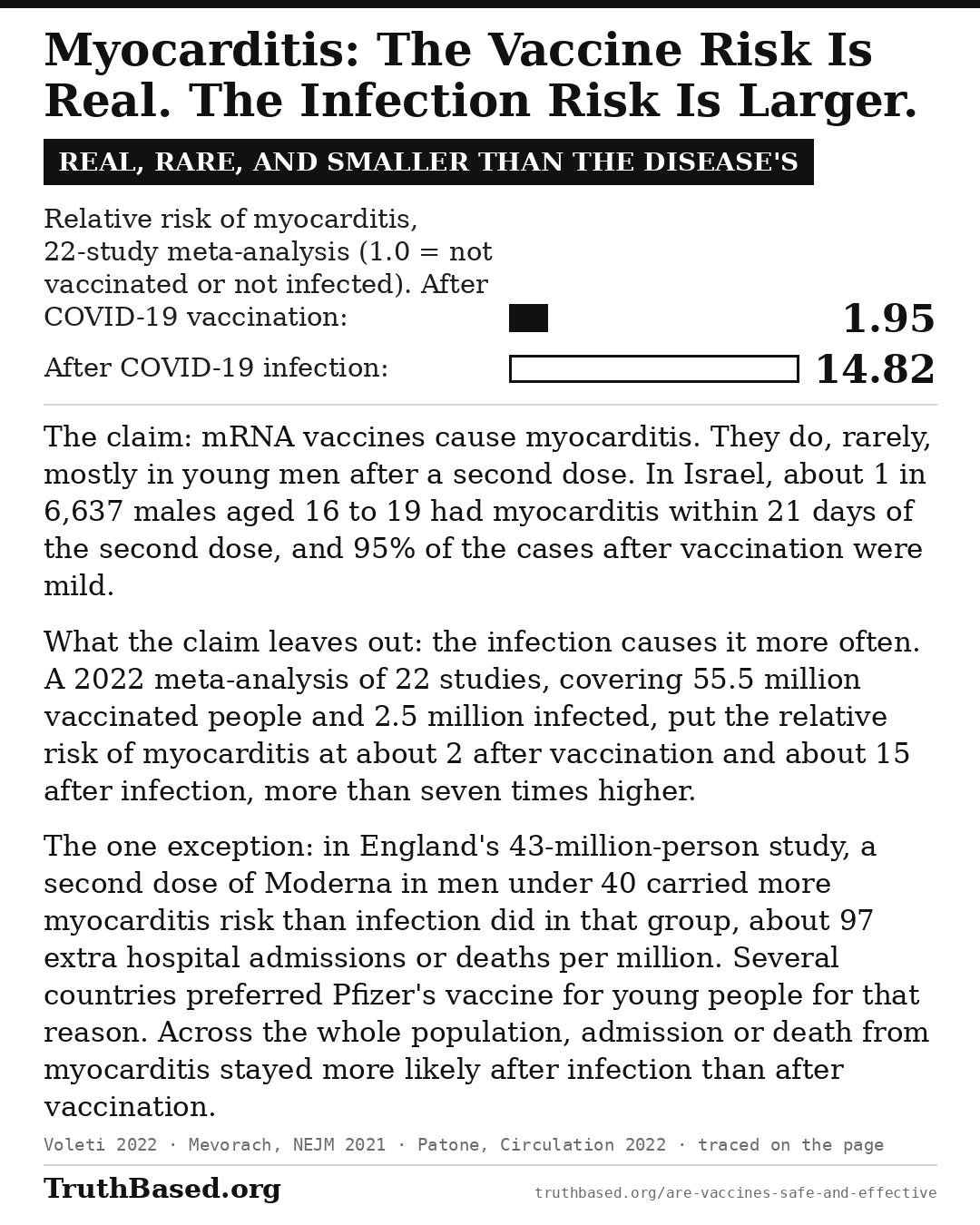
This section as one image: the vaccine risk, the infection risk, and the one exception.
Blood clots
Thrombosis with thrombocytopenia syndrome (TTS), clotting together with a low platelet count, was detected after the adenovirus-vector vaccines from J&J and AstraZeneca. In the U.S. the FDA and CDC confirmed 60 cases after the J&J vaccine, 9 of them fatal, a reporting rate of 3.23 per million doses (to March 2022). The rate was highest in women aged 30 to 49, at 9.0 to 10.6 per million doses (to August 2021). In May 2022 the FDA limited the vaccine to adults for whom other COVID-19 vaccines are not accessible or suitable, or who would otherwise go unvaccinated.
For scale, an English study of 29 million vaccinated people measured the risk of a venous clot leading to hospital admission or death. It was 1.10 times the usual rate in the second week after AstraZeneca’s vaccine, and 13.86 times after a positive COVID-19 test.
Long-term safety (3+ years)
A French national cohort followed 22.8 million adults vaccinated with mRNA vaccines and 5.9 million unvaccinated adults, all aged 18 to 59, for a median of 45 months. It found no excess all-cause mortality among the vaccinated (Semenzato et al., JAMA Network Open, December 2025). Their all-cause mortality was 25% lower after weighting for social and demographic factors and 41 conditions, with a 74% lower risk of death from COVID-19. The vaccinated had the lower risk of death whatever the cause, so there was no sign of extra deaths from other causes.
Each side’s best case
The evidence-based case for vaccines
Measles vaccination alone is estimated to have saved about 94 million lives worldwide since 1974 (Shattock et al., The Lancet, 2024). CDC modelling estimates routine childhood vaccination of children born from 1994 to 2023 will have prevented about 1.1 million deaths and 32 million hospitalizations (Zhou et al., MMWR, August 2024).
The evidence-based case for skepticism (non-conspiracy)
Real adverse events exist. Influenza vaccines: Guillain-Barré syndrome at 1 to 2 extra cases per million doses, in the seasons when a risk was found. In Ontario, though, a health-care visit for influenza carried about 17 times the vaccine’s added risk (17.2 against 1.03 admissions per million; Kwong et al., Lancet Infectious Diseases, 2013).
RotaShield, a rotavirus vaccine: intussusception, which led to its withdrawal in 1999. Pandemrix (2009 H1N1): about 3 to 7 extra cases of narcolepsy per 100,000 vaccinated children and teenagers in Finland and Sweden. That led Europe’s regulator to recommend restricting it for under-20s in 2011. mRNA vaccines: myocarditis, mostly in young males after a second dose. J&J: TTS, reported at 3.23 per million doses. These are rare but real.
VAERS is passive and subject to both under-reporting and media-driven over-reporting. Active systems like VSD cover millions but not everyone.
About half of the FDA’s budget comes from industry user fees: $3.5 billion of $7.2 billion in its budget request for 2025. While independent bodies like the Institute of Medicine provide review, the structural concern is legitimate.
In experiments with more than 13,000 Americans and Danes, vague, reassuring messages about COVID-19 vaccines lowered trust in health authorities. Disclosing a vaccine’s drawbacks raised trust, even though it could lower acceptance at first (Petersen et al., PNAS, 2021).
For some people the balance differs. CDC advises that anyone who developed myocarditis within three weeks of a COVID-19 vaccine dose should generally not have another.
Legitimate scientific debates (not fringe)
Countries differed on how long to wait between mRNA doses: in early 2022, from three weeks to twelve or more. Scientists also disagree on whether some vaccines affect overall survival beyond the diseases they target. A review commissioned by the World Health Organization (Higgins et al., BMJ, 2016) linked the measles and BCG vaccines to lower overall child mortality. It linked the DTP vaccine possibly to higher overall child mortality. Its observational studies, every DTP study among them, were at high or very high risk of bias.
Neither debate disputes the overall conclusion that vaccines’ benefits outweigh their risks. That review’s authors still urged that all children be immunized on schedule.
The verdict: what the evidence shows
Yes. The vaccines in routine use are effective, and their serious harms are rare, real and, across whole populations, smaller than the risks of the diseases they prevent. The claims that they cause autism or overload children’s immune systems do not hold up against the trials, the cohort studies and the safety data. Neither does the claim that VAERS reports show them killing people. The harms that are real were found by the same studies and safety systems, and several led to a vaccine being withdrawn or limited.
Claims and evidence
Claim“Vaccines cause autism”
ContradictedThe 1998 paper was fraudulent and retracted. Danish cohorts of 657,461 and 537,303 children find autism no more common in the vaccinated: estimates of 0.93 and 0.92, where 1.0 means no difference. A meta-analysis of 1.26 million children finds no link with MMR, thimerosal or mercury. Diagnoses kept rising after thimerosal was removed.
Claim“VAERS proves vaccines are killing people”
MisreadVAERS is an unverified report system with no denominator, designed to raise signals, not to count deaths. The signals it raised (TTS, myocarditis) were confirmed by case review and then measured, which is the system working.
Claim“Too many vaccines overload a child’s immune system”
ContradictedThe schedule covers more diseases with more than 90% fewer antigens than in 1980. The Institute of Medicine’s 2013 review found no evidence of major safety concerns with the schedule. Cumulative antigen exposure was unrelated to later infections in a Vaccine Safety Datalink study.
Claim“mRNA vaccines cause myocarditis”
True, rarely, and smaller than the infection’sAbout 1 in 6,637 Israeli males aged 16 to 19 after dose 2, mostly mild. In a 22-study meta-analysis, relative risk about 2 after vaccination against about 15 after infection, with one product-and-dose exception in young men that several countries acted on.
Claim“Vaccines are risk-free”
ContradictedFebrile seizures after MMR (about 1 in 1,150 to 1 in 1,700 doses), TTS after the J&J vaccine (reported at 3.23 per million doses), narcolepsy after Pandemrix, intussusception after RotaShield. Rare, real, and detected.
Download the conclusion
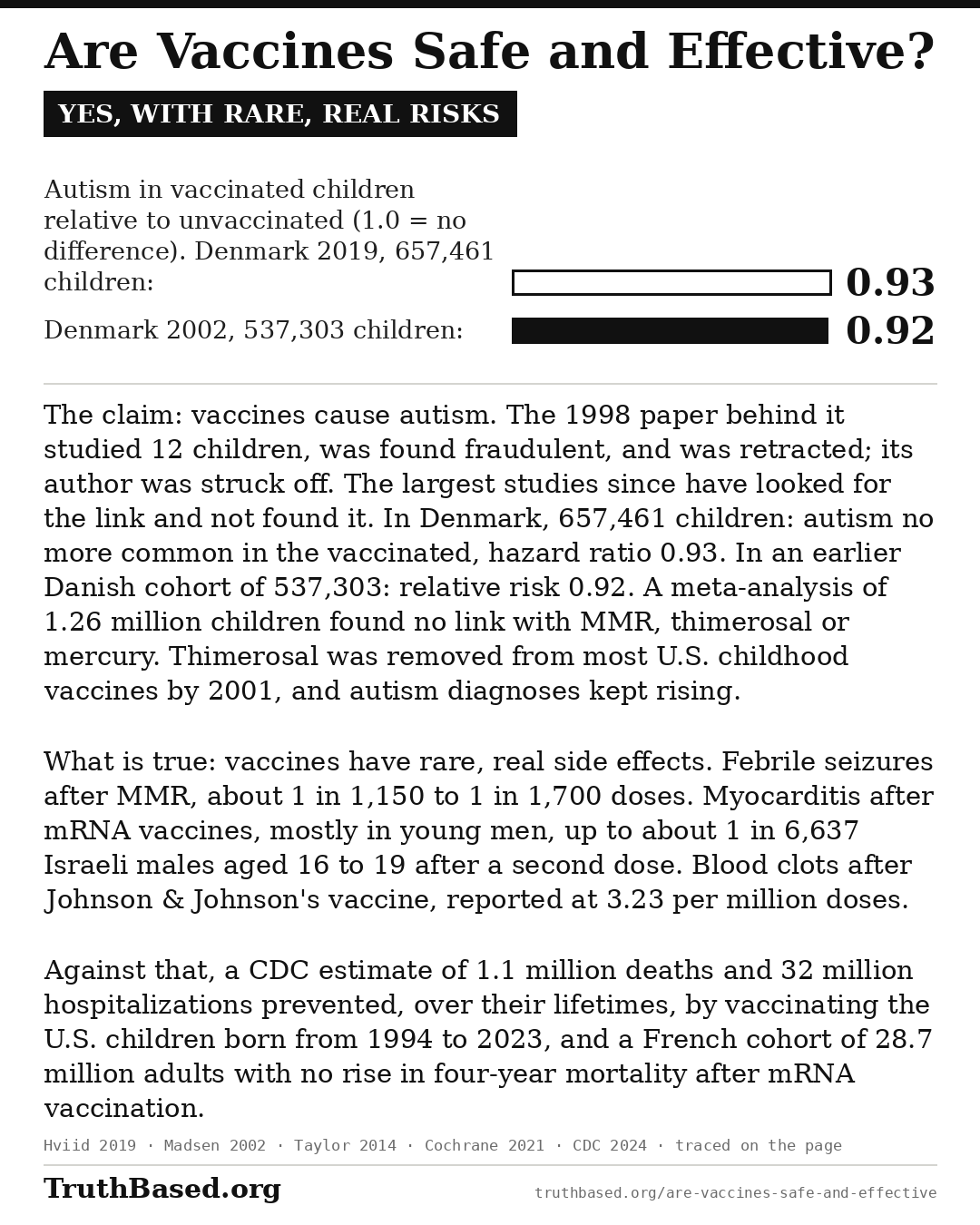
The verdict above as one image, with the two Danish cohort studies as its chart. It is 1,080 by 1,350 pixels, sized for posting as an image, and anyone may download it and post it.
What would change this conclusion
This article concludes that: (1) the 1998 paper behind the autism claim was fraudulent and retracted, and the largest studies since find autism no more common in vaccinated children; (2) autism diagnoses kept rising after thimerosal was removed; (3) vaccines have rare, real harms, and several led to a vaccine being withdrawn or limited; (4) across whole populations COVID-19 infection carries a higher myocarditis risk than the vaccines, with exceptions such as a second Moderna dose in men under 40; (5) a French cohort of 28.7 million adults found lower, not higher, four-year mortality among the vaccinated.
These conclusions would be falsified by:
• A large cohort or linkage study, with vaccination status recorded prospectively rather than by recall, finding a higher autism rate in vaccinated children after controlling for birth year and diagnostic criteria
• Large, well-controlled studies finding higher all-cause mortality or serious illness in vaccinated groups than in comparable unvaccinated groups
• Post-licensure surveillance, replicated across independent systems, showing serious adverse events at rates materially above those in the trials and the Vaccine Safety Datalink
Sources
Wakefield AJ, Murch SH, et al. Ileal-lymphoid-nodular hyperplasia, non-specific colitis, and pervasive developmental disorder in children. The Lancet, 1998;351(9103):637–41. The retracted case series of 12 children. pubmed.ncbi.nlm.nih.gov
Murch SH, Anthony A, et al. Retraction of an interpretation. The Lancet, 2004;363(9411):750. Ten of the authors’ withdrawal of the paper’s interpretation. pubmed.ncbi.nlm.nih.gov
The Lancet. Retraction: Ileal-lymphoid-nodular hyperplasia, non-specific colitis, and pervasive developmental disorder in children. The Lancet, 2010;375(9713):445. The full retraction of the 1998 paper, published on 2 February 2010 and printed in the issue of 6 February. pubmed.ncbi.nlm.nih.gov
General Medical Council, Fitness to Practise Panel. Findings of fact, 28 January 2010. The panel’s findings on the 1998 study, in the copy published by FactCheck.org. factcheck.org
General Medical Council, Fitness to Practise Panel. Determination on serious professional misconduct and sanction, 24 May 2010. The decision to erase Wakefield from the medical register, in the copy published by CIRCARE. circare.org
Deer B. How the case against the MMR vaccine was fixed. BMJ, 2011;342:c5347. Deer’s comparison of the children’s records with the paper, in the copy published by the Ventura County health agency as “Secrets of the MMR scare”. vcportal.ventura.org
Godlee F, Smith J, Marcovitch H. Wakefield’s article linking MMR vaccine and autism was fraudulent. BMJ, 2011;342:c7452. The BMJ’s editorial on the fraud, in the copy published by the Ventura County health agency. vcportal.ventura.org
Madsen KM, et al. A population-based study of measles, mumps, and rubella vaccination and autism. New England Journal of Medicine, 2002;347(19):1477–82. 537,303 Danish children; adjusted relative risk 0.92 (95% CI 0.68 to 1.24). pubmed.ncbi.nlm.nih.gov
Hviid A, et al. Measles, mumps, rubella vaccination and autism: a nationwide cohort study. Annals of Internal Medicine, 2019. 657,461 Danish children; fully adjusted hazard ratio 0.93 (95% CI 0.85 to 1.02). pubmed.ncbi.nlm.nih.gov
Taylor LE, Swerdfeger AL, Eslick GD. Vaccines are not associated with autism: an evidence-based meta-analysis of case-control and cohort studies. Vaccine, 2014. 1,256,407 children in five cohort studies; odds ratio 0.99 (95% CI 0.92 to 1.06) for autism, pooled from four of them. pubmed.ncbi.nlm.nih.gov
Jain A, et al. Autism occurrence by MMR vaccine status among US children with older siblings with and without autism. JAMA, 2015, corrected January 2016. 95,727 children, including those whose older sibling had autism; adjusted relative risks 0.56 to 1.09 in the corrected article. pubmed.ncbi.nlm.nih.gov
Di Pietrantonj C, et al. Vaccines for measles, mumps, rubella, and varicella in children. Cochrane Database of Systematic Reviews, 2021, CD004407.pub5. 138 studies and 23,480,668 participants; no association with autism (two studies, 1,194,764 children) or encephalitis; febrile seizures at 1 per 1,700 to 1 per 1,150 doses; idiopathic thrombocytopenic purpura at about 1 per 40,000 doses. pubmed.ncbi.nlm.nih.gov
CDC. Data and statistics on autism spectrum disorder (ADDM Network). Autism per 1,000 eight-year-olds at the network’s sites, 2000 to 2022. cdc.gov
Rosen NE, Lord C, Volkmar FR. The diagnosis of autism: from Kanner to DSM-III to DSM-5 and beyond. Journal of Autism and Developmental Disorders, 2021. The category for children meeting only some of the criteria, broadened in 1987; Asperger’s disorder, added in 1994; both merged with autistic disorder in 2013. pmc.ncbi.nlm.nih.gov
Johnson CP, Myers SM; American Academy of Pediatrics. Identification and evaluation of children with autism spectrum disorders. Pediatrics, 2007;120(5):1183–215. The 2007 strategy for early identification and parents’ greater awareness of early signs. pubmed.ncbi.nlm.nih.gov
King M, Bearman P. Diagnostic change and the increased prevalence of autism. International Journal of Epidemiology, 2009;38(5):1224–34. About a quarter (26.4%) of California’s rise in autism caseload, 1992 to 2005, through one diagnostic pathway. pubmed.ncbi.nlm.nih.gov
Schechter R, Grether JK. Continuing increases in autism reported to California’s developmental services system: mercury in retrograde. Archives of General Psychiatry, 2008;65(1):19–24. 0.6 per 1,000 live births in January 1995 and 4.1 in March 2007, children aged three to five. pubmed.ncbi.nlm.nih.gov
Madsen KM, et al. Thimerosal and the occurrence of autism: negative ecological evidence from Danish population-based data. Pediatrics, 2003;112(3):604–6. Autism in Denmark kept rising after thimerosal-containing vaccines were discontinued in 1992. pubmed.ncbi.nlm.nih.gov
CDC. Thimerosal and vaccines. Thimerosal taken out of U.S. childhood vaccines in 2001. cdc.gov
FDA. Thimerosal and vaccines. Thimerosal as a preservative, broken down to ethylmercury. fda.gov
Institute of Medicine. Immunization Safety Review: Vaccines and Autism. National Academies Press, 2004. The evidence “favors rejection” of a causal relationship between thimerosal-containing vaccines, or MMR, and autism. nationalacademies.org
CDC and FDA. About VAERS; Guide to Interpreting VAERS Data; Report an Adverse Event. VAERS since 1990, passive, co-managed by CDC and FDA; reports accepted without proof of cause; the federal penalty for a knowingly false report. vaers.hhs.gov
VAERS Data Use Guide, November 2020. Why VAERS counts cannot give incidence rates. vaers.hhs.gov
CDC. About the Vaccine Adverse Event Reporting System (VAERS). “A report to VAERS does not mean the vaccine caused the event”; signals studied further in the Vaccine Safety Datalink. cdc.gov
Shimabukuro TT, et al. Safety monitoring in the Vaccine Adverse Event Reporting System (VAERS). Vaccine, 2015;33(36):4398–405. Under-reporting and reporting stimulated by media attention. pmc.ncbi.nlm.nih.gov
MacNeil JR, et al. Updated recommendations from the ACIP for use of the Janssen (Johnson & Johnson) COVID-19 vaccine after reports of thrombosis with thrombocytopenia syndrome. MMWR, 2021;70(17):651–6. How VAERS reports of TTS were found and confirmed in April 2021. pubmed.ncbi.nlm.nih.gov
Gargano JW, et al. Use of mRNA COVID-19 vaccine after reports of myocarditis among vaccine recipients. MMWR, 2021;70(27):977–82. The myocarditis signal in VAERS and the Vaccine Safety Datalink. pubmed.ncbi.nlm.nih.gov
Gee J, et al. First month of COVID-19 vaccine safety monitoring. MMWR, 2021;70(8). V-safe’s check-ins: daily for a week, then weekly to six weeks. cdc.gov
Myers TR, et al. The v-safe after vaccination health checker: active vaccine safety monitoring during CDC’s COVID-19 pandemic response. Vaccine, 2023;41(7):1310–8. V-safe as active surveillance for COVID-19 vaccines. pubmed.ncbi.nlm.nih.gov
Shimabukuro T. Update: v-safe after vaccination health checker. Slides for the ACIP meeting, 19 April 2023. 10.1 million v-safe participants. cdc.gov
Hause AM, et al. Early safety findings among persons aged 60 years and older who received a respiratory syncytial virus vaccine, United States, May 3, 2023 to April 14, 2024. MMWR, 2024;73(21), with its erratum. The V-safe and VAERS figures for RSV vaccines. pmc.ncbi.nlm.nih.gov
Institute of Medicine. The Childhood Immunization Schedule and Safety. National Academies Press, 2013. Antigens in the schedule, 3,041 in 1980 and 123 to 126 in 2000, citing Offit et al., Pediatrics, 2002; schedules vary between countries. nationalacademies.org
Institute of Medicine. The Childhood Immunization Schedule and Safety: report brief, January 2013. No evidence of major safety concerns; why a randomized trial would be unethical. nap.nationalacademies.org
Children’s Hospital of Philadelphia, Vaccine Education Center. Science behind the vaccine schedule. Vaccines in the first two years contain fewer antigens than the smallpox vaccine’s 200; the acellular whooping cough vaccine’s two to five. chop.edu
Glanz JM, et al. Association between estimated cumulative vaccine antigen exposure through the first 23 months of life and non-vaccine-targeted infections from 24 through 47 months of age. JAMA, 2018;319(9):906–13. 193 cases and 751 controls; matched odds ratio 0.94 per 30 antigens. pubmed.ncbi.nlm.nih.gov
Hambidge SJ, et al. Timely versus delayed early childhood vaccination and seizures. Pediatrics, 2014;133(6):e1492–9. 323,247 children; seizure risk after on-time and delayed doses. pubmed.ncbi.nlm.nih.gov
Polack FP, et al. Safety and efficacy of the BNT162b2 mRNA Covid-19 vaccine. New England Journal of Medicine, 2020. The Pfizer trial: 43,548 participants, 95% efficacy. pubmed.ncbi.nlm.nih.gov
Baden LR, et al. Efficacy and safety of the mRNA-1273 SARS-CoV-2 vaccine. New England Journal of Medicine, 2021. The Moderna trial: 30,420 participants, 94.1% efficacy. pubmed.ncbi.nlm.nih.gov
Thomas SJ, et al. Safety and efficacy of the BNT162b2 mRNA Covid-19 vaccine through 6 months. New England Journal of Medicine, 2021. 91.3% efficacy over six months; 96.7% against severe disease. pmc.ncbi.nlm.nih.gov
Andrews N, et al. Covid-19 vaccine effectiveness against the Omicron (B.1.1.529) variant. New England Journal of Medicine, 2022. Effectiveness against symptomatic Omicron disease in England, after two doses and a booster. pubmed.ncbi.nlm.nih.gov
Ferdinands JM, et al. Waning 2-dose and 3-dose effectiveness of mRNA vaccines against COVID-19-associated emergency department and urgent care encounters and hospitalizations among adults, VISION Network. MMWR, 2022;71(7):255–63. 91% and 78% effectiveness against hospitalization after a third dose. pmc.ncbi.nlm.nih.gov
Dagan N, et al. BNT162b2 mRNA Covid-19 vaccine in a nationwide mass vaccination setting. New England Journal of Medicine, 2021. 596,618 matched pairs in Israel. pubmed.ncbi.nlm.nih.gov
Voleti N, Reddy SP, Ssentongo P. Myocarditis in SARS-CoV-2 infection vs. COVID-19 vaccination: a systematic review and meta-analysis. Frontiers in Cardiovascular Medicine, 2022. 22 studies, 55.5 million vaccinated and 2.5 million infected; relative risk 15 after infection and 2 after vaccination. frontiersin.org
Mevorach D, et al. Myocarditis after BNT162b2 mRNA vaccine against Covid-19 in Israel. New England Journal of Medicine, 2021. About 1 in 6,637 males aged 16 to 19 within 21 days of the second dose; 95% of cases mild. pmc.ncbi.nlm.nih.gov
Block JP, et al. Cardiac complications after SARS-CoV-2 infection and mRNA COVID-19 vaccination, PCORnet, United States, January 2021 to January 2022. MMWR, 2022;71(14):517–23. Myocarditis after a second dose and after infection, by age and sex. cdc.gov
Patone M, et al. Risk of myocarditis after sequential doses of COVID-19 vaccine and SARS-CoV-2 infection by age and sex. Circulation, 2022;146(10):743–54. 42.8 million vaccinated people in England; the exception after a second Moderna dose in men under 40. pubmed.ncbi.nlm.nih.gov
Stecker E, Mullen B. Vaccine-associated myocarditis risk in context: emerging evidence. American College of Cardiology, 9 February 2022. Vaccine-associated rates as high as 107 per million in teenage boys, against a post-infection rate of 7 per million from English data. acc.org
Moulia D. Myocarditis and COVID-19 vaccine intervals: international data and policies. CDC slides for the ACIP meeting, February 2022. Countries’ vaccine preferences for young people and their dosing intervals. stacks.cdc.gov
Alabama Department of Public Health. CDC revises optimal interval for some individuals to receive second COVID-19 mRNA vaccine, 23 February 2022. CDC’s eight-week interval, especially for males aged 12 to 39. alabamapublichealth.gov
FDA. FDA limits use of Janssen COVID-19 vaccine to certain individuals, 5 May 2022. 60 confirmed TTS cases, 9 fatal; 3.23 per million doses. content.govdelivery.com
Oliver SE, et al. Use of the Janssen (Johnson & Johnson) COVID-19 vaccine: updated interim recommendations from the ACIP, December 2021. MMWR, 2022;71(3). TTS rates by age and sex; the preference for mRNA vaccines. pmc.ncbi.nlm.nih.gov
Greinacher A, et al. Thrombotic thrombocytopenia after ChAdOx1 nCov-19 vaccination. New England Journal of Medicine, 2021. The clotting disorder after the AstraZeneca vaccine. pubmed.ncbi.nlm.nih.gov
Hippisley-Cox J, et al. Risk of thrombocytopenia and thromboembolism after covid-19 vaccination and SARS-CoV-2 positive testing: self-controlled case series study. BMJ, 2021;374:n1931. Venous clots 1.10 times usual after AstraZeneca’s vaccine and 13.86 times after a positive test. pubmed.ncbi.nlm.nih.gov
Semenzato L, et al. COVID-19 mRNA vaccination and 4-year all-cause mortality among adults aged 18 to 59 years in France. JAMA Network Open, December 2025 (EPI-PHARE). 22.8 million vaccinated and 5.9 million unvaccinated, median 45 months: 74% lower risk of death from COVID-19, 25% lower all-cause mortality. epi-phare.fr
Zhou F, et al. Health and economic benefits of routine childhood immunizations in the era of the Vaccines for Children program, United States, 1994–2023. MMWR, 2024;73(31):682–5. 1.1 million deaths and 32 million hospitalizations prevented among children born 1994 to 2023. pubmed.ncbi.nlm.nih.gov
Shattock AJ, et al. Contribution of vaccination to improved survival and health: modelling 50 years of the Expanded Programme on Immunization. The Lancet, 2024. 93.7 million lives saved by measles vaccination since 1974. pmc.ncbi.nlm.nih.gov
Kwong JC, et al. Risk of Guillain-Barré syndrome after seasonal influenza vaccination and influenza health-care encounters: a self-controlled study. Lancet Infectious Diseases, 2013;13(9):769–76. 1.03 admissions per million vaccinations against 17.2 per million influenza health-care encounters. pubmed.ncbi.nlm.nih.gov
CDC. Influenza (flu) vaccine safety. 1 to 2 additional Guillain-Barré cases per million doses when a risk has been found. cdc.gov
CDC. Withdrawal of rotavirus vaccine recommendation. MMWR, 1999;48(43):1007. RotaShield and intussusception. pubmed.ncbi.nlm.nih.gov
European Medicines Agency. European Medicines Agency recommends restricting use of Pandemrix, 27 July 2011. About 3 to 7 extra narcolepsy cases per 100,000 vaccinated children and teenagers in Finland and Sweden; the recommended restriction for under-20s. ema.europa.eu
FDA. FY 2025 FDA budget summary. The budget request: $3.5 billion in user fees within $7.2 billion. fda.gov
FDA. FDA user fees explained. User fees are collected from companies that produce certain products, such as drugs and medical devices. fda.gov
Petersen MB, et al. Transparent communication about negative features of COVID-19 vaccines decreases acceptance but increases trust. PNAS, 2021. Experiments with more than 13,000 Americans and Danes. pubmed.ncbi.nlm.nih.gov
CDC. Safety considerations for COVID-19 vaccines. Myocarditis after a dose as a precaution against further doses. cdc.gov
Higgins JPT, et al. Association of BCG, DTP, and measles containing vaccines with childhood mortality: systematic review. BMJ, 2016;355:i5170. The non-specific effects of vaccines on child mortality. pubmed.ncbi.nlm.nih.gov
Cite this article
TruthBased.org. “Are Vaccines Safe and Effective?” Updated October 2026. https://www.truthbased.org/are-vaccines-safe-and-effective