Crime & Justice
Why Does the U.S. Have More Gun Deaths?
Firearm deaths per 100,000 in the U.S. and twelve peers, split into homicide and suicide, and why the gap is a gun gap.
Groups & Crime
Are Trans People Overrepresented as Mass Shooters?
Three databases, each on its own definition, with the denominators shown.
Which Gun Policies Actually Have Evidence Behind Them?
Not whether gun control works, but which of the eighteen policies has evidence behind it and which has never been properly studied. Built on RAND's systematic review, with what each side has to give up.
Jump to the verdict ↓
What this covers
This reports the strength of evidence for each policy, policy by policy and outcome by outcome. It makes no recommendation about which laws should be passed. Where a rating is inconclusive, the article says what that does and does not mean, because that distinction carries most of the argument.
The short answer
A few of them do, for a few outcomes. Eighteen different gun policies have been studied. Most have never been tested well enough to say either way, which is not the same as finding that they do not work.
Eighteen policies, not one
"Does gun control work" is not a question with an answer, because gun control is not a thing. It is eighteen different policies doing eighteen different jobs, and the central finding of the serious literature is that they do not perform alike.
The RAND Corporation has spent nearly a decade grading that literature. Its Gun Policy in America project screens every empirical study of American firearm policy against fixed methodological criteria, discards the ones that fail, and rates what survives. The fifth and final edition, published in January 2026, covers research through December 2024.
The headline is arithmetic. RAND set out to assess 18 policies against 8 outcomes, which is 144 pairings. After reviewing several thousand candidate studies it found 207 that met its criteria. Those 207 studies produced evidence on 68 of the 144 pairings. Of those, 18 showed an increase or decrease in an outcome, 50 were inconclusive, and for the remaining 76 no qualifying study existed at all.
How to read it: each bar is a number of policy-outcome pairings out of the 144 that RAND set out to assess (18 policies against 8 outcomes): 18 where the qualifying studies found an increase or decrease, 50 where they were inconclusive, 76 where no study met RAND’s criteria at all. The longest bar is the questions nobody has properly studied. Source: RAND, What Science Tells Us About the Effects of Gun Policies, fifth edition.
So for more than half the questions people argue about, nobody has run a study capable of answering them.
What "inconclusive" means, and what it does not
This is the sentence the rest of the article depends on, so here it is in RAND's own words: where we conclude that evidence for a policy is weak or inconclusive, that does not mean that the policy is ineffective; the policy itself might well have important effects.
And from the report: they may or may not have the effects they were designed to produce; available scientific research cannot yet answer that question.
An inconclusive rating is a statement about the studies, not about the law. It usually means a policy has been adopted in too few places, or too recently, or that the outcome it targets is too rare for a study to detect a change in it. RAND makes the point directly about firearm stock: laws that govern who may buy a new gun act on a small fraction of the roughly 400 million firearms already in American hands, so even a policy working exactly as designed could produce an effect too small to measure.
Which cuts against both of the confident positions. "The evidence shows this works" is unavailable for most policies. So is "the evidence shows it doesn't."
RAND's five tiers, in ascending order of strength:
| Rating | What it takes |
|---|---|
| No studies | Nothing meeting the inclusion criteria has evaluated this pairing |
| Inconclusive | Studies of comparable rigour disagree, or a single study found only suggestive effects |
| Limited | One qualifying study found a significant effect and nothing equally strong contradicts it |
| Moderate | Two or more studies found significant effects in the same direction with no contradiction |
| Supportive | Three studies, at least two independent datasets, same direction, no contradiction |
The four policies with supportive evidence
Out of 144 pairings, four reach RAND's top tier. Two of them are findings that a policy makes an outcome worse.
| Policy | Effect |
|---|---|
| Child-access prevention | Reduces firearm suicide among young people, unintentional firearm deaths among children, and firearm homicide and assault among young people |
| Minimum age requirements | Reduces firearm suicide among young people |
| Stand-your-ground | Increases firearm and total homicide |
| Shall-issue concealed carry | Increases firearm and total homicide and violent crime |
Child-access prevention is the strongest-supported policy in American gun law, and it is the one that gets the least political attention. RAND's own explanation for why the evidence is clearer here is mechanical: safe-storage laws act on how the existing stock is kept, rather than on who may buy something new, so there is more for a study to detect.
The two increase findings are worth sitting with, because both policies were adopted on the argument that they would reduce violence. On the concealed-carry finding RAND notes that permit holders are themselves rarely convicted of violent crime, so if the effect is real the mechanism is likely something else, such as more guns in circulation being stolen or diverted, rather than permit holders offending.
The policies people argue about most
Below the top tier the picture gets specific, and several familiar claims do not survive it.
Background checks. RAND rates the evidence moderate that dealer and point-of-sale checks reduce firearm and total homicide. The evidence on private-seller checks specifically, which is what "universal background checks" means in practice, is inconclusive. That distinction rarely survives into the debate.
Assault weapons bans. The Congressionally mandated evaluation of the 1994 federal ban reached a conclusion that has not been improved on since. Assault weapons were used in around 2% of gun crimes before the ban. The evaluators wrote that should it be renewed, the ban's effects on gun violence are likely to be small at best and perhaps too small for reliable measurement. That is not a finding that the ban failed; it is a finding that the category of weapon was too small a share of gun crime for a ban on it to move the total. RAND folds assault weapons and high-capacity magazines into one category and rates only the magazine component as limited evidence of reducing mass shootings and their fatalities. Violent crime effects are inconclusive.
Waiting periods. Moderate evidence of reducing firearm suicide and moderate evidence of reducing total homicide. The most-cited study exploits every state waiting-period change between 1970 and 2014 and estimates roughly a 17% reduction in gun homicides. Its authors note their suicide estimate is not robust across specifications.
Red flag laws. Limited evidence of reducing firearm and total suicide. The underlying studies come from Connecticut and Indiana, where the populations subject to removal orders had suicide rates roughly 30 to 40 times the general public's, and estimate on the order of one suicide averted per ten to twenty removals. A competing analysis estimated far larger effects and was criticised on the grounds that it implies nearly every person subject to an order would otherwise have died. The case studies of orders used against threatened shootings cannot establish that any specific event was prevented.
Permit to purchase. Upgraded in the fifth edition from inconclusive to limited evidence of reducing total and firearm homicide, on the strength of new studies. It rests largely on two natural experiments, Connecticut adopting a licensing requirement in 1995 and Missouri repealing one in 2007, both with single treated states. RAND and the critics agree on the limitation: a single state cannot isolate one law's effect from everything else changing at the same time. Several of the authors are based at a centre that publicly advocates purchaser licensing, which is worth naming without treating it as disqualifying.
Gun-free zones. Inconclusive for violent crime, and no qualifying studies for anything else.
Armed staff in schools. No qualifying studies on any outcome.
Lost and stolen firearm reporting. No qualifying studies on any outcome.
Most American gun deaths are suicides
This single fact reorganises the whole subject, and it is missing from most arguments about it.
| Year | Total | Suicide | Homicide | Other |
|---|---|---|---|---|
| 2023 | 46,728 | 27,300 (58%) | 17,927 (38%) | 1,502 |
| 2024 | 44,447 | 27,593 (62%) | 15,364 (35%) | 1,490 (police 636, accidental 450, undetermined 404) |
How to read it: each pair of bars is one kind of firearm death; the darker bar is 2023, the lighter bar 2024. Suicide 27,300 then 27,593; homicide 17,927 then 15,364; other (police, accidental, undetermined) 1,502 then 1,490. Suicide is the tallest pair in both years. Source: CDC WONDER, final data.
Gun suicides have outnumbered gun homicides in every year since 1981, when the CDC’s published series begins, and in recent decades they have been a majority of all gun deaths. Any figure presented as "gun violence" that is actually the total is describing something roughly 60% of which is people killing themselves. That is not a semantic complaint. It changes which policies could possibly matter, because the policies with the clearest evidence behind them are the ones that act on suicide.
It also raises the objection that people who cannot reach a gun will use something else. The strongest evidence against complete substitution is a California cohort study following 26.3 million adults for up to twelve years. New handgun owners showed sharply elevated suicide risk driven entirely by firearm suicide, with no elevation at all in suicide by other means. Risk peaked shortly after acquisition and persisted for years afterwards.
What that supports is that reducing firearm access reduces firearm suicide, and in several designs total suicide. What it does not support is the stronger claim that method substitution never happens.
Download this conclusion: suicide
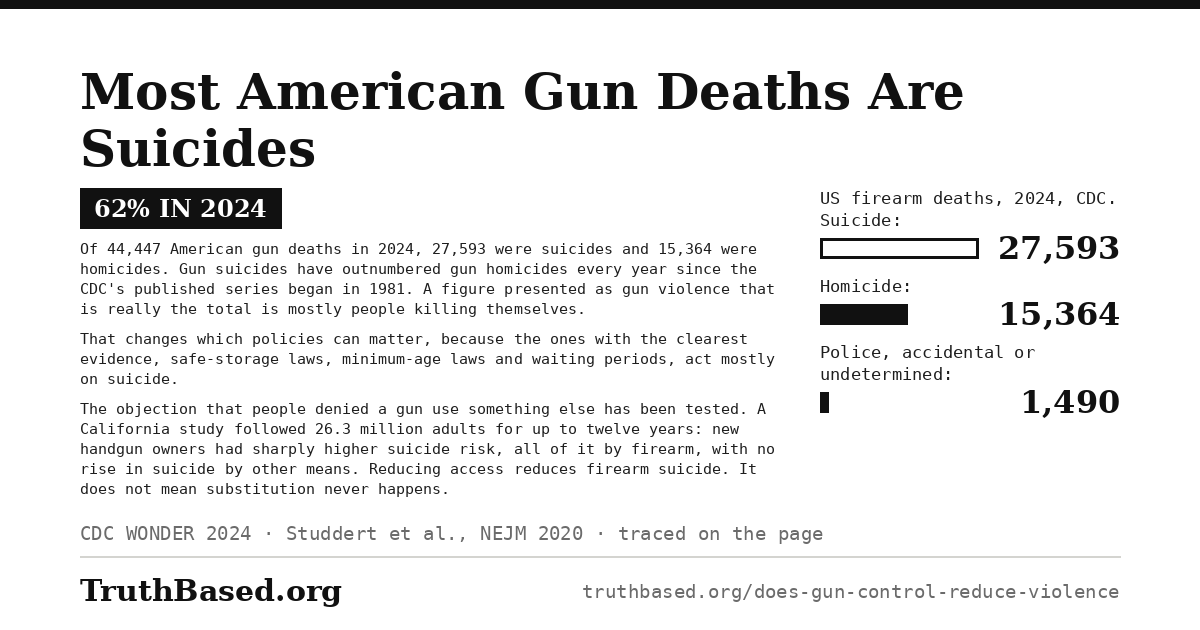
This section as one image: what American gun deaths are made of, and the cohort study on what happens when access changes.
Defensive gun use, where the numbers span two orders of magnitude
Estimates of how often Americans use a gun defensively run from about 55,000 to 116,000 a year, from the National Crime Victimization Survey, up to 2.5 million, from a 1993 telephone survey.
The gap is a survey-design problem rather than a mystery. The NCVS is large and government-administered, asks about victimisation first and never asks about defensive gun use directly, which critics say undercounts it. The 2.5 million figure comes from 66 respondents out of 4,977 reporting a defensive use, extrapolated to the national population. In a survey measuring something rare, a small share of false positives produces enormous overestimates, and internal cross-checks in that survey imply more defensive uses during burglaries than there were burglaries. RAND treats the 2.5 million figure as not plausible against better sources and treats the frequency question as unresolved.
RAND found five qualifying studies on any policy's effect on defensive gun use. All five were inconclusive. It is one of the least-studied outcomes in the entire field, which is notable given how central it is to the argument.
Numbers that do not survive tracing
Four figures, two from each direction.
"40% of guns are acquired without a background check." Traces to a 1994 telephone survey in which about 251 people answered the acquisition question, roughly 36% reporting a non-dealer source. The survey largely predates the Brady Act. A 2017 study of 1,613 gun owners put the modern figure at 22%, rising to 57% in states that do not regulate private sales and falling to 26% in states that do.
"A gun in the home is 43 times more likely to kill a family member than an intruder." A raw count ratio from a 1986 study of three counties, not an adjusted risk estimate. The same author's later case-control study reported an adjusted odds ratio of 2.7. The 43 figure should not be quoted as a risk ratio.
"94% of mass shootings happen in gun-free zones." Produced using a narrow definition of mass shooting and one researcher's own database. A counter-analysis using a broader definition found around 10%. A fact-check applying the original method to a comparable window got about 86%. The disagreement is definitional, not factual, and neither number describes the same set of events.
"The US has 31% of the world's mass shooters." From a 2016 study. A rebuttal including many more foreign incidents put the figure between 1.4% and 3%. The original author declined to release the underlying data; the rebuttal's inclusion criteria are themselves disputed. Unresolved in both directions.
One more, because it explains why two people can quote wildly different mass shooting counts and both be accurate. Databases reporting several hundred mass shootings a year define one as four or more people shot, anywhere. Databases reporting a handful define it as four or more killed, in public. Neither is wrong. They are counting different things, and a figure from one cannot be set beside a figure from the other.
What each side has to concede
Gun control advocates must concede that the homicide-reduction claim attached to universal background checks and assault weapons bans outruns the evidence RAND found. That the federal assault weapons ban's own Congressionally mandated evaluation concluded any effect would likely be too small to measure. That for 76 of 144 policy-outcome pairings there is no qualifying study at all. And that defensive gun use, one of the main objections to several of these policies, has barely been studied.
Gun rights advocates must concede that "gun laws don't work" is not what inconclusive evidence means, and RAND says so in as many words. That four policy findings do reach the top evidence tier, and two of them find that policies adopted to reduce violence increased it. That child-access prevention has supportive evidence across three separate outcomes. And that "more guns, less crime" was reviewed by a National Research Council panel that could not confirm it, with fifteen of sixteen members stating the scientific evidence did not support the dissenting member's position.
The honest summary is narrower than either campaign wants. A small number of gun policies have real evidence behind them, mostly acting on suicide and on children. A larger number have been studied and produced nothing conclusive. The majority have not been studied adequately at all. And the two policies with the strongest evidence of making things worse were both passed on the argument that they would make things better.
The verdict: what the evidence shows
1. RAND assessed 18 policies against 8 outcomes. Of 144 pairings, 18 showed an effect, 50 were inconclusive, and 76 had no qualifying study at all.
2. Four pairings reach the top evidence tier. Two of those are findings that a policy increases homicide.
3. Inconclusive means the studies cannot answer the question, not that the policy failed. RAND states this directly, and it defeats the strong claim in both directions.
4. Most American gun deaths are suicides, 58% in 2023 and 62% in 2024, and the policies with the clearest evidence are the ones acting on suicide and on children.
5. The assault weapons ban evaluation found the weapons covered were used in about 2% of gun crimes, so any effect on the total would likely be too small to detect.
6. Defensive gun use estimates differ by a factor of forty, and all five qualifying studies of any policy's effect on it were inconclusive.
Download the conclusion
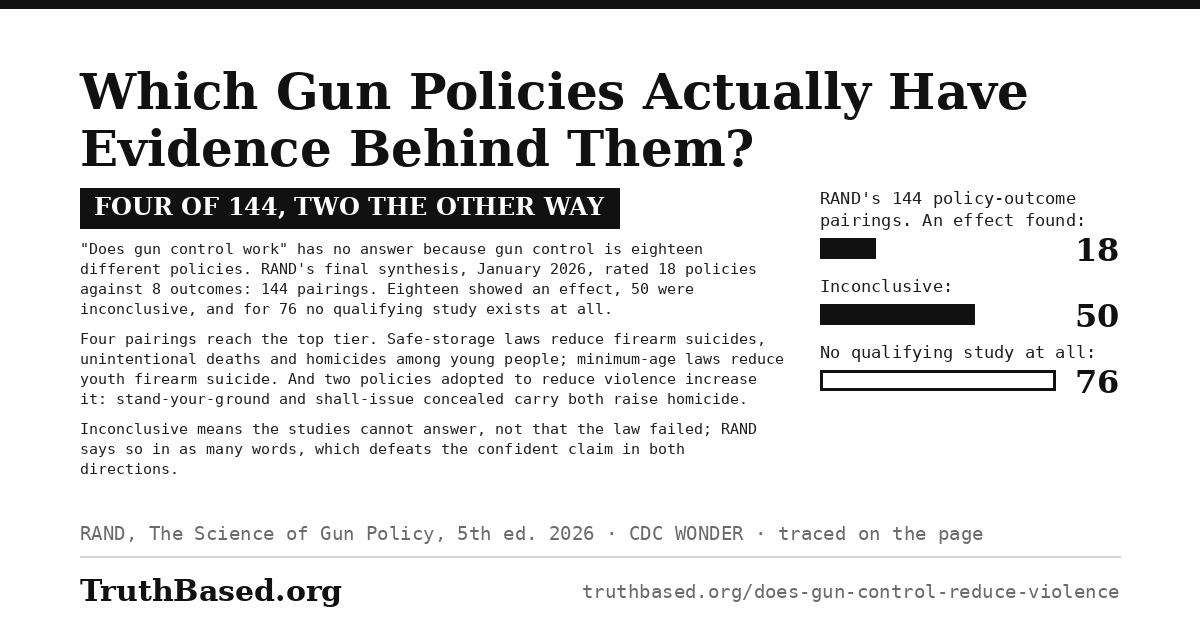
The verdict above as one image, with RAND’s 144 pairings as its chart. It is 1,200 by 630 pixels, the size social networks use for link previews, and anyone may download it and post it.
What would change this conclusion
More policies adopted in more states for longer, which is what most of the inconclusive ratings are waiting on rather than better statistics. A defensive gun use measure that does not depend on asking people to recall rare events by telephone. Release of the underlying data behind the disputed mass-shooter counts, which would settle a dispute that is currently unresolvable from outside. And a study design able to detect small effects on a stock of roughly 400 million firearms, which is the structural reason many of these questions stay open.
Sources
RAND Corporation. The Science of Gun Policy: A Critical Synthesis of Research Evidence on the Effects of Gun Policies in the United States, fifth edition, RR-A4360-2, January 2026; and the release of 29 January 2026 closing the Gun Policy in America initiative. The primary source for every rating in this article. Covers 18 policies against 8 outcomes, research through December 2024, 207 qualifying studies against 67 in the first edition. Funded by Arnold Ventures. rand.org release rand.org
RAND. What Science Tells Us About the Effects of Gun Policies. Source for the rating tier definitions, the 207 qualifying studies, the 68 pairings with evidence, the 18 showing an effect, the 50 inconclusive and the 76 with no qualifying study, and for the statement that inconclusive evidence does not mean a policy is ineffective. rand.org
RAND. Additions and Updates to the Gun Policy in America Initiative. Source for what changed between editions, including the stand-your-ground upgrade to supportive and the permit-to-purchase upgrade to limited. rand.org
RAND. Gun Policy in America: An Overview. Source for the estimate of about 400 million firearms in 2023 and for the explanation of why policies acting only on new purchases may have effects too small to detect. rand.org
Koper, Woods and Roth. An Updated Assessment of the Federal Assault Weapons Ban: Impacts on Gun Markets and Gun Violence, 1994-2003. National Institute of Justice, NCJ 204431, 2004. The Congressionally mandated evaluation. Source for assault weapons being used in about 2% of gun crimes before the ban and for the conclusion that any renewed ban's effects would likely be too small for reliable measurement. ojp.gov
CDC WONDER, Underlying Cause of Death; and Pew Research Center, What the data says about gun deaths in the U.S. (2026 update), which reports the same 2024 figures with the police, accidental and undetermined split and the series back to 1968. pewresearch.org Source for the 2023 and 2024 firearm death totals by intent. Reproduce with Injury Intent and Mechanism set to firearm, ICD-10 X72-X74 for suicide and X93-X95 for homicide, all ages, United States. wonder.cdc.gov
Luca, Malhotra and Poliquin. Handgun waiting periods reduce gun deaths. PNAS, 2017. Source for the waiting-period estimate and for the authors' own note that the suicide result varies across specifications. pnas.org
Swanson et al. Implementation and Effectiveness of Connecticut's Risk-Based Gun Removal Law, 2017; and Swanson et al., Journal of the American Academy of Psychiatry and the Law 47(2), 2019, on Indiana. Source for the removal-order suicide estimates and the elevated baseline suicide rates in those populations. pubmed.ncbi.nlm.nih.gov
Studdert et al. Handgun Ownership and Suicide in California. New England Journal of Medicine 382(23), 2020. Source for the 26.3 million person cohort and for the finding that elevated suicide risk among new handgun owners was driven entirely by firearm suicide with no elevation in other methods. nejm.org
Donohue, Aneja and Weber. Right-to-Carry Laws and Violent Crime: A Comprehensive Assessment. Journal of Empirical Legal Studies 16(2), 2019. Source for the synthetic-control estimates on concealed carry. The opposing position is Lott and Mustard's More Guns, Less Crime. onlinelibrary.wiley.com
National Research Council. Firearms and Violence: A Critical Review, 2004. Source for the panel's conclusion that the evidence could not support a conclusion about right-to-carry effects, and for the fifteen members' response to the dissent. nap.nationalacademies.org
Kleck and Gertz. Armed Resistance to Crime: The Prevalence and Nature of Self-Defense with a Gun. Journal of Criminal Law and Criminology 86(1), 1995; with Hemenway's critique in the same journal, 1997. Source for the 2.5 million estimate, its sample of 66 respondents out of 4,977, and the false-positive critique of it. northwestern.edu
Miller, Hepburn and Azrael. Firearm Acquisition Without Background Checks. Annals of Internal Medicine, 2017. Source for the 22% figure and the state-by-state split that replaced the 40% claim. acpjournals.org
Kellermann and Reay. Protection or Peril? An Analysis of Firearm-Related Deaths in the Home. New England Journal of Medicine, 1986. Origin of the 43-times claim, which is a raw count ratio rather than an adjusted risk estimate. nejm.org
Note on the sourcing. RAND's rating tier definitions, the 207/68/18/50/76 study breakdown and the wording on what an inconclusive rating means are as RAND's own pages give them. The individual policy ratings, the CDC totals, the assault weapons ban evaluation wording and the individual study findings are reported at the level the cited sources state them, not re-derived from the underlying tables. Mass shooting counts are given with their definitions attached because the databases are not interchangeable. Where a contested figure has no settled value, the range and the reason for it are given rather than a single number.
A companion question
This article is about individual policies. A separate piece asks how the United States compares with other countries on firearm homicide, suicide and mass shootings, and what explains the gap.
Cite this article
TruthBased.org. "Which Gun Policies Actually Have Evidence Behind Them?" September 2026. https://www.truthbased.org/does-gun-control-reduce-violence