Political Fact Checks
Is There Really a Border Crisis?
CBP’s counts from FY2000 to FY2025: what an encounter counts, how much repeat crossing Title 42 added, and how many crossers are caught.
Crime & Justice
Which Side Commits More Political Violence?
Deaths and attacks by side in the counts of CSIS, Cato, New America and ADL, and what moves the totals.
Groups & Crime
Do Immigrants Commit More Crime?
No: 674 undocumented and 303 legal immigrants incarcerated per 100,000 against 1,195 native-born in Cato’s estimates from the 2024 American Community Survey, Texas arrest rates say the same, and why Europe differs.
Is Voter Fraud a Real Problem?
How much voter fraud is on record, set against the ballots cast; which kinds are rarest, including the one voter ID is aimed at; what the 2020 lawsuits and the investigations since found; and the strongest case that the record misses a great deal.
Jump to the verdict ↓
The short answer
A small one. Voter fraud happens and is prosecuted, but rarely. The Heritage Foundation’s database, which says itself that it is not complete, lists 1,619 cases from 1982 to 2025, about 7 for every 10 million ballots cast in federal general elections alone. Fraud has forced at least one election to be re-run: North Carolina’s 9th congressional district in 2018, after an absentee-ballot scheme. It has not come near a presidential result. Reversing 2020 meant wiping out Biden’s margins in Arizona, Georgia and Wisconsin, 42,918 votes together; Heritage lists 17 cases from that election in those states, and the one win among the 64 lawsuits that followed was too small to matter.
The Scale of American Elections
The Heritage Foundation, a conservative think tank, keeps an Election Fraud Database (electionfraud.heritage.org). At its last update, on December 12, 2025, it listed 1,619 cases dated from 1982 to 2025, each ending in a criminal conviction (about 1,380 of them), a diversion program that clears the case once the defendant completes it, a civil penalty, or a finding of fraud by a court or an official body. A case can be one person's single vote or a scheme involving many ballots. Heritage calls the list "a sampling" that "does not capture all cases", and says that "nobody really knows the extent of election fraud."
In the 22 federal general elections from 1982 to 2024, Americans cast about 2.26 billion ballots. Heritage's 1,619 cases come to about 7 for every 10 million of those ballots, or 0.00007%. That rate is generous to the fraud claim, because Heritage's cases also come from primaries and from state and local elections, whose ballots are not in the total.
Ballots cast in each federal general election, 1982 to 2024
How to read it. Each bar is one November federal election, 1982 at the left to 2024 at the right; presidential years alternate with lower midterms. Heights are ballots cast, in millions, from zero; the series gives no national count of ballots for 1982 to 1996, so those bars are votes for the highest office on the ballot, slightly lower. Values are in the table below. Source: the University of Florida Election Lab's national turnout series, from state election reports.
| Year | Ballots | Year | Ballots |
|---|---|---|---|
| 1982 | 67.6 | 1984 | 92.7 |
| 1986 | 65.0 | 1988 | 91.6 |
| 1990 | 67.9 | 1992 | 104.4 |
| 1994 | 75.1 | 1996 | 96.3 |
| 1998 | 74.8 | 2000 | 107.4 |
| 2002 | 80.3 | 2004 | 123.5 |
| 2006 | 85.8 | 2008 | 132.6 |
| 2010 | 90.9 | 2012 | 130.2 |
| 2014 | 83.2 | 2016 | 138.7 |
| 2018 | 118.6 | 2020 | 159.7 |
| 2022 | 112.0 | 2024 | 156.8 |
| All 22 elections | 2,255.1 | ||
Fraud changes a result only if it wipes out the winning margin. In 2020 Joe Biden carried the three closest states, Georgia, Arizona and Wisconsin, by 11,779, 10,457 and 20,682 votes, and Pennsylvania, the fourth closest by share of the vote, by 80,555 (certified results). Without the first three he would have had 269 electoral votes, one short of a majority, so 42,918 votes of margin in the right three states was the least that fraud would have had to wipe out; all four states together come to 123,473. Heritage's database holds 1,619 cases from every kind of election since 1982, and 17 from the 2020 general election in those three states.
None of this shows that no fraud went undetected. It shows the size an undetected scheme would have needed.
Fraud by Category
The kinds of fraud in Heritage's cases are far from equally common. The kind voter ID laws are built to stop, someone voting in another person's name at the polls, is among the rarest: 34 of the 1,619 cases name it, against 387 that involve absentee ballots.
Heritage's 1,619 cases by the kind of fraud they name
How to read it. Each bar is one kind of fraud; its length is the number of Heritage's cases naming it, on an axis from zero. A case can name more than one kind, so the bars add to more than 1,619. Values are in the table below. Source: Heritage's database as of December 12, 2025.
| Kind of fraud | Cases |
|---|---|
| Absentee ballots | 387 |
| False registration | 386 |
| Felon voting | 234 |
| Vote buying | 208 |
| Duplicate voting | 177 |
| Petition fraud | 113 |
| Noncitizens | 98 |
| Impersonation at the polls | 34 |
Justin Levitt, a law professor, tracked every specific, credible allegation that someone had voted as another person at the polls and found about 31 incidents from 2000 to 2014, some involving more than one ballot, in years when general and primary elections alone drew more than a billion ballots (Washington Post, August 2014). He expected some to be debunked. The Justice Department made election crimes a priority for all its offices in October 2002; by July 2008 it had charged more than 140 people and convicted more than 100, and the New York Times reported in 2007, from court records and interviews, that the drive had turned up virtually no evidence of any organized effort to skew federal elections. Lorraine Minnite, reviewing the Department's own list of cases to September 2005, found that the 24 people convicted of illegal voting were 14 noncitizens, 5 still under state supervision for felony convictions and 5 who voted in two states. None had voted in someone else's name.
Absentee ballots are the most common kind, yet the Brookings Institution, counting Heritage's cases for the general elections of 2016 to 2022, put mail fraud at 0.000043% of mail ballots, about 4 in every 10 million.
| Count | Found | What happened |
|---|---|---|
| Heritage's database, 2000 to 2024 | 98 cases | Convictions and other findings |
| Georgia citizenship audit, 2026 | 432 possible noncitizens | Each had voted at some point since 1996 |
| Michigan, 5.7 million ballots, 2024 | 15 appear to have voted | 13 referred for prosecution |
| Utah, 2.07 million registered, 2025 to 2026 | 27 registered | 13 had voted since 2018; 25 more probable |
| Nevada, FBI review of the 2020 rolls | 38 may have voted | Closed in 2026, too late to charge (CBS News's report) |
A false registration becomes a false vote only if someone casts a ballot with it, in person or by mail. Of the more than 1.3 million registration forms ACORN collected in 21 states for the 2008 election, about 400,000 were rejected as duplicates, incomplete or fraudulent, ACORN and its partner Project Vote told the New York Times. In Washington, seven ACORN workers were charged in 2007 over about 1,800 made-up registrations; none led to a vote, the Seattle Times reported.
For fiscal years 2001 through 2017, the Government Accountability Office counted 19 election fraud cases filed by the Justice Department's Public Integrity Section, which supervises election crime enforcement nationally, and 185 filed by the U.S. Attorneys' Offices, about 0.02% of their caseload.
Real Cases
A Kansas law in force from July 2015 let the secretary of state, Kris Kobach, prosecute election crimes himself, a power no other secretary of state held. In 2016 he told the News21 project that double voting was “amazingly frequent”.
In three and a half years he brought 15 cases. Thirteen ended in pleas, twelve by people who had voted in two states and one by a noncitizen; two were dropped. Each plea brought a fine, and nobody went to jail (the Sunflower State Journal’s count). In 2018, at the trial of Kansas’s proof-of-citizenship law, with him as defendant, Judge Julie Robinson found his evidence showed at most 39 noncitizens on the Kansas rolls since 1999, and struck the law down.
Three CasesMcCrae Dowless / North Carolina 9th District
What happened
Mark Harris, the Republican candidate, hired Dowless to run an absentee ballot operation. The State Board of Elections found his paid workers illegally collected ballots, some unsealed and blank, falsely signed as witnesses and filled in votes.
Scale
His operation turned in at least 1,019 ballot requests; Harris led by 905 votes. The board refused to certify and found more ballots affected than that.
Outcome
A new election was ordered, and Harris did not run. Dowless died in 2022 before trial; several people charged with him pleaded guilty.
Party
Republican operative and candidate
Kimberly Zapata, Milwaukee Election Commission
What happened
The commission’s deputy director requested three military ballots under invented names and had them sent to a Republican legislator, saying she meant to expose a loophole.
Outcome
A jury convicted her of misconduct in public office, a felony, and three counts of election fraud; the Wisconsin Court of Appeals upheld the convictions in 2026.
America PAC, Georgia
What happened
Voters in five Georgia counties got absentee ballot applications, not ballots, from America PAC, the committee Elon Musk founded, partly filled in and without the prominent statement, required by law, that they were not official. Only a relative, or someone helping a disabled or illiterate voter, may send a pre-filled one (O.C.G.A. 21-2-381).
Outcome
On 18 February 2026 the State Election Board voted unanimously to send the PAC a letter of reprimand (case SEB2024-151).
Party
Pro-Trump PAC
The 2020 Litigation Record
Trump and his supporters brought 64 cases in the six battleground states, by the count of Lost, Not Stolen, a 2022 review by eight conservatives, three of them retired federal judges. Fourteen were dropped, 20 were dismissed before any hearing on the merits and 30 were heard on the merits. The one win, in Pennsylvania, involved too few votes to matter.
| Jurisdiction / Case | Primary Allegation | How Decided |
|---|---|---|
| Arizona — Ward v. Jackson | Errors in duplicated ballots | Nine errors in the 1,626 duplicate ballots checked, worth seven votes to Trump and two to Biden. The Arizona Supreme Court affirmed, calling the error “statistically negligible”. |
| Nevada — Law v. Whitmer | Faulty machines, illegal votes | After a hearing, the contestants had proved no machine faults, misconduct or illegal votes “under any standard of proof”. The Nevada Supreme Court affirmed four days later. |
| Michigan — Costantino v. Detroit | Fraud in Detroit’s count | Injunction refused without a trial; the judge found the challengers’ account “not credible”. Both appeals courts denied leave to appeal. |
| Wisconsin — Trump v. Biden | Four groups of absentee ballots | Rejected 4–3. The “indefinitely confined” challenge was “meritless on its face” and the rest came too late; the dissenters wanted the merits decided. |
| Pennsylvania — Trump v. Boockvar | Counties’ differing mail ballot rules | Dismissed with prejudice; the Third Circuit upheld refusing a further amendment as late and futile. |
| Georgia — Wood v. Raffensperger | Absentee ballot and recount rules | Denied for lack of standing and as too late. The Eleventh Circuit affirmed on standing and mootness alone. |
| U.S. Supreme Court — Texas v. Pennsylvania (et al.) | Bar four states from appointing electors | Leave to file denied for lack of standing; Alito and Thomas would have allowed filing but no other relief. |
Statements on the 2020 election
September–December 2020
FBI Director Christopher Wray, Senate testimony, 24 Sep 2020, before the election“We have not seen historically any kind of coordinated national voter fraud effort in a major election, whether it is by mail or otherwise”
CISA and the election infrastructure councils, 12 Nov 2020“The November 3rd election was the most secure in American history”
Attorney General Bill Barr to the Associated Press, 1 Dec 2020“To date, we have not seen fraud on a scale that could have effected a different outcome in the election”
The 2026 Investigations
On 28 January 2026 FBI agents searched Fulton County’s election hub in Union City, Georgia, and took more than 600 boxes of its 2020 election records, including the ballots, tabulator tapes, ballot images and voter rolls. The case began with a referral from Kurt Olsen, a lawyer who had worked on Trump’s effort to overturn the 2020 result, whom Arizona courts had sanctioned over election suits for Kari Lake, and whom Trump had since made Director of Election Security and Integrity.
The affidavit, sworn by FBI Special Agent Hugh Raymond Evans, listed five “deficiencies or defects” in the count, among them missing ballot images and ballots scanned twice in the recount, both admitted by the county. It named no suspect and said the deficiencies would be crimes if they were intentional. The county called the seizure “dependent on unsubstantiated hypotheticals.”
What the evidence shows (Fulton County)
Fulton’s 2020 ballots were counted three times: in the original machine count, by hand in the audit state law required (the narrow margin made it a full count), and by machine in the recount Trump requested. All three confirmed Biden’s win, and state investigators later found errors, such as batches scanned twice, that did not change the result. On 6 May 2026 Judge J.P. Boulee let the Justice Department keep the records, because the county had not shown that its rights were “callously disregarded,” though he found the affidavit “defective in some respects.” On 7 July Judge William Ray II quashed a Justice Department subpoena for the names and home details of the county’s 2020 election workers, calling its breadth “staggering” and noting that the time limit for any 2020 election charge had long passed. On 19 August Boulee dismissed, without prejudice, a suit to limit use of the seized voter data, Democracy Docket reported. As of September 2026 no one has been charged in the investigation, and the department has made public no evidence of fraud from the records, though it has told a court that some of the seized ballots look suspicious.
The Washington Post reported in February 2026 that the Justice Department had struggled to meet White House demands to prosecute noncitizen voters, slowed, officials said, by a lack of evidence. On 18 September it announced charges against 16 noncitizens in seven states, most of them accused of voting in federal elections. Nevada’s closed review is in the noncitizen table above.
The Limits of the Record and the Strongest Counterargument
A list of proven cases cannot show fraud nobody caught; Heritage says its own database “obviously cannot list fraud that goes undetected.” When three researchers tested the most prominent statistical claims about the 2020 election, from Dominion machines to turnout in Democratic strongholds, they found none “even remotely convincing” (Eggers, Garro and Grimmer, 2021).
The claim
Heritage calls its cases “just the tip of the iceberg, given many other potential cases of fraud that election officials and prosecutors have failed to investigate or prosecute,” and says the database shows “the vulnerabilities within the electoral process.”
What holds
The database counts only proven cases, civil and administrative findings included, so fraud that was never investigated is missing from it. No system is proof against fraud.
The answer
A possibility is not evidence of scale. Kris Kobach, the one election chief who could prosecute, got thirteen pleas in three and a half years. Flipping 2020 meant wiping out margins of 42,918 votes across three states, where Heritage lists 17 cases from that election.
Arizona’s Senate paid Cyber Ninjas $150,000 to review Maricopa County’s 2020 ballots and, by the Arizona Republic’s count, spent nearly $1.1m in all by June 2022; Trump-aligned groups gave the firm about $5.7m, by its own account. The firm’s own hand count gave Biden 99 more votes and Trump 261 fewer, a net 360. Wisconsin’s special counsel, Michael Gableman, budgeted at $676,000, cost taxpayers nearly $2.8m by Wisconsin Watch’s count, including a $432,000 records settlement in 2025, found nothing that would overturn the result, and was fired by the Assembly speaker who hired him. Georgia counted its 2020 ballots three times. In Texas, the Houston Chronicle found, the attorney general’s office logged more than 22,000 staff hours on voter fraud in 2020 and resolved 16 cases, all Harris County residents who gave false addresses on registration forms; none was jailed.
Those with the power and the motive to find fraud have found individual cases and, in North Carolina, one scheme that forced a congressional election to be run again. None has found fraud near the scale that would change a presidential result.
The verdict: what the evidence shows
Voter fraud is real, and rare. The Heritage Foundation’s database lists 1,619 cases from 1982 to 2025: about 1,380 criminal convictions, 138 diversion programs, 50 civil penalties and 50 official or court findings. The 22 federal general elections of those years counted about 2.26 billion ballots, so that is about 7 cases for every 10 million, and the cases also come from local, state and primary elections. Heritage says the list is not complete, and fraud that is never caught cannot be counted.
Fraud that was caught has changed a result: an absentee-ballot scheme in North Carolina’s 9th congressional district led the state board to order a new election in 2019. Nothing found comes near a presidential result. Reversing 2020 meant wiping out Biden’s margins in Arizona, Georgia and Wisconsin, 42,918 votes together, and Heritage lists 17 cases from that election in those states. The investigations since, from Arizona’s 2021 review to the 2026 seizure of Fulton County’s records, have produced no evidence of fraud at that scale. The kind voter ID is aimed at, voting in someone else’s name at the polls, is among the rarest: 34 of Heritage’s 1,619 cases.
Five claims, against the evidence
Claim“There are 1,619 proven cases of voter fraud.”
True, in contextHeritage lists 1,619 from 1982 to 2025, about 7 for every 10 million ballots cast in federal general elections alone; 138 of them are diversion programs rather than convictions. Heritage says the list is not complete.
Claim“Voter ID laws stop fraud.”
A very rare kindID at the polls is aimed at in-person impersonation, 34 of Heritage’s 1,619 cases. None of the 24 people convicted of illegal voting in the Justice Department’s 2002 to 2005 drive had voted in someone else’s name (Lorraine Minnite’s review).
Claim“The 2020 election was stolen.”
No evidenceReversing it meant wiping out margins of 42,918 votes in three states, where Heritage lists 17 cases. Of 64 lawsuits, 30 were heard on the merits and the one win was too small to matter. Trump’s attorney general said the Justice Department had not seen fraud on a scale that could have changed the outcome.
Claim“Millions of noncitizens are voting.”
Not foundHeritage lists 98 noncitizen cases from 2000 to 2024. States that checked their rolls found far fewer than millions: 15 who appear to have voted among 5.7 million ballots in Michigan in 2024, and 432 possible noncitizens who had voted at some point since 1996 in Georgia.
Claim“Fraud has never changed an election.”
It hasNorth Carolina’s 9th congressional district election of 2018 was run again after an absentee-ballot scheme. Fraud matters most where margins are small.
Download the conclusion
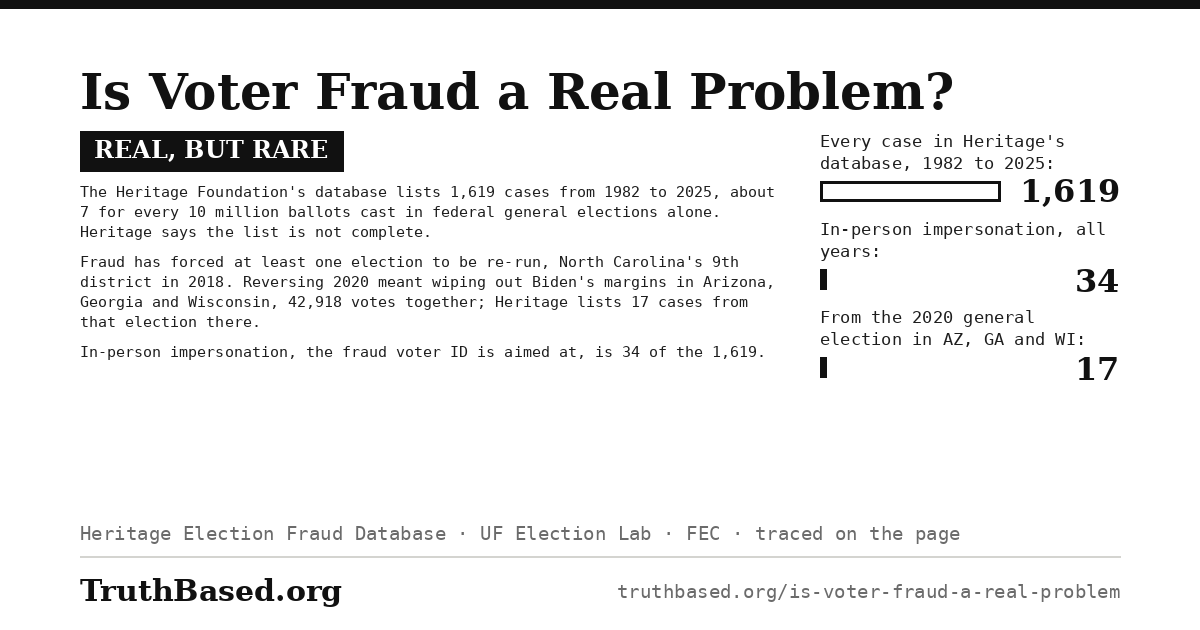
The verdict above as one image, with three counts from Heritage’s own database: every case it lists from 1982 to 2025, 1,619; the cases of in-person impersonation, the fraud voter ID is aimed at, 34; and the cases from the 2020 general election in Arizona, Georgia and Wisconsin, where Biden’s margins came to 42,918 votes, 17.
What would change this conclusion
This article concludes that: (1) documented voter fraud is rare, about 7 cases for every 10 million ballots cast in federal general elections in Heritage’s database; (2) in-person impersonation, the fraud voter ID is aimed at, is among the rarest kinds; (3) no evidence has shown fraud on the scale that would have changed the 2020 presidential result; and (4) fraud can still force a small, close race to be run again, as it did in North Carolina in 2018.
These conclusions would be falsified by:
• A court, audit or prosecution establishing fraudulent votes in the tens of thousands in a single state’s presidential count
• A check of a whole state’s voter file against citizenship records finding illegal votes at many times the rates found so far
• Evidence that undetected fraud is large, such as patterns in audits or recounts that fraud explains and ordinary error does not
Sources
Heritage Foundation, Election Fraud Database, last updated 12 December 2025, and the whole database as exported on 24 September 2026: 1,619 entries dated 1982 to 2025 (about 1,380 criminal convictions, 138 diversion programs, 50 civil penalties and 50 official or court findings), each with its state and type of fraud. Source for the count, the 17 cases from the 2020 general election in Arizona, Georgia and Wisconsin, the 34 of in-person impersonation and the 98 noncitizen cases. electionfraud.heritage.org
Heritage Foundation, about the Election Fraud Database. Source for Heritage’s statement that the database is not an exhaustive or comprehensive record of election fraud. electionfraud.heritage.org/about, heritage.org
University of Florida Election Lab (Michael McDonald), national turnout series, “1980-2022 General Election Turnout Rates (v1.2)” and “2024 General Election Turnout Rates (v0.4)”: ballots counted in each November general election from 1998 to 2024, and the vote for the highest office from 1982 to 1996, for which the series gives no national count of ballots; its national counts for 1998 to 2008 are the Lab’s estimates, scaled up from the states that reported ballots counted. Source for the 2.26 billion ballots. election.lab.ufl.edu, 2024 table
2020 certified margins. Georgia, Biden +11,779; Arizona, +10,457; Wisconsin, +20,682; Pennsylvania, +80,555. Georgia has two certified figures and both circulate: the first certification on 20 November 2020 gave +12,670, and the machine recount Trump requested afterwards produced +11,779, which is the final certified margin and the one used here. Federal Election Commission, official 2020 presidential results: fec.gov
U.S. Department of Justice, Ballot Access and Voting Integrity Initiative. Established October 2002. DOJ fact sheet of 26 July 2006: 119 individuals charged with ballot fraud offences and 86 convicted, from over 300 investigations opened. DOJ fact sheet of 2 July 2008: over 140 charged with election fraud offences and over 100 convicted, from over 360 investigations. The 2006 sheet counts campaign financing fraud separately, at 48 charged and 42 convicted, outside its totals; the 2008 sheet gives no campaign financing figure. justice.gov 2006; justice.gov 2008
Eric Lipton and Ian Urbina, “In 5-Year Effort, Scant Evidence of Voter Fraud,” New York Times, 12 April 2007. Source for the report, from court records and interviews, that five years into the initiative the Justice Department had turned up virtually no evidence of any organized effort to skew federal elections. nytimes.com
Justin Levitt (2014) — "A comprehensive investigation of voter impersonation finds 31 credible incidents out of one billion ballots cast." Washington Post, August 6, 2014: washingtonpost.com; a copy filed with Heritage’s database: static.heritage.org
Lorraine C. Minnite, The Politics of Voter Fraud (Project Vote, March 2007). Source for the Justice Department’s list of the 24 people convicted of illegal voting from October 2002 to September 2005: 14 noncitizens, 5 under supervision for felony convictions and 5 who voted in two states. projectvote.org
Samara Angel and others, Brookings Institution, 6 November 2025, on fraud in mail voting. Source for the mail-ballot fraud rate. brookings.edu
Georgia Secretary of State, release of 1 September 2026: 432 possible noncitizens who had voted at some point since 1996, 204 of them flagged by earlier audits and 228 new. sos.ga.gov. The 2024 audit of 8.2 million registrations, as the Associated Press reported it on 23 October 2024: keyt.com
Michigan Department of State, review of the 2024 general election, 3 April 2025. 15 potential noncitizens identified as having cast a ballot out of more than 5.7 million votes, which, with a case found in October 2024, the Department put at 0.00028% of votes cast; 13 referred to the Attorney General, one voter since deceased, one still under investigation. The review matched 7.9 million driving records against 7.2 million registered voters. michigan.gov
Utah Lieutenant Governor, citizenship review of the voter rolls, full summary of 27 May 2026. 27 registered voters confirmed as noncitizens, 13 of whom had voted, and 25 probable noncitizens, 9 of whom had voted; the single noncitizen reported in January 2026 was a preliminary update of the same review. ltgovernor.utah.gov
Nevada, FBI review of the 2020 voter rolls. Ordered in July 2025 by Sigal Chattah, Nevada’s top federal prosecutor. The FBI compared the Nevada rolls against Department of Homeland Security citizenship data and identified 38 possible noncitizen voters, told her office the statute of limitations had expired, and closed the inquiry in late January 2026, as CBS News reported on 12 March 2026 from people with direct knowledge of it. CBS describes the 38 only as possible noncitizen voters. cbsnews.com
ACORN’s registration drives, 2006 and 2008. The count ACORN and Project Vote announced on 8 October 2008, more than 1.3 million registrations collected in 21 states: projectvote.org. About 400,000 of them rejected, the two groups told the New York Times, as NPR reported on 24 October 2008: npr.org. Seven ACORN workers charged in Washington State in 2007 over about 1,800 false registrations, with names made up or taken from phone books and newspapers, none of which led to a vote; four ACORN canvassers in Kansas City, Missouri, had pleaded guilty in federal court (Seattle Times, 27 July 2007): seattletimes.com
U.S. Government Accountability Office, GAO-19-485 (27 June 2019) — "Voter Registration: Information on Federal Enforcement Efforts and State and Local List Management." Source for the 19 election fraud cases filed by the Public Integrity Section and the 185 filed by the U.S. Attorneys’ Offices, about 0.02% of their caseload, in fiscal years 2001 through 2017. gao.gov
AG Bill Barr, interview with the Associated Press (Michael Balsamo), December 1, 2020 — not a DOJ press release: apnews.com. A Justice Department spokesperson said the same day that some outlets had wrongly reported a finding of no fraud, “not what the Associated Press reported nor what the Attorney General stated”, as NBC News reported: nbcnews.com
Kris Kobach’s prosecutions as Kansas Secretary of State. The Sunflower State Journal’s count from his office’s list: sunflowerstatejournal.com. Kansas SB 34 (2015) and K.S.A. 25-2435: kslegislature.gov, ksrevisor.gov. News21’s report on NBC News: nbcnews.com. Fish v. Kobach, 309 F. Supp. 3d 1048 (D. Kan. 2018): courtlistener.com
North Carolina State Board of Elections, order of 13 March 2019 on the 2018 9th District election. ncsbe.gov. The pleas that followed and Dowless’s death in April 2022: NBC News, WSOC-TV, KKTV (AP)
State v. Zapata, 2026 WI App 36 (Wisconsin Court of Appeals, No. 2025AP425-CR, 12 May 2026). wicourts.gov. That the legislator was a Republican, from the Associated Press’s report of the verdict on 20 March 2024: NBC News (AP)
Georgia State Election Board, case SEB2024-151 (America PAC), letter of reprimand voted 18 February 2026 for pre-filled absentee ballot applications sent into Chattooga, Cherokee, Coweta, Floyd and Whitfield counties, as 11Alive reported it: 11alive.com. Georgia’s law on absentee ballot applications, O.C.G.A. 21-2-381: law.justia.com. The committee’s support for Trump: FactCheck.org’s profile of it, factcheck.org
Ward v. Jackson, Maricopa County Superior Court CV2020-015285, ruling of 4 December 2020, affirmed at No. CV-20-0343-AP/EL (Ariz., 8 December 2020, en banc and unanimous), certiorari denied 22 February 2021. The trial court reviewed 1,626 duplicate ballots and found nine duplication errors. law.justia.com
Costantino v. City of Detroit, Wayne County Circuit Court No. 20-014780-AW, opinion and order of Chief Judge Timothy Kenny, 13 November 2020. Leave to appeal denied by the Michigan Court of Appeals, No. 355443, 16 November 2020, and by the Michigan Supreme Court, No. 162245, 950 N.W.2d 707, 23 November 2020, which was not persuaded that the question should be reviewed; Justice Zahra, joined by Justice Markman, concurred, writing that the Wayne County board’s certification had made the request for an injunction moot, and Justice Viviano dissented. A denial of leave is not a ruling on the merits. Chief Judge Kenny’s opinion, as filed in a federal case: courtlistener.com. The Court of Appeals’ order: courts.michigan.gov. The Michigan Supreme Court’s order: electioncases.osu.edu
Donald J. Trump for President, Inc. v. Boockvar, M.D. Pa. No. 4:20-cv-02078, memorandum opinion and order of 21 November 2020 granting the motions to dismiss the first amended complaint with prejudice and denying leave to amend. Affirmed sub nom. Donald J. Trump for President, Inc. v. Secretary of Pennsylvania, 3d Cir. No. 20-3371, 27 November 2020 (Smith C.J., Chagares and Bibas JJ.). The appeal was taken on the single question of whether the district court abused its discretion in refusing a second amended complaint; the panel held the delay undue and amendment futile because the claims had no merit, and denied an injunction pending appeal. ca3.uscourts.gov
Wood v. Raffensperger, N.D. Ga. No. 1:20-cv-04651-SDG, order of 20 November 2020 denying emergency relief on standing, alternatively on laches, and alternatively on the merits. Affirmed at 11th Cir. No. 20-14418, 5 December 2020 (Pryor C.J.), on standing and mootness only: the panel held that because the case was not justiciable it lacked jurisdiction and expressly declined to address the other issues raised. Certiorari denied 22 February 2021. 11th Circuit opinion law.justia.com
Law v. Whitmer, First Judicial District Court of Nevada, Carson City, No. 20 OC 00163 1B, judgment of Judge James T. Russell, 4 December 2020, dismissing the election contest with prejudice after a hearing. The court found "no credible or reliable evidence" that the Nevada result was affected by fraud, gave the contestants’ experts "very little weight", and held that nothing had been proved approaching the 33,596-vote margin. Affirmed by the Supreme Court of Nevada without dissent (Justice Cadish recused), No. 82178, on 8 December 2020. courtlistener.com
Trump v. Biden, 2020 WI 91, Supreme Court of Wisconsin No. 2020AP2038, decided 14 December 2020 by 4 to 3, on review of the Milwaukee County Circuit Court (Judge Stephen A. Simanek). The challenge to the ballots of indefinitely confined voters was held meritless on its face; laches barred the remaining three categories. wicourts.gov
Texas v. Pennsylvania, U.S. Supreme Court No. 22O155, order of 11 December 2020: "The State of Texas's motion for leave to file a bill of complaint is denied for lack of standing under Article III of the Constitution." All other pending motions were dismissed as moot. Justice Alito, joined by Justice Thomas, stated that he would have granted leave to file but no other relief, and expressed no view on any other issue. supremecourt.gov
Joint statement of the election infrastructure government and sector coordinating councils, 12 November 2020, published by CISA: cisa.gov
FBI Director Christopher Wray, testimony to the Senate Committee on Homeland Security and Governmental Affairs, 24 September 2020, printed record S. Hrg. 116-487. It was given six weeks before the election and describes the record before it. govinfo.gov
Lost, Not Stolen: The Conservative Case that Trump Lost and Biden Won the 2020 Presidential Election (July 2022). Source for the 64 cases in the six battleground states: 14 dropped, 20 dismissed before a hearing on the merits, 30 heard on the merits, and one minor win in Pennsylvania. lostnotstolen.org. The eight authors, three of them retired federal appeals judges, as the report’s release of 14 July 2022 describes them: prnewswire.com
The three Georgia counts, 2020. The original machine count; the risk-limiting audit required by a 2019 state law, which the Secretary of State applied to the presidential race and which the narrow margin turned into a hand count of all roughly five million ballots in mid-November 2020; and a machine recount, which state law lets a trailing candidate request when the margin is under half a percentage point and which the Trump campaign requested. Secretary of State’s release, gpb.org
The search warrant affidavit of FBI Special Agent Hugh Raymond Evans: courtlistener.com; NPR, 10 February 2026: npr.org
The sanctions involving Kurt Olsen. The federal order in Lake v. Hobbs (D. Ariz.): courtlistener.com, affirmed by the Ninth Circuit on 14 March 2025: ca9.uscourts.gov; the Arizona Supreme Court’s order of 4 May 2023: democracydocket.com. The January 6 committee’s letter to Olsen: justsecurity.org
Fulton County's amended motion for return of property, filed 17 February 2026 in the U.S. District Court for the Northern District of Georgia, No. 1:26-cv-00809-JPB, Doc. 30. Source for the county's description of the affidavit: "Unsupported by probable cause and dependent on unsubstantiated hypotheticals, Respondent's seizure violated the Fourth Amendment." courtlistener.com
Fulton County rulings, 2026. Judge J.P. Boulee’s order of 6 May 2026 denying return of the seized records: caselaw.findlaw.com (docket: courtlistener.com); Judge William M. Ray II’s order of 7 July 2026 quashing the subpoena for election workers’ details, in Fulton County Board of Registration and Elections v. United States, No. 1:26-cv-02777-WMR: justsecurity.org; NAACP v. United States (N.D. Ga.), filed 15 February 2026 by the NAACP, its Georgia and Atlanta branches, the Georgia Coalition for the People’s Agenda and two Fulton County voters, dismissed without prejudice by Judge Boulee on 19 August 2026, as Democracy Docket reported it: democracydocket.com. Also wrdw.com
Washington Post, 20 February 2026, on the Justice Department’s struggle to prosecute noncitizen voters: washingtonpost.com
U.S. Department of Justice, 18 September 2026, charges against 16 people, all of them noncitizens, for illegal voting and related crimes in Texas, Idaho, Georgia, Massachusetts, Wisconsin, New Jersey and Michigan: justice.gov
Hans von Spakovsky, “Election Fraud Database Tops 1,400 Cases,” Heritage Foundation: heritage.org; and Heritage’s press release “Heritage Corrects Media Misrepresentations of Voter Fraud Database”: heritage.org
Andrew C. Eggers, Haritz Garro and Justin Grimmer, “No evidence for systematic voter fraud: A guide to statistical claims about the 2020 election,” PNAS 118(45), e2103619118 (2021), full text: europepmc.org
Maricopa County review, 2021. Cyber Ninjas’ hand count gave Biden 99 more votes and Trump 261 fewer than the certified result, a net 360 more for Biden (the report’s Volume III, section 4.1: copy). Costs: the Senate’s $150,000 contract and the nearly $5.7m raised by Trump-aligned groups, the firm’s own figure, as PolitiFact reported them: politifact.com; Senate spending of about $1.1m as tracked by the Arizona Republic, which put the publicly funded costs near $5m by June 2022: pressreader.com
Wisconsin Office of Special Counsel. Michael Gableman, appointed by Assembly Speaker Robin Vos in 2021 and dismissed in August 2022, at a cost of nearly $2.8m once a $432,000 open-records settlement was reached in April 2025, as Wisconsin Watch reported it: wisconsinwatch.org
Texas Attorney General’s election fraud unit. Its 16 prosecutions resolved in 2020, all Harris County residents who gave false addresses on registration forms, none of them jailed, from records obtained by the Houston Chronicle: houstonchronicle.com. A 2021 ruling of the Texas Court of Criminal Appeals barred the Attorney General from prosecuting election crimes without local prosecutors’ consent, and in August 2025 the Legislature passed SB 12 to restore the power: votebeat.org
Cite this article
TruthBased.org. “Is Voter Fraud a Real Problem?” Updated September 2026. https://www.truthbased.org/is-voter-fraud-a-real-problem