Health & Medicine
What Is Gender Dysphoria, and What Does the Evidence Actually Show?
The diagnosis, the treatments and the outcome studies.
Groups & Crime
How Often Are Transgender People Victims of Crime?
Survey rates, hate crime counts and what the prison figures show.
Groups & Crime
Are Trans People Overrepresented as Mass Shooters?
The claim against the three shooter databases.
Do Trans Women Retain an Athletic Advantage After Transition?
Testosterone suppression reverses some physical advantages completely, others only partly, and some not at all. Which is which decides the answer.
Jump to the verdict ↓
What this covers
This covers adults who went through male puberty and began hormone therapy as adults. It does not cover anyone who took puberty blockers before or during puberty, which is a different physiological question with its own much thinner evidence base. It does not cover athletes with differences of sex development. Caster Semenya and the 46,XY DSD cases are biologically and legally distinct, and treating them as the same question is one of the most common errors in this debate.
The short answer
It depends which measure you take. Some advantages disappear within months, some shrink but remain, and the skeleton does not change at all.
What is actually being asked
The claim in dispute is not whether male puberty confers athletic advantage. It does, and nobody serious disputes the size of it. Handelsman and colleagues put the overall figure at "at least" 8 to 12 percent, and the sport-by-sport picture from Hilton and Lundberg runs from about 11 percent in swimming and running to 31 to 37 percent in Olympic weightlifting and over 50 percent in a field hockey drag flick.
The dispute is what happens to that advantage when an adult suppresses testosterone. One side treats advantage as a function of circulating hormones, so lowering testosterone should remove it. The other treats it as a function of development, so what puberty built stays built. Both are partly right, and the reason the argument never resolves is that each side has picked a different set of measures.
Sorting every physical trait into one bucket is the central mistake, and both sides make it. Some traits track current hormone levels closely. Some track them slowly. Some do not track them at all.
What reverses, and quickly
Blood is the clearest case. Testosterone drives red blood cell production, and when it is suppressed, haemoglobin and haematocrit fall to the range typical of cisgender women. Harper and colleagues, reviewing twenty-four studies, put the timeline at about four months.
The one measure that fully normalises
Haemoglobin and haematocrit reach cisgender female levels, not merely approach them. Harper's review puts it plainly: after four months of hormone therapy trans women have haemoglobin and haematocrit equivalent to those of cisgender women, and the reduction is described as rapid. Because oxygen-carrying capacity is tightly coupled to aerobic performance, this removes a large part of the endurance advantage, and it does so early.
This is the strongest evidence that hormone-level reasoning works, and it works for endurance events specifically.
What changes slowly, and what that means depends on the denominator
Muscle is the contested middle. Across roughly twelve longitudinal studies, twelve months of suppression produces about a 5 percent loss of lean mass. Wiik and colleagues, following eleven trans women, measured thigh muscle volume down 5 percent and quadriceps cross-sectional area down 4 percent at one year, with knee extensor strength holding steady. Over three years Gooren and Bunck recorded a 12 percent fall in thigh muscle area.
Hilton and Lundberg put strength differences between the sexes at 30 to 100 percent depending on the cohort and the task, and the performance gap at 10 to 50 percent depending on the sport. A 5 percent loss against a baseline of that size leaves most of it in place on paper. That subtraction is the heart of the retained-advantage argument, and in absolute terms it holds: both major 2021 reviews concluded that lean mass, muscle area and strength remain above cisgender female means at three years.
Why the same data produces opposite headlines
Hamilton and colleagues, in a study funded by the International Olympic Committee, tested trained athletes. Absolute grip strength came out higher in trans women than in cisgender women, 40.7 kg against 34.2 kg. In the same cohort, relative jump height was lower, 0.7 against 1.0 centimetres per kilogram, and relative oxygen uptake was lower, 45.1 against 54.1 millilitres per kilogram per minute. Alvares and colleagues, testing non-athletes, found absolute oxygen uptake and grip strength both higher in trans women than cisgender women and both lower than in cisgender men, an intermediate pattern. A correction to that paper added a result the original had left out: once adjusted for fat-free mass, neither the oxygen uptake nor the grip strength difference between trans women and cisgender women remained. Neither set of results is wrong. They measure different things, and which one you quote decides which headline you get.
Anyone citing a single strength or fitness number in this debate is choosing a denominator, usually without saying so. The absolute figures favour the retained-advantage case. The body-mass-relative figures favour the inclusion case. Both are in the same papers.
What does not change at all
Height, limb length, bone geometry, hand and foot size and overall frame are set by puberty and are not altered by adult hormone therapy. Hilton and Lundberg reach this conclusion directly: there is no plausible mechanism by which testosterone suppression would change bone length or hip width, and trans women generally maintain bone mass across at least 24 months of suppression rather than losing it. They name the sports where it matters most, those where height, limb length and handspan are decisive, giving basketball, volleyball and handball as examples.
These matter differently by sport. Reach and leverage are decisive in throwing and striking events. Height matters in basketball, volleyball and handball. In events where performance is measured per kilogram of body mass, they matter much less. This is the least contested part of the retained-advantage case and the part that no amount of hormone therapy addresses.
The baseline gap, sport by sport
How much a permanent trait is worth depends entirely on the event, and the spread is wide. Hilton and Lundberg put the gap between cisgender men and cisgender women at 11 to 13 percent in rowing, swimming and running, 31 to 37 percent in Olympic weightlifting, and over 50 percent in a baseball pitch and a field hockey drag flick. Those are male-female baselines, not measurements of trans women, and they are the starting point the hormone therapy decline is subtracted from.
The range is the finding. A trait that decides a drag flick barely registers in a per-kilogram event, so “does an advantage persist” has no single answer across sports. Where trained athletes have been measured on body-mass-relative terms, trans women came out lower than cisgender women athletes, not merely less far ahead: lower relative jump height, lower relative oxygen uptake, lower lung function ratio in Hamilton's cohort.
The strongest case that advantage persists
Put at its strongest: male puberty builds a skeleton that hormone therapy cannot remodel, and it builds muscle that hormone therapy reduces by only about a twentieth in the first year. The decline slows sharply after year one and appears to settle above the cisgender female mean rather than reaching it. Three years in, measured against cisgender women, trans women still carry more lean mass and greater absolute strength.
The field data support this in part. In the US Air Force cohort, the largest with actual performance testing, trans women before hormone therapy ran 1.5 miles 21 percent faster than cisgender women, did 31 percent more push-ups and 15 percent more sit-ups. After one year of testosterone suppression, the period World Athletics then required, they were still 9 percent faster. Two years in, the push-up and sit-up gaps had closed, but the run time advantage was still 12 percent.
How to read it: each bar is how far trans women were ahead of the average airwoman under 30 on that test, in percent; the darker bar is before hormone therapy, the lighter bar after two years of it, and a bar at zero means no remaining gap. Push-ups 31 to 0, sit-ups 15 to 0, 1.5-mile run speed 21 to 12 (9 at one year). Source: Roberts, Smalley and Ahrendt, British Journal of Sports Medicine 2021, 46 transgender women in the US Air Force.
The precautionary version of the argument is that where the residual cannot be ruled out, the burden should fall on inclusion rather than on the women already in the category. That is a judgement about which error to risk, not a claim about the data, and it should be argued on those terms.
The strongest case that it does not
Put at its strongest: the subtraction that produces the residual is not arithmetic anyone is entitled to do. The baseline gap comes from comparing elite cisgender men with elite cisgender women. The 5 percent decline comes from small clinical studies of mostly sedentary trans women. The two numbers describe different populations measured different ways, and subtracting one from the other assumes trans women start at the cisgender male mean. Wiik's data indicate they do not: muscle volumes were below cisgender male means before treatment began.
The largest synthesis to date
Sieczkowska and colleagues pooled 50 studies covering 6,099 people, in the corrected version of the paper, and compared trans women against cisgender women directly. Upper-body strength, standardised mean difference 0.92, with a confidence interval running from minus 0.52 to 2.35. Lower-body strength, minus 0.10. Maximal oxygen uptake, minus 0.28. Relative lean mass, 0.19. Relative fat mass, minus 0.29. None reached statistical significance. Trans women carried higher absolute lean mass, but relative lean mass, relative fat mass, strength and aerobic capacity were all comparable. The authors grade the evidence very low to low certainty and say it does not support theories of inherent athletic advantage for trans women. The paper was corrected after publication, three studies removed and one added, and the figures here are the corrected ones; the 52 studies and 6,485 people reported in the press coverage are from the original version.
How to read it: each bar is a standardised mean difference between trans women on hormone therapy and cisgender women; zero means no difference, a bar to the right means trans women measured higher, a bar to the left lower, and 0.2 is a small difference, 0.8 a large one. None of the five reached statistical significance, and the upper-body strength bar sits on a confidence interval running from minus 0.52 to 2.35. Source: Sieczkowska and colleagues, British Journal of Sports Medicine 2026, corrected version, 50 studies and 6,099 people.
The same analysis found the gaps against cisgender men large and statistically significant, which places trans women between the two groups rather than with either. Hamilton's study of trained athletes points the same way on the measures that scale with body mass: lower relative jump height, lower relative oxygen uptake, lower lung function ratio than cisgender women athletes.
Download this conclusion: the meta-analysis
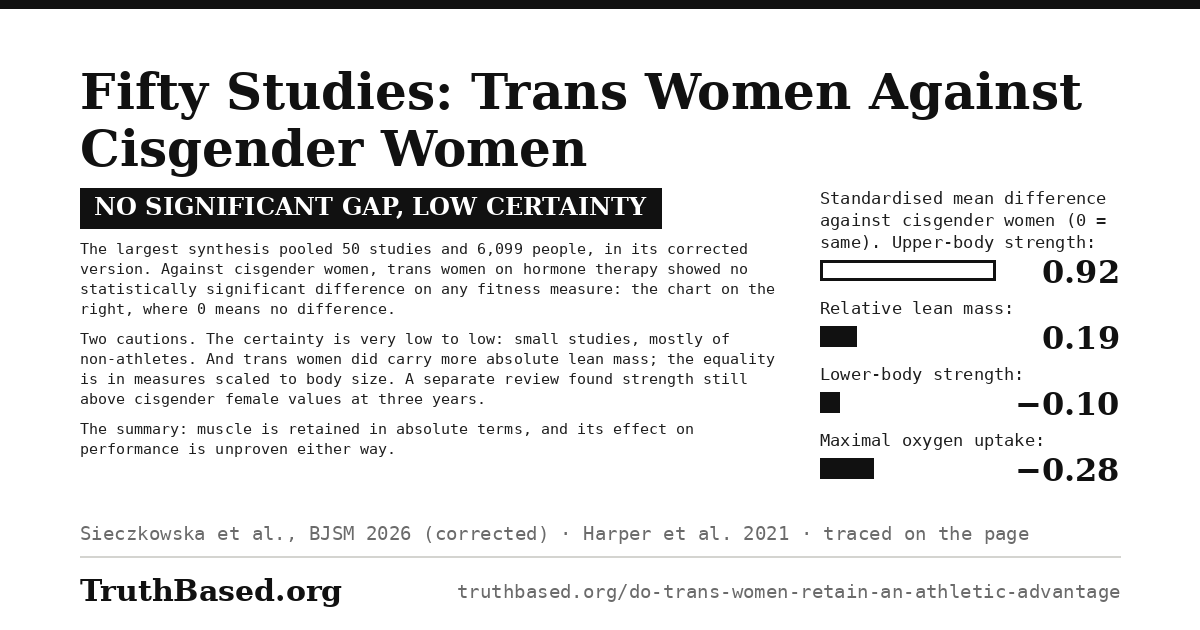
This section as one image: what the largest synthesis found when it compared trans women on hormone therapy with cisgender women, and the two cautions its authors attach.
What the governing bodies decided, and on what
Policy has moved further and faster than the evidence. In 2021 the International Olympic Committee dropped its single testosterone threshold, established that there should be no presumption of advantage, and pushed eligibility down to individual federations. Most federations then went the other way.
World Aquatics in June 2022 restricted the women's category to those who had not experienced male puberty beyond Tanner stage 2 or age 12, whichever came later, and created an open category. When that category was piloted at a World Cup event in 2023, nobody entered. Cycling's UCI followed in July 2023, having concluded that its previous testosterone threshold was not sufficient to eliminate the benefits of puberty and that lasting differences in bone and limb length could not be ruled out. World Athletics announced on 23 March 2023 that it would exclude trans women who had been through male puberty from female world ranking competition, effective 31 March. Sebastian Coe said that where the science was insufficient to justify keeping a testosterone rule, the council had to be guided by its overarching principle, which was to protect the female category, and World Athletics said that with no transgender athletes then competing internationally there was no athletics-specific evidence either way, so it chose fairness over inclusion. The NCAA changed its policy in February 2025, one day after a presidential executive order on the subject.
What the bans rest on
The federations that gave reasons cited precaution and the impossibility of ruling out a residual, not evidence that trans women were winning disproportionately. No such evidence exists in either direction, because no elite competition outcome dataset has been assembled. The NCAA's own president told the Senate in December 2024 that of more than 500,000 student athletes he was aware of fewer than ten who were transgender.
The state of the evidence
This literature is thin enough that anyone claiming it settles the question is overstating it. Sample sizes run from single digits to about fifty. Wiik studied 11 trans women, Alvares 15, Hamilton 23, Roberts 46. Most of the longitudinal physiology comes from clinical populations who were not athletes, which is the wrong population for a question about competitive sport. Hamilton's study is the main one using trained athletes, and it is cross-sectional, so it cannot establish a time course.
The reviews rest heavily on the same small studies, so agreement between them reflects shared source data rather than independent confirmation. And the designs disagree systematically: small longitudinal studies emphasise retention, matched cross-sectional comparisons emphasise convergence.
Several things are simply unstudied. Muscle fibre type change over time. Tendon and connective tissue. Anything beyond four years. Cardiac and respiratory remodelling. Competition outcomes at elite level.
The verdict: what the evidence shows
1. The answer is different for different measures, and no single verdict covers them all. Blood oxygen capacity normalises to cisgender female levels within about four months. Muscle mass and strength fall roughly 5 percent in the first year and remain above cisgender female means in absolute terms at three years. The skeleton does not change at all.
2. Whether the retained muscle translates into competitive advantage is not settled. The largest synthesis, 50 studies and 6,099 people in its corrected form, found no statistically significant difference in strength or aerobic fitness between trans and cisgender women, at very low to low certainty, with a confidence interval on upper-body strength wide enough to include a large advantage and a deficit. Studies of trained athletes find absolute measures higher and body-mass-relative measures equal or lower.
3. The common subtraction, baseline male advantage minus the hormone therapy decline, is sound for skeletal traits and directionally sound for absolute muscle. It is not reliable as arithmetic, because the two figures come from different populations measured different ways.
4. Nobody has the data that would decide this. There is no large longitudinal study of trained trans women with matched cisgender female athletes and actual competition outcomes. Every position currently held is held on evidence graded low certainty.
5. Most major federations now exclude post-pubertal trans women from elite women's categories. Those that gave reasons cited precaution and residual uncertainty rather than evidence of disproportionate winning, which nobody has collected.
Download the conclusion
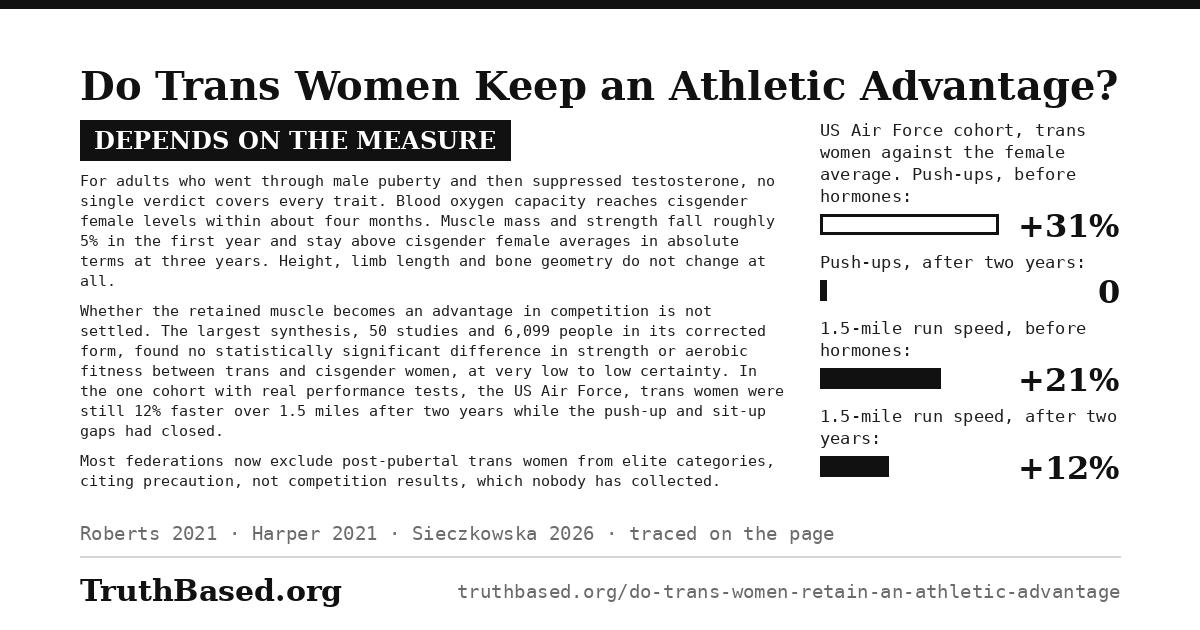
The verdict above as one image, with the Air Force cohort’s before-and-after figures as its chart. It is 1,200 by 630 pixels, the size social networks use for link previews, and anyone may download it and post it.
What would change this conclusion
1. A longitudinal study of more than 100 trained trans women with matched cisgender female athletes, measuring actual performance outcomes rather than laboratory proxies, would be close to decisive. None exists. Its publication should reset any position held here.
2. Elite competition results showing systematic over-performance by trans women would strengthen the exclusion case directly, and no such dataset has been assembled either way.
3. Direct evidence on the 24 to 48 month trajectory. Almost all the muscle and strength data stops at 12 or 36 months, and the shape of the curve after that is assumed rather than measured.
4. Replication of the Hamilton adjustment finding in a larger trained cohort. If the grip strength difference continues to vanish once fat-free mass and hand size are accounted for, the functional case for retained advantage weakens considerably.
Sources
Sieczkowska S.M., Mazzolani B.C., Coimbra D.R., Longobardi I., Casale A.R., da Hora J.D.F.V.M.P., Roschel H. & Gualano B. (2026). Body composition and physical fitness in transgender versus cisgender individuals: a systematic review with meta-analysis. British Journal of Sports Medicine 60(3), 198, published 11 February 2026 and corrected since (three studies removed, one added; all analyses updated). DOI 10.1136/bjsports-2025-110239. PROSPERO CRD42024562210. 50 studies, n=6,099 in the corrected version. Source for the standardised mean differences (upper-body strength 0.92, 95% CI −0.52 to 2.35; lower-body strength −0.10; maximal oxygen consumption −0.28; relative lean mass 0.19; relative fat mass −0.29) and the certainty grading. doi.org
Harper J., O'Donnell E., Sorouri Khorashad B., McDermott H. & Witcomb G.L. (2021). How does hormone transition in transgender women change body composition, muscle strength and haemoglobin? Systematic review with a focus on the implications for sport participation. British Journal of Sports Medicine 55(15), 865-872. DOI 10.1136/bjsports-2020-103106. Twenty-four studies reviewed. Source for the four-month haemoglobin timeline and for the finding that strength, lean body mass and muscle area remain above cisgender female values even after 36 months. doi.org
Hilton E.N. & Lundberg T.R. (2021). Transgender women in the female category of sport: perspectives on testosterone suppression and performance advantage. Sports Medicine 51(2), 199-214. DOI 10.1007/s40279-020-01389-3. Source for the sport-by-sport baseline gaps (rowing, swimming and running 11 to 13 percent; Olympic weightlifting 31 to 37 percent; baseball pitch and field hockey drag flick over 50 percent), for strength differences of 30 to 100 percent depending on cohort and task, for the roughly 5 percent first-year decline drawn from twelve longitudinal studies, for Gooren and Bunck's 12 percent thigh muscle loss over three years in 19 trans women, and for the conclusion that height and skeletal parameters remain unaltered. springer.com
Hamilton B. et al. (2024). Strength, power and aerobic capacity of transgender athletes: a cross-sectional study. British Journal of Sports Medicine 58, 586-597. DOI 10.1136/bjsports-2023-108029. n=23 transgender women, 21 cisgender women, 12 transgender men, 19 cisgender men. Source for absolute grip strength (40.7 against 34.2 kg), relative jump height (0.7 against 1.0 cm/kg), relative oxygen uptake (45.1 against 54.1 mL/kg/min) and the lung function ratio, all in trained athletes. doi.org
Roberts T.A., Smalley J. & Ahrendt D. (2021). Effect of gender affirming hormones on athletic performance in transwomen and transmen: implications for sporting organisations and legislators. British Journal of Sports Medicine 55, 577-583. DOI 10.1136/bjsports-2020-102329. US Air Force cohort, n=46 transgender women and 29 transgender men. Source for the push-up, sit-up and 1.5-mile run figures before treatment, at one year and at two years. doi.org
Wiik A. et al. (2020). Muscle strength, size and composition following 12 months of gender-affirming treatment in transgender individuals. Journal of Clinical Endocrinology and Metabolism 105(3), e805-e813. DOI 10.1210/clinem/dgz247. n=11 transgender women. Source for the thigh volume and quadriceps figures and for maintained knee extensor strength. academic.oup.com
Alvares L.A.M. et al. (2022). Cardiopulmonary capacity and muscle strength in transgender women on long-term gender-affirming hormone therapy: a cross-sectional study. British Journal of Sports Medicine. DOI 10.1136/bjsports-2021-105400. Read with its published correction, DOI 10.1136/bjsports-2021-105400corr1, which revises the group sizes to 15 non-athlete transgender women, 14 cisgender men and 13 cisgender women, corrects the oxygen units to mL/min, and restores two omitted results. Average 14.4 years of hormone therapy. Source for the intermediate pattern: peak oxygen uptake 2606 mL/min in trans women against 2167 in cisgender women and 3358 in cisgender men, and grip strength 35.3 kg against 29.7 and 48.4; and, from the correction, oxygen uptake per kilogram of fat-free mass of 47.3 against 53.3 in cisgender women and strength adjusted for fat-free mass of 0.6 against 0.7, neither difference significant. doi.org
Handelsman D.J., Hirschberg A.L. & Bermon S. (2018). Circulating testosterone as the hormonal basis of sex differences in athletic performance. Endocrine Reviews 39(5), 803-829. DOI 10.1210/er.2018-00020. Source for the 8 to 12 percent overall figure. academic.oup.com
Note on the evidence base. Sample sizes across this literature run from single digits to about fifty, and most longitudinal physiology comes from clinical populations rather than athletes. The reviews draw on overlapping primary studies, so agreement between them is not independent confirmation. Figures given here are those the cited papers report; where a paywalled paper's full tables could not be read, the figure comes from its abstract or from tables reproduced in a review.
Cite this article
TruthBased.org. "Do Trans Women Retain an Athletic Advantage After Transition?" September 2026. https://www.truthbased.org/do-trans-women-retain-an-athletic-advantage