Crime & Justice
Which Side Commits More Political Violence?
Deaths and attacks by side in the counts of CSIS, Cato, New America and ADL, and what moves the totals.
Religion & Society
Does Religiosity Correlate With Better Social Outcomes?
Crime, trust, wellbeing, charity, religious vs. secular populations.
Historical Fact Check
What Does the Record Actually Show About Columbus?
Columbus’s journal entries, the Hispaniola data, and how Washington Irving built the flat-Earth myth.
Does Religion Cause Violence?
The claim is argued with counts of wars, terrorism data, sectarian conflicts and old death tolls. This reads each count for what it measures, and sets it beside the studies that test religion against poverty, weak states and exclusion from power as causes of civil war.
Jump to the verdict ↓
The short answer
Sometimes, but rarely on its own. Since 1975 a growing share of armed conflicts has been fought over religious demands: 3% of the government-rebel pairs at war in 1975, 55% in 2015. Religious terrorist groups have been deadlier than secular ones. But more religiously diverse countries have been no more likely to have civil wars once income is taken into account, and in the sectarian conflicts examined here religion marked the sides alongside ethnicity, power and wealth. The death tolls popularly blamed on the Inquisition and the witch trials are far above what historians count.
How Often Wars Are Fought Over Religion
The claim that only about 7% of wars were religious comes from the index of the Encyclopedia of Wars by Charles Phillips and Alan Axelrod (2005), which catalogs 1,763 wars. Counting that index in 2018, the historian Andrew Holt found 121 entries under “religious wars”, about 7%.
Holt found no statement of how the editors chose; the label appears only in the index. An index entry is yes or no, so a war fought partly over religion counts in full or not at all.
A separate audit for the BBC in 2003, by peace researchers at the University of Bradford, rated major wars of the past 3,500 years from 0 to 5 for religious motivation. By Scott Atran’s account of it (Foreign Policy, 2012), more than 60% showed none and fewer than 7% scored above 3.
Since 1975Isak Svensson and Desirée Nilsson’s RELAC data (Journal of Conflict Resolution, 2018) cover 420 pairings of a government and a rebel group that fought with at least 25 battle deaths in a year between 1975 and 2015. A pair counts as fought over a religious issue when either side stated a religious demand at the outset, even if not its main one. Such pairs were 3% of those active in 1975 and 55% in 2015, and over the whole period 75% of them set a government against a group with Islamist claims.
Government-Rebel Pairs Fighting Over a Religious Issue, 1975 and 2015
| Year | Share fought over a religious issue |
|---|---|
| 1975 | 3% |
| 2015 | 55% |
Monica Duffy Toft’s count of civil wars from 1940 to 2000 (Belfer Center, 2006) found religious ones rising from 19% of all civil wars in the 1940s to 43% in the 1990s, and 7 of the 14 still under way in 2000 were religious. She found them deadlier for fighters and civilians (International Security, 2007); in her count they also lasted about two years longer and were about twice as likely to recur, though neither difference was statistically significant. Isak Svensson (2007) found that from 1989 to 2003, government-rebel pairs in which either side made explicit religious claims were significantly less likely than others to end in a negotiated settlement.
In sub-Saharan Africa, Matthias Basedau of Hamburg’s GIGA institute judged that eight of the ten intrastate armed conflicts active in mid-2017 had a religious dimension, and at least five were “theological”, fought partly over ideas such as religion’s role in the state.
The definition problemRELAC records what the sides said they wanted, and its authors warn that stated positions often differ from underlying interests: conflicts defined by religious claims “may, or may not, have religious causes.” Basedau adds that there is “no such thing as a purely ‘religious conflict.’” William Cavanaugh (The Myth of Religious Violence, 2009) goes further, arguing that religion has no transhistorical and transcultural essence and that what counts as religious or secular depends on political power.
How Deadly Religious Terrorism Is, and Who Dies
In 2023 the EU recorded 120 terrorist attacks. Separatists carried out 70 of them (58%), and jihadists 14, of which five were completed; those five killed six people and injured 12, and Europol calls jihadist attacks the most lethal. In 2024 attacks fell to 58, and jihadist attacks, 24, were the largest category, ahead of left-wing and anarchist ones at 21; jihadist attacks killed five people and injured 18. Of 449 terrorism arrests that year, 289 were for jihadist offences.
WorldwideIn the RAND-St Andrews chronology of international terrorism, Bruce Hoffman found that none of the 11 identifiable groups active in 1968 was religious. By 1995, 26 of 56 were, and that year religious terrorists committed 25% of recorded international incidents but caused 58% of the deaths. In 1996, the latest year with complete figures when he wrote, the count was 13 of 46 (RAND Review, 1998–99).
Victor Asal and R. Karl Rethemeyer (Journal of Politics, 2008) found that a terrorist organisation’s size, ideology, control of territory and ties to other groups predicted how many people it killed, with religious groups more likely to kill than others, while state sponsorship, the group’s age and its host country did not. In Ido Levy’s study (Terrorism and Political Violence, 2023), jihadist groups kill more per attack than other groups, largely because of their attachment to suicide attacks. James Piazza (Terrorism and Political Violence, 2009) found that casualty rates vary widely among Islamist groups and follow their organisation and goals more than Islamism itself, separating “strategic” groups, which behave like secular national-liberation or regime-change movements, from “abstract/universal” groups tied to al-Qaeda’s global network.
Where the deaths happenThe French Fondation pour l’innovation politique (Fondapol) counted 66,872 Islamist terrorist attacks worldwide from 1979 to April 2024, which killed at least 249,941 people, and found that 86.3% of the attacks and 88.9% of the deaths took place in Muslim countries. Anthony Cordesman of CSIS, drawing on many indicators in 2017, wrote that most extremist and terrorist violence occurs in largely Muslim states and “overwhelmingly consists of attacks by Muslim extremists on fellow Muslims.”
Four sectarian conflicts and what drove them
Northern Ireland’s Troubles set Catholics against Protestants, and scholars disagree about how much religion itself mattered. Some call the conflict ethno-national and dismiss religion’s role; others call it religious (Gladys Ganiel and Paul Dixon’s account of the field, 2008). Joseph Ruane writes that Ireland’s Catholic-Protestant conflict rests on “multiple, overlapping differences: religious, ethnic, colonial, political.” The Sutton Index at Ulster University’s CAIN archive lists 3,532 deaths from July 1969 to the end of 2001; Republican paramilitaries were responsible for about 58% of them, Loyalist paramilitaries for about 29% and British security forces for about 10%.
IraqThe Iraq war killed roughly 300,000 people by violence from 2003 to 2023, by Michael Spagat’s reckoning in PLOS ONE (2024), which adds combatants to Iraq Body Count’s documented civilian deaths; he judges it might be a fifth too high or, at a stretch, half the true toll. That is the whole war’s toll, and sectarian killing is one part of it. The U.S. Defense Department called November 2006 the height of sectarian violence; Iraq Body Count recorded about 29,500 civilian deaths that year and 26,100 in 2007. Fawaz Gerges writes that by destroying state institutions and establishing a sectarian-based political system, the invasion “polarized the country along Sunni-Shia lines” (ISIS: A History, 2016).
Myanmar and IndiaIn Myanmar, Médecins Sans Frontières estimated that at least 6,700 Rohingya were killed in the first month of the 2017 “clearance operations”, including at least 730 children under five. A UN fact-finding mission reported that nearly 725,000 had fled to Bangladesh within a year and found grounds for senior generals to be investigated and prosecuted for genocide; in 2022 the U.S. State Department determined that members of the military had committed genocide. The mission’s report describes anti-Muslim hate speech spread by extremist Buddhist groups, and calls the Rohingya’s lack of legal status the cornerstone of their oppression.
In India, Ashutosh Varshney and Steven Wilkinson collected every Hindu–Muslim riot reported in the Bombay edition of the Times of India from 1950 to 1995. Eight cities with about 5% of India’s population had 45% of the deaths. Comparing pairs of cities with similar shares of Muslims, Varshney tied the difference between riots and peace to how much civic life Hindus and Muslims shared. Wilkinson found that state governments decide whether to stop riots by whether doing so will win or lose them votes.
Why conflicts follow religious linesJeffrey Seul (1999) argues that religion meets the need for identity more fully than other sources of meaning, which may partly explain why group conflicts so often follow religious lines. Frances Stewart and her colleagues found inequalities between religious or ethnic groups, in politics, wealth or status, to be an important catalyst of such conflicts.
The Crusades, the Inquisition and the Witch Trials
The published totals for the crusades to the east, 1095 to 1291, run from 1 million (John Hittell, 1874) to 9 million (John M. Robertson, 1902). The historian Andrew Holt, who collected them, notes that modern crusade historians tend not to make or trust such totals, because they doubt anyone can count the deaths over nearly two centuries with any precision. After the sack of Jerusalem in 1099, Latin chroniclers put 10,000 dead in the Temple area and later Muslim chroniclers 70,000 or even 100,000, but Ibn al-Arabi, a Spanish Muslim who had been in the city before it fell, reported 3,000 men and women killed in the al-Aqsa Mosque. The historian Thomas Madden, working from that report and the size of the building, puts the dead there at 3,000 to 5,000.
The InquisitionPolemical totals of 50 million to 150 million, the figures David Plaisted collected in 2006, count everyone the papacy is said to have killed, in wars and crusades as well as by the Inquisition. Historians working from the Spanish Inquisition’s records put its executions in the thousands, most of them before 1540.
Executions by the Spanish Inquisition
Estimates and counts
William Monter (1990)2,750
Henry Kamen (4th ed., 2014)at most 3,000
Agostino Borromeo, presenting the Vatican’s study (2004)about 1% of some 125,000 trials
Jaime Contreras and Gustav Henningsen, 1540–1700826 of 44,674 tried (1.8%)
Tomasz Karlikowski, 1480–18207,300 (about 4,500 confirmed)
Andrea Del Col, up to 1700at least 12,100
Executions in person. Monter, Kamen, Del Col and the 1540–1700 count as Karlikowski’s Ereticopedia review gives them; Borromeo as the Associated Press reported him.
Witch trialsThe figure of nine million witches put to death goes back to an extrapolation by Gottfried Christian Voigt, a Quedlinburg lawyer and local historian, in 1784. The American suffragist Matilda Joslyn Gage repeated it in 1893 in Woman, Church and State. Brian Levack puts the executions at about 45,000 from some 90,000 prosecutions, and Ronald Hutton at 40,000 to 60,000, probably in the lower half. Most were sentenced by secular courts; the Spanish Inquisition condemned 59 witches to death in its 125,000 trials, Agostino Borromeo said in 2004.
Where religion restrains violence
The Community of Sant’Egidio in Rome hosted the talks that ended Mozambique’s civil war and, with the Archbishop of Beira and an Italian government envoy, mediated the 1992 Rome accord. It held until RENAMO, the former rebels, took up arms again in 2013; new accords followed in 2014 and 2019. In Northern Ireland, Father Alec Reid, a Belfast priest, facilitated the secret talks between John Hume and Gerry Adams that laid the foundations for the 1998 agreement.
The studiesJeremy Ginges, Ian Hansen and Ara Norenzayan (Psychological Science, 2009) tested which side of religion goes with support for suicide attacks. In two surveys of Palestinians and an experiment with Israeli settlers, how often people attended religious services predicted support, while how often they prayed did not; in the experiment, a reminder of prayer dampened support for one attack. A fourth study, a survey across six religions in six countries, found the same split for a willingness to die for one’s beliefs joined to blaming other religions.
A 2016 study by Ginges and colleagues (PNAS) gave 555 Palestinian Muslim adolescents a dilemma about saving five Jewish Israeli or five Palestinian children. Fewer favoured the Palestinian children when answering as they thought Allah would than when answering for themselves.
The just war traditionTwo rules of the law of war, that attacks may be aimed only at combatants and military objectives and that harm to civilians must not be excessive for the military advantage expected, were codified in 1977 in Additional Protocol I to the Geneva Conventions. Christian just war theorists, the theologian Francisco de Vitoria among them, had argued for both four centuries earlier.
The Atheist Regimes
Religious and 20th-century secular death tolls
Seven centuries against five decades
Crusades to the east (1095–1291)1–9 million, none reliable
Spanish Inquisition, executions (1480–1820)2,750–12,100
European witch trials (about 1450–1750)40,000–60,000
Thirty Years’ War (1618–1648, partly political; Peter Wilson)about 5–8 million
Religious side, counted generouslyabout 6–17 million
Stalin’s USSRabout 3–9 million
Mao’s China, Great Leap Forward famine (1958–1962)30–45 million
Mao’s China, Cultural Revolution (1966–1976)about 1–3 million
Khmer Rouge (1975–1979; 19–25% of Cambodia)1.5–2 million
Three regimesabout 36–59 million
For Stalin, Stephen Wheatcroft counts about a million deliberate killings and about two million deaths through neglect among prisoners and exiles, and leaves out the famine of the early 1930s; Timothy Snyder counts about six million deliberately killed, famine deaths in Soviet Ukraine among them, and about nine million with foreseeable deaths from deportation, hunger and the camps. The Great Leap figures run from demographers’ estimates of about 30 million, though some are as low as 17 million, to Frank Dikötter’s at least 45 million, and the Cultural Revolution’s from John Fairbank’s one million to Ding Shu’s two to three million, among the estimates Song Yongyi collects, which run from half a million to eight million. Both totals count famine or war deaths as well as killings.
By a news report of its findings, a Russian presidential commission chaired by Alexander Yakovlev found more than 85,000 Orthodox priests shot in 1937 alone.
The causal questionSnyder ties the Soviet killing to “an ideologically informed vision of modernization” and at times to national or ethnic motives. Tim O’Neill, an atheist who writes History for Atheists, calls two arguments wrong: that the Soviet regime killed because it was atheistic, and that atheism had nothing to do with its killing, when it demolished churches as part of its “dedication to the imposition of atheism.” R.J. Rummel, who compiled the century’s killings by governments, found that they rose with a regime’s power: “The more Power at the center, the more killing.”
Testing the case that religion drives violence
The strongest case that religion drives violence rests on the findings above: since 1975 the share of government-rebel pairs in armed conflict that fought over a religious issue has grown, religious civil wars became a larger share of civil wars and were deadlier, religious terrorist groups are more likely to kill and jihadist ones kill more per attack, and attending religious services goes with support for suicide attacks.
What the models find
Religion in cross-country studies of civil war
Data from 1945 to 2009
Fearon & Laitin (2003), 1945–1999More religiously diverse countries no more likely to have civil war, once income is controlled
Collier & Hoeffler (2004), 1960–1999Economic variables explain considerably more than grievances, religious divisions among them
Cederman, Wimmer & Min (2010), 1946–2005Ethnic groups excluded from state power more likely to rebel
Montalvo & Reynal-Querol (2005), 1960–1999Ethnic polarization predicts civil war; religious polarization only in some models
Bormann, Cederman & Vogt (2017), 1946–2009Language divides more conflict-prone than religious ones; Muslim groups not especially so
Monica Duffy Toft’s newer data (2021) suggest a rise in religious civil wars; Bormann, Cederman and Vogt replied in 2026 that her classification overstates the rise and that their own result stands.
The verdict: what the evidence shows
Sometimes, but rarely on its own. Counted across history, few wars are listed as religious: the index of one encyclopedia labels 121 of its 1,763 wars religious, about 7%, without saying how it chose. Since 1975, though, conflicts fought at least partly over religious demands have grown from 3% of the government-rebel pairs at war to 55% in 2015, and religious terrorist groups have been deadlier than secular ones.
What the counts do not show is religion acting alone. RELAC records what each side said it wanted, and a religious demand is not proof of a religious cause. Studies that compare countries find that more religiously diverse ones have been no more likely to have civil wars once income is taken into account, while poverty, weak states and exclusion from power predict them. In Northern Ireland, Iraq, Myanmar and India, religion marked the sides alongside ethnicity, power and wealth, and in some places religious leaders and practice worked against violence. How fast religious civil war has been rising is disputed by the researchers who count it.
The death tolls popularly blamed on the Inquisition and the witch hunts are far above what historians count: the Spanish Inquisition’s executions ran to thousands, and Europe’s witch-trial executions to roughly 40,000 to 60,000.
Six common claims, against the evidence
Claim“Religion causes most wars.”
Not by the countsOne encyclopedia’s index labels 121 of its 1,763 wars religious, about 7%. Religious demands have figured in a growing share of armed conflicts since 1975, but a stated demand is not proof of cause.
Claim“Only 7% of wars were religious.”
An index countThe 7% is 121 entries in one encyclopedia’s index, chosen on no stated criteria, across all of history. It says nothing about the conflicts since 1975.
Claim“Religious diversity causes civil war.”
Not in the cross-country studiesMore religiously diverse countries were no more likely to have civil wars from 1945 to 1999 once income was taken into account (Fearon and Laitin); poverty and weak states predicted them.
Claim“Religious terrorism is the deadliest kind.”
Largely supportedReligious terrorist groups have been deadlier than secular ones, in Bruce Hoffman’s data from the 1990s and in later studies, and jihadist groups kill more per attack, largely through suicide attacks.
Claim“The Inquisition and the witch hunts killed millions.”
Far fewerHistorians put the Spanish Inquisition’s executions in the thousands (826 in person in 44,674 trials from 1540 to 1700) and Europe’s witch-trial executions at roughly 40,000 to 60,000.
Claim“Atheism caused the killing under Stalin.”
Not the historians’ accountSnyder ties the Soviet killing to a vision of modernization. Tim O’Neill, an atheist who writes History for Atheists, rejects two claims: that the regime killed because it was atheist, and that atheism had nothing to do with it.
Download the conclusion
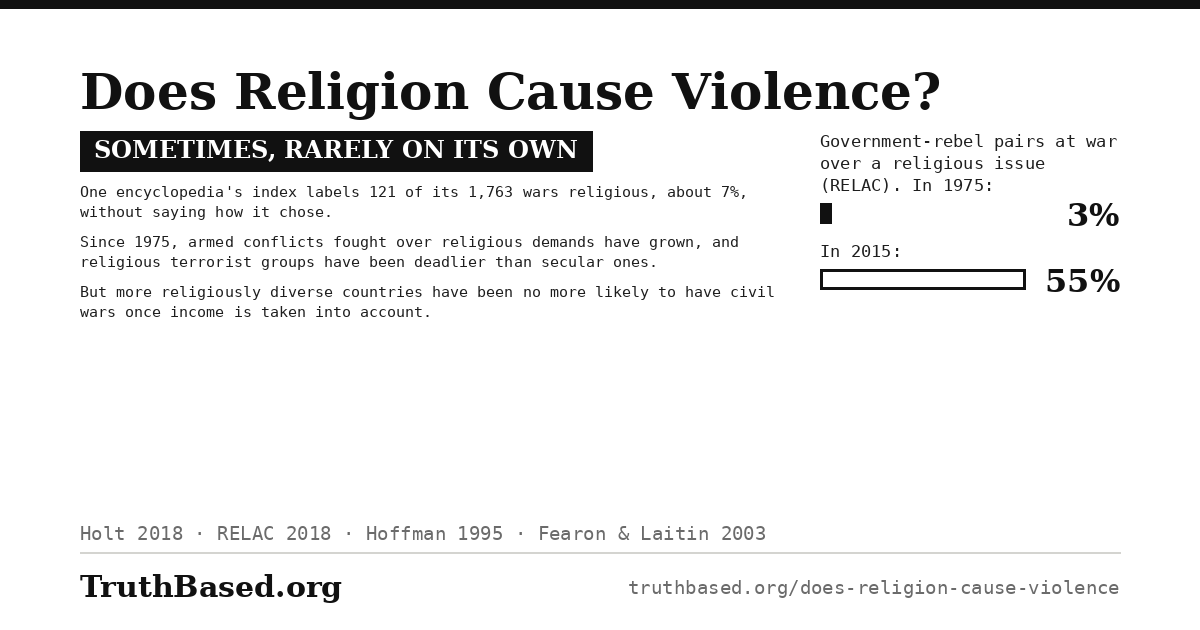
The verdict above as one image, with the two numbers that frame it: the share of government-rebel pairs in armed conflict fought over a religious issue, 3% in 1975 and 55% in 2015. It is 1,200 by 630 pixels, the size social networks use for link previews, and anyone may download it and post it.
What would change this conclusion
This article concludes that: (1) the count behind “only about 7% of wars were religious” is one encyclopedia’s index, chosen on no stated criteria; (2) since 1975 the share of government-rebel pairs at war over a religious issue has grown, from 3% to 55% in 2015, though a religious demand is not proof of a religious cause; (3) religious terrorist groups have been deadlier than secular ones; (4) more religiously diverse countries have been no more likely to have civil wars once income is taken into account; (5) historians’ counts of executions by the Spanish Inquisition and in the witch trials are far below the popular totals.
These conclusions would be falsified by:
• A coding of religious motivation across all wars, with agreement between its coders tested, that finds a much larger share fought over religion
• A recount of government-rebel pairs since 1975 that finds no rise in the share fought over religious issues
• A study holding a terrorist group’s size, territory and ties constant that finds religious groups no deadlier than others
• Cross-country studies with better measures of religious division that find it predicts civil war once income and exclusion from power are accounted for
• Counts of the Spanish Inquisition’s or the witch trials’ executions an order of magnitude above the historians’ estimates
Sources
Andrew Holt — “Counting ‘Religious Wars’ in the Encyclopedia of Wars”, apholt.com, 26 December 2018: the 121 entries under “religious wars” in the index of Charles Phillips and Alan Axelrod’s Encyclopedia of Wars (Facts on File, 2005), which catalogs 1,763 wars, and the absence of any stated criteria. apholt.com
Scott Atran — “God and the Ivory Tower”, Foreign Policy, 6 August 2012, for the audit by Greg Austin, Todd Kranock and Thom Oommen, God and War: An Audit & An Exploration (University of Bradford, for the BBC, 2003). foreignpolicy.com
Isak Svensson and Desirée Nilsson — “Disputes over the Divine: Introducing the Religion and Armed Conflict (RELAC) Data, 1975 to 2015”, Journal of Conflict Resolution 62(5): 1127–1148 (2018), 420 government-rebel pairs; and the authors’ summary on Political Violence at a Glance, 23 May 2018. journals.sagepub.com politicalviolenceataglance.org
Monica Duffy Toft — “Religion, Civil War, and International Order”, BCSIA Discussion Paper 2006-03, Belfer Center for Science and International Affairs, Harvard University, July 2006, for religious civil wars’ share by decade, duration and recurrence; and “Getting Religion? The Puzzling Case of Islam and Civil War”, International Security 31(4): 97–131 (2007), for their deadliness. belfercenter.org (2006) belfercenter.org (2007)
Isak Svensson — “Fighting with Faith: Religion and Conflict Resolution in Civil Wars”, Journal of Conflict Resolution 51(6): 930–949 (2007), for negotiated settlements, 1989 to 2003. journals.sagepub.com
Matthias Basedau — The Rise of Religious Armed Conflicts in Sub-Saharan Africa: No Simple Answers, GIGA Focus Africa 4, August 2017, for sub-Saharan Africa’s armed conflicts in mid-2017. d-nb.info
William T. Cavanaugh — The Myth of Religious Violence: Secular Ideology and the Roots of Modern Conflict (Oxford University Press, 2009), his argument as his publisher describes it. global.oup.com
Europol — EU Terrorism Situation and Trend Report (TE-SAT) 2024 and 2025, on the years 2023 and 2024. TE-SAT 2024 summary TE-SAT 2025 summary
Bruce Hoffman — “Old Madness, New Methods”, RAND Review 22(2), winter 1998–99, pp. 12–17, for the RAND-St Andrews counts; and “Holy Terror”, Studies in Conflict and Terrorism 18(4): 271–284 (1995), whose abstract calls religiously motivated groups far more lethal than their secular counterparts. rand.org doi.org
Victor Asal and R. Karl Rethemeyer — “The Nature of the Beast: Organizational Structures and the Lethality of Terrorist Attacks”, Journal of Politics 70(2): 437–449 (2008), for what predicts how many a terrorist organisation kills. start.umd.edu
Ido Levy — “Lethal Beliefs: Ideology and the Lethality of Terrorist Organizations”, Terrorism and Political Violence 35(4): 811–827 (2023), for jihadist groups’ deaths per attack. ideas.repec.org
James A. Piazza — “Is Islamist Terrorism More Dangerous?: An Empirical Study of Group Ideology, Organization, and Goal Structure”, Terrorism and Political Violence 21(1): 62–88 (2009), for casualty rates among Islamist groups. pure.psu.edu
Fondation pour l’innovation politique — Islamist Terrorist Attacks in the World 1979–2024 (October 2024): 66,872 attacks and at least 249,941 deaths to 12 April 2024, 86.3% and 88.9% of them in its list of Muslim countries. fondapol.org
Anthony H. Cordesman — Islam and the Patterns in Terrorism and Violent Extremism, CSIS, 17 October 2017, for where extremist violence occurs and whom it kills. csis.org
CAIN, Ulster University — the Sutton Index of Deaths, 14 July 1969 to 31 December 2001: 3,532 deaths, by the organisation responsible. cain.ulst.ac.uk
Gladys Ganiel and Paul Dixon — “Religion, Pragmatic Fundamentalism and the Transformation of the Northern Ireland Conflict”, Journal of Peace Research 45(3): 419–436 (2008), on how scholars read religion’s part in the Northern Ireland conflict. ideas.repec.org
Joseph Ruane — “Long conflict and how it ends: Protestants and Catholics in Europe and Ireland”, Irish Political Studies 36(1): 109–131 (2021), on Ireland’s Catholic-Protestant conflict. cora.ucc.ie
Michael Spagat — “The violent death toll from the Iraq War: 2003–2023”, PLOS ONE 19(2): e0297895 (2024), and its correction of 3 July 2024, which puts the total at roughly 300,000. the paper the correction
Iraq Body Count — the database of documented civilian deaths, for its totals for 2006 and 2007. iraqbodycount.org
U.S. Department of Defense — Measuring Stability and Security in Iraq, June 2008, for the height of sectarian violence. globalsecurity.org
Fawaz Gerges — ISIS: A History (Princeton University Press, 2016), quoted from Malise Ruthven’s review of it, “How to Understand ISIS”, New York Review of Books, 23 June 2016. nybooks.com
Médecins Sans Frontières — press release of 12 December 2017 on its mortality surveys among Rohingya refugees. msf.org
UN Human Rights Council — report of the Independent International Fact-Finding Mission on Myanmar, A/HRC/39/64, 12 September 2018, for the Rohingya’s flight and the mission’s findings. documents.un.org
U.S. Department of State — Secretary Antony J. Blinken’s remarks on the genocide and crimes against humanity in Burma, United States Holocaust Memorial Museum, 21 March 2022. state.gov
Ashutosh Varshney and Steven Wilkinson — their dataset of Hindu-Muslim violence in India, 1950–1995, ICPSR 4342; Varshney, Ethnic Conflict and Civic Life (Yale University Press, 2002); and his essay “Ethnic Conflict in Urban Asia”, Items (Social Science Research Council), 24 June 2014, for the eight cities’ shares. icpsr.umich.edu items.ssrc.org
Steven Wilkinson — Votes and Violence (Cambridge University Press, 2004), for why state governments stop riots or do not. cambridge.org
Jeffrey Seul — “‘Ours is the Way of God’: Religion, Identity, and Intergroup Conflict”, Journal of Peace Research 36(5): 553–569 (1999), on religion, identity and group conflict. ideas.repec.org
Frances Stewart (ed.) — Horizontal Inequalities and Conflict: Understanding Group Violence in Multiethnic Societies (Palgrave Macmillan, 2008), for inequalities between groups as a cause of conflict. springer.com
Andrew Holt — “Death Estimates for the Crusades”, apholt.com, 30 January 2019, for the published totals and historians’ view of them. apholt.com
Thomas F. Madden — “Rivers of Blood: An Analysis of One Aspect of the Crusader Conquest of Jerusalem in 1099”, Revista Chilena de Estudios Medievales 1 (2012): 25–37, for the dead of 1099 in the al-Aqsa Mosque. dialnet.unirioja.es
David A. Plaisted — “Estimates of the Number Killed by the Papacy in the Middle Ages and Later” (self-published, 2006), for the polemical totals. archive.org
Tomasz Karlikowski — “Spanish Inquisition: number of victims”, Ereticopedia (Edizioni CLORI), for his own count and for those of Jaime Contreras and Gustav Henningsen (1540–1700: 44,674 trials, 826 executions in person), William Monter, Henry Kamen and Andrea Del Col. ereticopedia.org
Henry Kamen — The Spanish Inquisition: A Historical Revision, 4th ed. (Yale University Press, 2014), p. 253, as The Cripplegate quotes it and Karlikowski reports it. thecripplegate.com
Associated Press — “Vatican Looks Back At Inquisition”, CBS News, 15 June 2004, for Agostino Borromeo’s figures, with UPI’s report of 16 June 2004; the witch-trial figure as Zenit reported it the same day. cbsnews.com upi.com zenit.org
Matilda Joslyn Gage — Woman, Church and State (1893), p. 247; and Wolfgang Behringer, “Neun Millionen Hexen: Entstehung, Tradition und Kritik eines populären Mythos”, Geschichte in Wissenschaft und Unterricht 49 (1998): 664–685, on Gottfried Christian Voigt’s extrapolation of 1784. archive.org historicum.net (archived)
Brian P. Levack — The Witch-Hunt in Early Modern Europe, 3rd ed. (Pearson Longman, 2006) and 4th ed. (Routledge, 2016): about 45,000 executions from some 90,000 prosecutions, as Kerice Doten-Snitker and colleagues give his estimate in Theory and Society 53 (2024), and 45,000 as Michael D. Bailey’s review of the third edition gives it (Magic, Ritual, and Witchcraft 2(1), 2007). link.springer.com lib.iastate.edu
Ronald Hutton — “Witch-Hunting in European and World History”, Gresham College lecture, 5 June 2024, whose transcript gives 40,000 to 60,000 executions, probably in the lower half. gresham.ac.uk
Community of Sant’Egidio — its account of the Rome accord of 1992, whose text names the four mediators; with the Mail & Guardian of 7 August 2019 and PA-X’s record on the later accords. santegidio.org the 1992 agreement mg.co.za peaceagreements.org
Father Alec Reid — John Manley, “Hume-Adams talks laid the foundations of the peace process”, The Irish News, 4 August 2020; and RTÉ News, 22 November 2013. irishnews.com rte.ie
Jeremy Ginges, Ian Hansen and Ara Norenzayan — “Religion and Support for Suicide Attacks”, Psychological Science 20(2): 224–230 (2009), for its four studies; their reply, “Religious Belief, Coalitional Commitment, and Support for Suicide Attacks”, Evolutionary Psychology 8(3): 346–349 (2010), for the prayer reminder; and Hansen’s account of the fourth study’s measure, Behavioral and Brain Sciences 41: e204 (2018). psychologicalscience.org ncbi.nlm.nih.gov york.cuny.edu
Jeremy Ginges, Hammad Sheikh, Scott Atran and Nichole Argo — “Thinking from God’s perspective decreases biased valuation of the life of a nonbeliever”, PNAS 113(2): 316–319 (2016), for the dilemma put to Palestinian adolescents, with Carnegie Mellon’s release on it. ncbi.nlm.nih.gov cmu.edu
International Committee of the Red Cross — “Cyber Operations during Armed Conflict: The Principle of Distinction”, citing Additional Protocol I (1977), Articles 48, 51 and 52; with the Practical Guide to Humanitarian Law on proportionality; and Francisco de Vitoria’s lecture of 1539 on the law of war (De Jure Belli, sections 35 and 37), in John Pawley Bate’s translation (Carnegie Institution, 1917). icrc.org guide-humanitarian-law.org archive.org
Peter H. Wilson — The Thirty Years War: Europe’s Tragedy (Harvard University Press, 2009), as the California Literary Review’s review reports it. calitreview.com
Stephen Wheatcroft — “The Scale and Nature of German and Soviet Repression and Mass Killings, 1930–45”, Europe-Asia Studies 48(8): 1319–1353 (1996), pp. 1334 and 1348, for deliberate killings and deaths through neglect, as Wikipedia’s article on excess mortality under Stalin quotes them. doi.org wikipedia.org
Timothy Snyder — “Hitler vs. Stalin: Who Killed More?”, New York Review of Books, 10 March 2011, for Soviet deaths and their causes. timothysnyder.wordpress.com
The Great Leap Forward famine — the demographers’ estimates of Ashton, Hill, Piazza and Zeitz (Population and Development Review 10(4), 1984) and Judith Banister (China’s Changing Population, 1987), about 30 million, and the lower ones, from about 17 million, as Xin Meng, Nancy Qian and Pierre Yared sum them up (NBER Working Paper 16361, 2010) and a paper for the IUSSP by Mi Hong, Yang Mingxu and Jia Ning reports them; and Frank Dikötter’s Mao’s Great Famine (2010), as Jonathan Fenby’s review, carried by Gulf News, reported it. nber.org iussp.org gulfnews.com
Song Yongyi — “Chronology of Mass Killings during the Chinese Cultural Revolution (1966–1976)”, Sciences Po, Mass Violence and Resistance, 25 August 2011, with the estimates of John Fairbank and Ding Shu. sciencespo.fr
Ben Kiernan — Yale University’s Genocide Studies Program (about 1.7 million dead, 21% of the population); and The Pol Pot Regime (1996), for a 1975 population of about 7.89 million, as Bruce Sharp’s “Counting Hell” reports it; with Patrick Heuveline, “The Boundaries of Genocide”, Population Studies 69(2): 201–218 (2015). yale.edu mekong.net ncbi.nlm.nih.gov
Russian presidential commission — its finding on Orthodox priests shot in 1937, as Alexander Yakovlev lists it in his book Maelstrom of Memory and The Globe and Mail reported it, 9 March 2001. theglobeandmail.com
Tim O’Neill — “The Great Myths 10: Soviet Atheism”, History for Atheists, 31 January 2021, for the two arguments about Soviet atheism. historyforatheists.com
R.J. Rummel — Power Kills: Democracy as a Method of Nonviolence (Transaction, 1997), chapter 1, for killing by governments and their power. hawaii.edu
James D. Fearon and David D. Laitin — “Ethnicity, Insurgency, and Civil War”, American Political Science Review 97(1): 75–90 (2003), civil wars from 1945 to 1999. stanford.edu
Paul Collier and Anke Hoeffler — “Greed and Grievance in Civil War”, Oxford Economic Papers 56(4): 563–595 (2004), civil wars from 1960 to 1999. ora.ox.ac.uk
Lars-Erik Cederman, Andreas Wimmer and Brian Min — “Why Do Ethnic Groups Rebel? New Data and Analysis”, World Politics 62(1): 87–119 (2010), ethnic groups’ access to power from 1946 to 2005. doi.org
José G. Montalvo and Marta Reynal-Querol — “Ethnic Polarization, Potential Conflict, and Civil Wars”, American Economic Review 95(3): 796–816 (2005), civil wars from 1960 to 1999. upf.edu
Nils-Christian Bormann, Lars-Erik Cederman and Manuel Vogt — “Language, Religion, and Ethnic Civil War”, Journal of Conflict Resolution 61(4): 744–771 (2017), ethnic groups’ language and religious divides from 1946 to 2009; and their reply to Toft, “Getting Religion Wrong: A Response to Toft’s ‘Getting Religion Right’”, Journal of Conflict Resolution 70(9): 1728–1744 (2026). essex.ac.uk ucl.ac.uk
Monica Duffy Toft — “Getting Religion Right in Civil Wars”, Journal of Conflict Resolution 65(9): 1607–1634 (2021), for her newer data on religious civil wars. tufts.edu
Cite this article
TruthBased.org. “Does Religion Cause Violence?” Updated September 2026. https://www.truthbased.org/does-religion-cause-violence