Groups & Crime
Are LGB People More Likely to Be Victims of Crime?
What victimisation surveys in the US and Britain show.
Groups & Crime
Is It True That Trans Women Are More Likely to Be Sex Offenders?
Two versions of one infographic, traced to their sources.
Groups & Crime
Are Trans People Overrepresented as Mass Shooters?
The claim tested against three mass-shooting databases, each on its own definition.
Are LGB People More Likely to Be Sex Offenders?
The claim in circulation about lesbian, gay and bisexual (LGB) people is about gay men and children. Nobody has measured a rate for lesbian or bisexual women.
Jump to the verdict ↓
The short answer
No. Neither the United States nor England and Wales publishes a rate of sexual offending by sexual orientation. So no measured rate backs the claim, or the reply that the rates are equal. The popular figure, 10 to 20 times more likely than heterosexuals, came from Paul Cameron counting every same-sex molestation as a homosexual act. But most men who molest boys report no sexual interest in adult men. The strongest evidence for the claim does not measure gay men’s offending. Studies of men attracted to children describe those men, not gay men. In prisons in England and Wales in 2024 to 2025, gay, lesbian and bisexual prisoners started treatment programmes for sexual offending at three to four times their share of prisoners. But that rests on only 86 programme starts, and prisoners report their own orientation.
If you were sexually abused as a child, you can talk to someone free and in confidence. In the US, the National Sexual Assault Hotline is open at any hour: call 800-656-4673, chat at rainn.org/hotline or text HOPE to 64673. In the UK, adults can call the National Association for People Abused in Childhood on 0808 801 0331. The line is open Monday to Thursday 10am to 9pm and Friday 10am to 6pm.
No official rate
In the United States, the Federal Bureau of Investigation's National Incident-Based Reporting System records a known offender's age, sex, race and ethnicity, and not the offender's orientation. The Bureau of Justice Statistics' nine-year follow-up of released sex offenders describes them by sex, race, Hispanic origin and age. Under the federal standard for sex offender registries, a registry must hold 20 kinds of information, from DNA to internet identifiers; orientation is not one of them.
England and Wales are no different. The Ministry of Justice's statistics break defendants down by sex, age and ethnicity.
One official source there does record orientation. His Majesty's Prison and Probation Service (HMPPS) publishes, once a year, what prisoners in England and Wales say about their own orientation.
HMPPS Offender Equalities Report, self-reported orientation
England and Wales, Jan–Mar 2025, prisoners who declared
Heterosexual97% (72,174)
Gay or lesbian1.3% (994)
Bisexual1.4% (1,076)
Other0.3% (195)
Declaration rate85%
These figures cover the whole prison population and are not split by offence, so they cannot show whether men convicted of sexual offences against children differ from other prisoners.
HMPPS says the quality of these data is assumed to be low. Orientation is self-reported, it says, and likely to be under-reported and prone to bias towards heterosexuality.
The three studies both sides cite
Both sides of this argument quote small studies of convicted men, clinic charts and volunteers. Three of those studies, from 1978 to 1994, turn up on both sides.
Jenny, Roesler and Poyer, 1994A Denver team went through the charts of 352 children seen at the child sexual abuse clinic of a children's hospital. They noted whether the alleged offender was reported to be gay, lesbian or bisexual. In the 269 cases with an identified adult offender, two were identified as gay or lesbian. In 222 of those cases, the alleged offender was a heterosexual partner of a close relative of the child. The authors concluded that these children were unlikely to have been molested by identifiably gay or lesbian people.
That conclusion is a finding about what the charts recorded, since the researchers did not interview the offenders. Two cases are also too few for a precise figure. The authors put the likely share of cases with a recognizably homosexual adult as the abuser at 0 to 3.1%.
Groth and Birnbaum, 1978A random sample of 175 men convicted in Massachusetts of sexual assault against children was assessed for adult sexual orientation and the sex of their victims. All were examined from 1970 to 1975 at a state centre that evaluates whether sex offenders are dangerous. The authors reported that every man who had turned to children from adult relationships was heterosexual in adult orientation, whether his victims were boys or girls.
The psychologist Gregory Herek's account of the paper's counts splits the 92 men who had turned to children from adult relationships into 70 heterosexual and 22 bisexual. The 22 had sex with men on occasion but never preferred men to women. The remaining 83 of the 175 men were fixated on children.
No man was primarily attracted to adult men. The authors raised the possibility that the adult heterosexual male is a greater risk to children than the adult homosexual male.
How to read it: the 175 men in the Massachusetts study, by adult attraction; the bar for men primarily attracted to adult men is zero. Source: Groth and Birnbaum (1978), counts as reported by Gregory Herek.
| Adult attraction | Men |
|---|---|
| Fixated on children | 83 |
| Heterosexual in adult life | 70 |
| Bisexual in adult life | 22 |
| Primarily attracted to adult men | 0 |
Paul Cameron has argued that those who practise homosexual acts molest children more often. In 1985 he cited the paper, as Herek quotes him, as showing that 54% of its molestations were by bisexual or homosexual practitioners. Herek found the figure nowhere in the paper.
Freund, Watson and Rienzo, 1989At the Clarke Institute of Psychiatry in Toronto, researchers measured penile volume while men viewed nude figures of different ages and sexes. Men attracted to adult men, recruited through a gay bookstore, responded no more to boys than men attracted to adult women responded to girls. The groups were small (28 to 78 men), and arousal in a laboratory is not offending.
The authors, citing Cameron, still treated offenders against boys as a substantially larger share of homosexual men than offenders against girls are of heterosexual men. They suggested, as a speculation, that the development of pedophilia is more closely linked with homosexuality than with heterosexuality.
Download this conclusion: the three studies
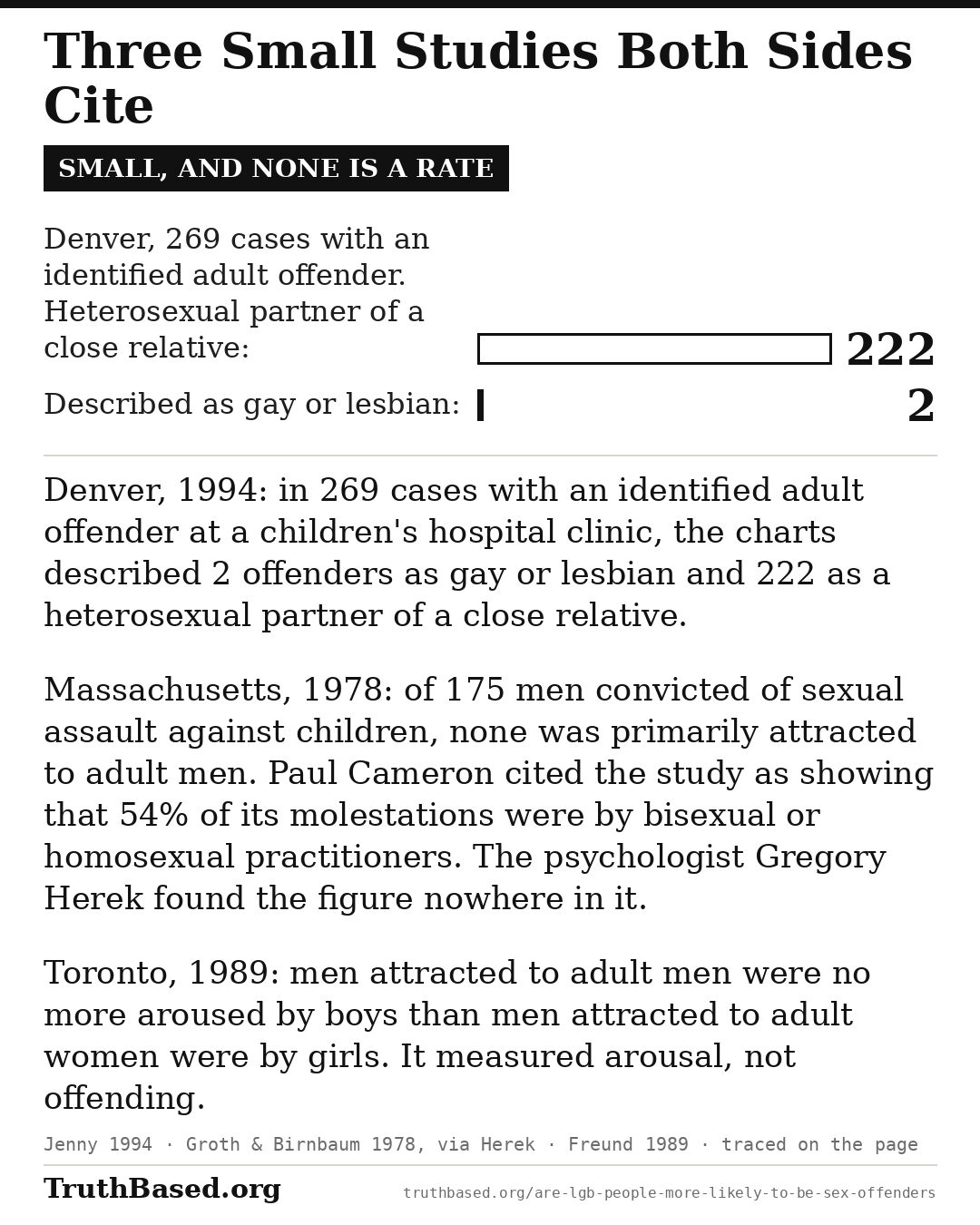
This section as one image: the three small studies both sides cite, what each found, and what none of them can tell you.
Two different things called homosexual
The argument turns on a word doing two jobs. Sex researchers describe a man's erotic interest by both the age and the sex of the people he is drawn to. A pedophile is a man whose erotic interest in children exceeds his interest in adults. Men drawn mainly to adult men are called androphilic, and men drawn mainly to adult women gynephilic.
A gay man, in ordinary speech, is androphilic. A homosexual pedophile, in the clinical literature, is a pedophile whose interest is in boys. The sex researcher James Cantor calls it "mere sophistry" to name the sex an offender is drawn to and not the age.
A National Research Council panel made the same point in 1993, in a passage the psychologist Gregory Herek quotes. Sorting child molesters into homosexual and heterosexual, it wrote, "relies on the premise that male molesters of male victims are homosexual in orientation". In the same passage, the panel wrote that most men who molest boys do not report sexual interest in adult men.
In laboratory tests of arousal, pedophiles distinguish less between females and males than men attracted to adults do. So, Cantor argues, pedophiles are likelier to abuse children of their less preferred sex than men attracted to adults are to have sex with adults of their less preferred sex. He argues, too, that the share of homosexuality among pedophiles "cannot be meaningfully compared" with the share among men attracted to adults.
The strongest case that gay men offend more
Paul Cameron's figures are set aside first, since the serious version of this argument is not his. His 1985 review concluded that people who practised homosexual acts were at least 12 times more apt to molest a child. After a correction for bisexuals, it concluded, the figure was probably at least 16 times.
Cameron counted same-sex molestations as homosexual acts and put them at a third or more of reported cases. He set that against an estimate that about 4% of people are bisexual or homosexual. That step is the premise the National Research Council panel described in 1993.
According to the psychologist Gregory Herek:
- the American Psychological Association dropped Cameron in 1983 for an ethics violation (Cameron says he had resigned first);
- the American Sociological Association condemned "his consistent misrepresentation of sociological research" in 1986;
- the federal judge in Baker v. Wade found in 1985 that he had "made misrepresentations to this Court".
These judgements bear on his numbers but do not settle the question.
The puzzle both sides agree onIn 2002 the sex researcher James Cantor put men who offend against boys at roughly 20 to 30% of all offenders against children. He put gay men at about 2 to 4% of men, the range he said nearly every large probability survey had found. Such a survey gives everyone in the population a known chance of being chosen. Cantor accepts that gap between the two figures.
Cantor gives three forensic series, from the Kinsey Institute, a Toronto clinic and Canada's federal corrections service. In those series, the share of offenders with a male victim comes to about a third.
Freund and Watson, 1992Kurt Freund and Robin Watson turned the gap into a number. Men who had offended only against a daughter or stepdaughter were no longer seen at their Toronto laboratory. So Freund and Watson added an imaginary 98 of them. That step gave 1.93 offenders against girls for each one against boys.
They then estimated from their laboratory's arousal test how many were true pedophiles. That estimate brought the ratio to 1.35 or 1.44 pedophiles preferring girls for each one preferring boys.
Abel and colleagues had found in 1987, Freund and Watson note, that men who offended against boys outside the family reported a mean of about 150 victims each. In the same study, men who offended against girls outside the family reported a mean of about 20. Assuming, tentatively, that the chance of being caught rises in step with the number of victims, Freund and Watson scaled the ratio up by that difference, to about 11:1.
They took the ratio among men attracted to adults to be about 20:1, so on this calculation pedophilia is proportionally more common where erotic development runs toward males. Their abstract says this "would not indicate that androphilic males have a greater propensity to offend against children".
The Australian Institute of Criminology reports Abel's medians as about 4.4 victims for offenders against boys and 1.3 for offenders against girls. It also reports that Abel's team said the medians better reflect the usual offender. With the medians, the same step gives about 5:1.
In 2000 Ray Blanchard and colleagues found homosexuality in 25% of the pedophiles they studied, and called that prevalence high.
Two more figures for the claimErickson, Walbek and Seely drew on the records of 229 convicted child molesters admitted to the Minnesota Security Hospital between 1975 and 1984, as Herek describes the study. Their 1988 paper is quoted as finding that 86% of offenders against males "described themselves as homosexual or bisexual"; Cantor reports it as 86% homosexual.
The 86% is not in the abstract, and it rests on what the men said about themselves; offenders, Cantor notes, are "highly motivated to claim any self-descriptor other than pedophile". As quoted, it pools two labels, so it cannot be assigned to gay men or to bisexual men.
In prisons in England and Wales in 2024 to 2025, gay and lesbian offenders made 5% of starts on accredited treatment programmes for sexual offending (44 starts). Bisexual offenders made 4% (42). Across all programme types, by contrast, each group made about 1% of starts. Among prisoners who declared an orientation from January to March 2025, 1.3% were gay or lesbian and 1.4% bisexual. So both groups appear on those programmes at three to four times their share of the prison population.
The counts are small, a start is not a conviction, orientation is self-declared, and His Majesty's Prison and Probation Service (HMPPS) assumes its orientation data are of low quality.
Download this conclusion: the strongest case that gay men offend more
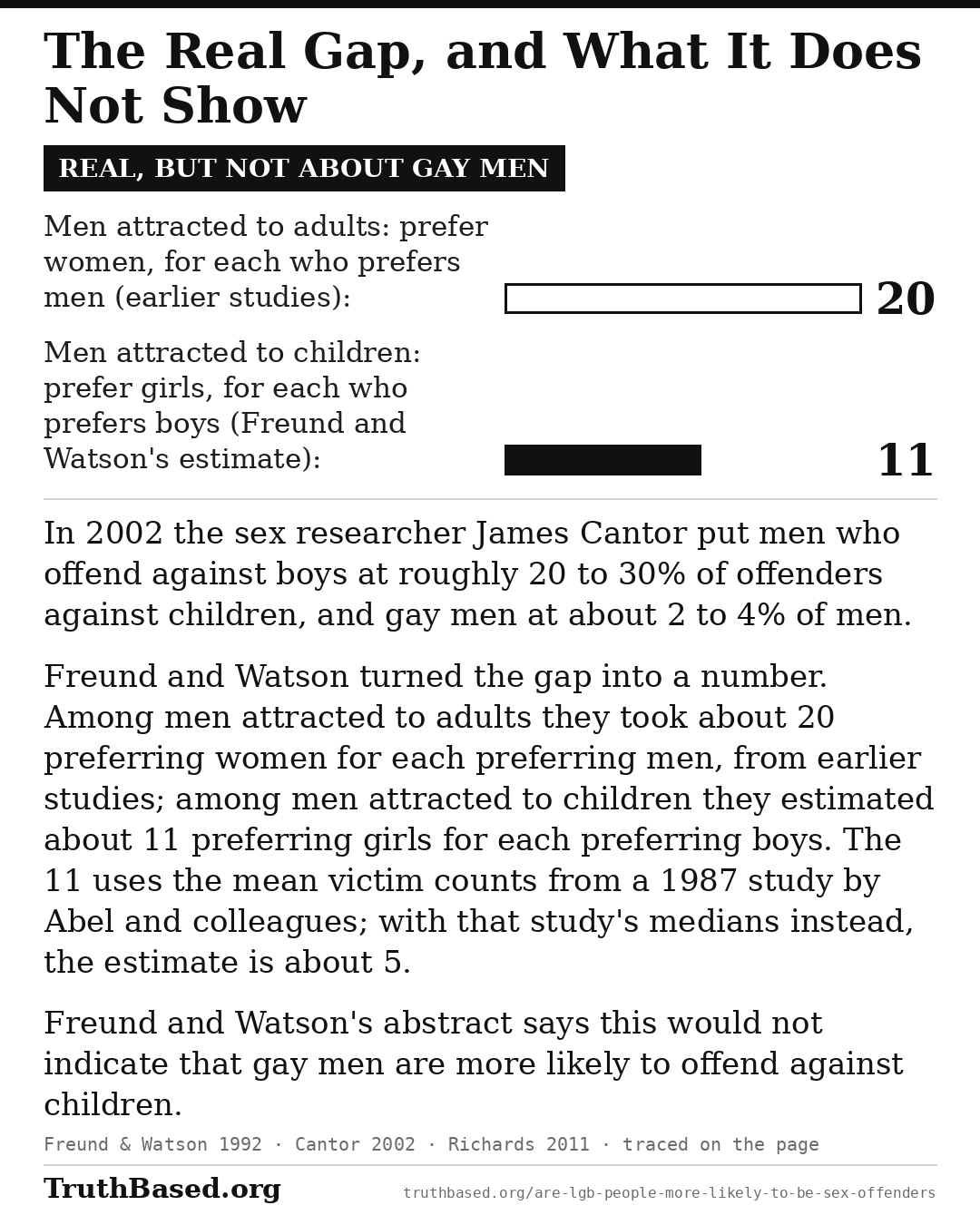
This section as one image: the gap between Cantor's two figures, the paper that turned it into a number, and what its authors said it does not show.
How to read it: men who prefer the female sex, for each one who prefers the male sex. The bar for men attracted to adults is a figure Freund and Watson took from earlier studies; the bar for men attracted to children is their estimate. Source: Freund and Watson, Journal of Sex & Marital Therapy 18 (1992).
| Men attracted to | Prefer the female sex, for each who prefers the male sex |
|---|---|
| Adults | About 20 |
| Children (Freund and Watson's estimate) | About 11 |
Why a caseload is not a rate
Each route into the data lets in different people.
| Route in | Who it lets in |
|---|---|
| Conviction | People caught, charged and convicted |
| Children's hospital | Abused children seen in one year, and those accused |
| Arousal laboratory | Men tested for arousal, some of them offenders |
| Security hospital files | Men admitted to one hospital, as staff recorded them |
| Prison records | Prisoners, by what they chose to declare |
| Registry survey | Registrants who chose to answer online |
As the psychologist Gregory Herek points out, none of this research comes from a probability sample, one that can be assumed to represent all abusers. Most comes from convicted men or men who sought treatment. Most people sexually abused as children told no one at the time, England and Wales's crime survey finds.
A population claim needs a defined population, a defined outcome, one orientation measure for offenders and everyone else, and a correction for how differently offenders get caught. No study here has all four.
Convictions in the data that would not be crimes now
Sex between consenting men was a crime in England and Wales until 1967 and in 13 American states until 2003.
The Supreme Court struck down Texas's version in Lawrence v. Texas in 2003, but earlier convictions stood. Mississippi, Idaho and South Carolina went on making people convicted of sodomy before 2003 register as sex offenders.
A federal judge wrote in 2018 that Mississippi's sodomy law could not be squared with Lawrence, yet some men were still listed in 2024, Mississippi Today reported. Idaho was ordered to take two men off its registry in 2021 and settled in 2022.
South Carolina agreed in a court order of 22 April 2022 to remove everyone registered solely for sodomy between consenting adults. The suit had been brought by a man convicted of buggery in 2001 for consensual sex with another man. It said at least 18 other people were registered for buggery or an out-of-state equivalent.
In England and Wales a 1967 Act allowed sex between two men only in private and from 21. At the time, a man and a woman could consent at 16. The men's age fell to 18 in 1994 and to 16 on 8 January 2001.
Lord Sharkey proposed pardons for men convicted under those laws. In 2016 he said that about 65,000 men had been convicted under them and 15,000 were still alive, as the BBC reported. The dead were pardoned automatically; a living man keeps his conviction unless he applies and it qualifies for deletion.
Long conviction series and registries therefore count some men for sex that is now legal, most heavily on the same-sex side, by an amount nobody has published. The nearest figure is a 2020 Williams Institute survey of 964 people on US registries, answered anonymously online. In it, 9% of lesbian, gay, bisexual, queer or transgender respondents said they had been charged with sodomy, against 3% of the rest. It is a survey of volunteers, not an audit of a registry.
What has never been measured
Nobody knows the orientation of abusers who are never caught. No published audit says how many registry entries rest on conduct legal today.
No study has measured whether lesbian or bisexual women offend at a different rate. Women do sexually abuse children; a 2019 review by Tozdan, Briken and Dekker says the taboo around it may leave it under-reported and hard to research.
Groth and Gary wrote in 1982 that there appeared to be "practically no reportage" of lesbian adults molesting girls, as the psychologist Gregory Herek quotes them. Of the 219 abused girls in the Denver study, the abuse of one was attributed to a lesbian, the American Psychological Association's 2000 Supreme Court brief reports. Two studies of registered women labelled some of them homosexual offenders from records that note the sex of victims, not the orientation of offenders.
An American Psychological Association official told the fact-checking site Lead Stories in 2023 that researchers do not consider gay or lesbian people likelier to abuse. The official pointed to the association's 2000 Supreme Court brief, which says gay adults do not present a heightened danger of sexual abuse. That position accurately describes an absence of evidence. No study has measured equal rates either.
The verdict: what the evidence shows
No. In the United States and in England and Wales, no official statistics give a rate of sexual offending by orientation. So there is no measured rate behind the claim, and none behind the reply that gay men offend at the same rate.
What circulates instead comes from small studies. Paul Cameron's multiplier, quoted as 10 to 20 times more likely than heterosexuals, counted every same-sex molestation as a homosexual act. Most men who molest boys, though, report no sexual interest in adult men, and in one sample of 175 convicted men none was primarily attracted to adult men.
Two findings lean toward the claim, but neither measures how often gay men offend. In 1992 Freund and Watson estimated that men attracted to children prefer boys more often, in proportion, than men attracted to adults prefer men. Their abstract says this does not show that gay men are more likely to offend. In England and Wales, gay, lesbian and bisexual prisoners start treatment programmes for sexual offending at three to four times their share of the prison population. But that rests on only 86 programme starts, and prisoners report their own orientation.
For lesbian and bisexual women, no rate has been measured at all.
Four common claims, against the evidence
Claim“Homosexuals are 10 to 20 times more likely than heterosexuals to molest children.”
Not supportedThe figure traces to Paul Cameron, who counted every same-sex molestation as a homosexual act. Most men who molest boys do not report sexual interest in adult men, a National Research Council panel noted in 1993.
Claim“86% of pedophiles described themselves as homosexual or bisexual.”
MisquotedThe sentence in Erickson, Walbek and Seely's 1988 paper, as quoted, is about offenders against boys only, and pools two labels the men gave themselves. Offenders, the sex researcher James Cantor notes, are motivated to claim any label but pedophile.
Claim“Homosexual males are three times more likely than straight men to engage in pedophilia.”
Not what the study saysIn 1992 Freund and Watson estimated about 11 men preferring girls for each preferring boys among men attracted to children. They set that against about 20 women-preferring men for each man-preferring man among men attracted to adults. The 11 uses the mean victim counts from a 1987 study by Abel and colleagues; with that study's medians instead, the estimate is about 5. Freund and Watson's abstract says this does not indicate that gay men are more likely to offend.
Claim“Ninety percent of child abuse is committed by heterosexual men.”
UnmeasuredNo official statistics give a rate of abuse by orientation, so nothing measures this either. The American Psychological Association's position that gay adults pose no heightened danger describes an absence of evidence, not a measured equality.
Download the conclusion
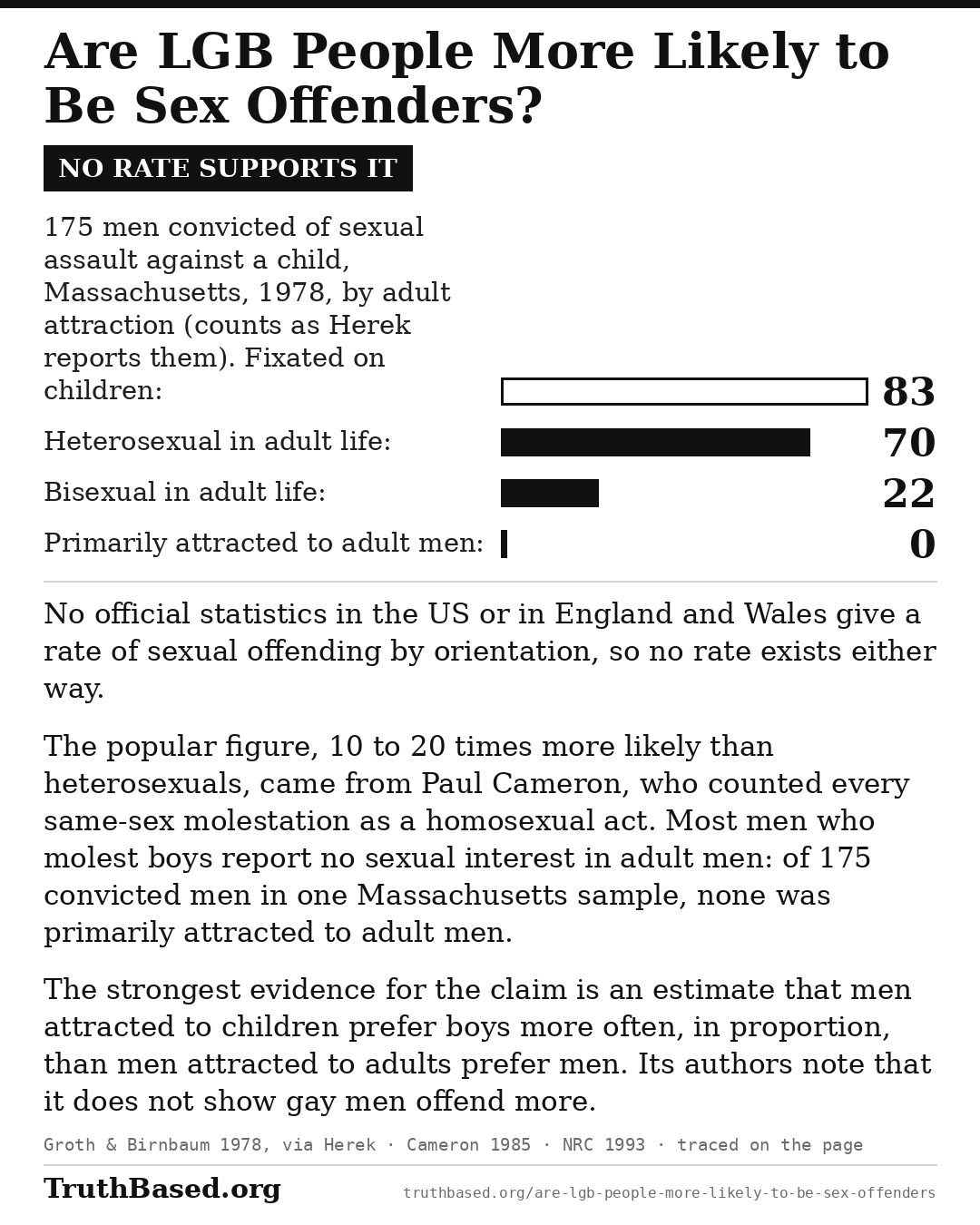
The verdict above as one image, with Groth and Birnbaum's 175 convicted men by adult attraction, the counts as Gregory Herek reports them. It is 1,080 by 1,350 pixels, sized for posting as an image, and anyone may download it and post it.
What would change this conclusion
This article concludes that: (1) no official statistics in the US or in England and Wales give a rate of sexual offending by orientation, so no rate exists either way. (2) The 10-to-20-times figure rests on reading the sex of a victim as the orientation of the offender. (3) The findings that lean toward the claim describe men attracted to children, or 86 prison programme starts by prisoners who reported their own orientation. Neither measures the offending rate of gay men.
These conclusions would be falsified by:
• Official records of offenders' orientation, set against the same question in a population survey and corrected for how differently offenders are caught. They would have to show a higher rate among gay, lesbian or bisexual people
• A study that assessed the adult attractions of men convicted of abusing boys and found most of them mainly attracted to adult men
• A replication of the 1989 arousal study, on a larger sample of men who are not offenders. It would have to find men attracted to adult men more aroused by boys than men attracted to adult women are by girls
Sources
Federal Bureau of Investigation — A Guide to Understanding NIBRS, which lists what an incident report records about offenders: age, sex, race and ethnicity. fbi.gov
Bureau of Justice Statistics — Alper, M. & Durose, M.R. (2019), Recidivism of Sex Offenders Released from State Prison: A 9-Year Follow-Up (2005-14), NCJ 251773, whose table 1 describes the released sex offenders by sex, race and Hispanic origin, and age. bjs.ojp.gov
US Department of Justice, SMART Office — Registry requirement FAQs: the 20 kinds of information a sex offender registry must hold under the Sex Offender Registration and Notification Act (SORNA). smart.ojp.gov
Ministry of Justice — Statistics on Ethnicity in the Criminal Justice System, 2024, whose chapter 7 breaks defendants and offenders down by ethnicity, sex and age. gov.uk
HM Prison and Probation Service — Offender Equalities Annual Report 2024-25, published 27 November 2025. Source for prisoners’ self-reported orientation (January to March 2025), the 85% declaration rate, the data-quality warning, and the starts on accredited sexual offending programmes in custody by orientation. gov.uk
Jenny, C., Roesler, T.A. & Poyer, K.L. (1994) — Are children at risk for sexual abuse by homosexuals? Pediatrics 94(1), 41–44. pubmed.ncbi.nlm.nih.gov
Groth, A.N. & Birnbaum, H.J. (1978) — Adult sexual orientation and attraction to underage persons. Archives of Sexual Behavior 7(3), 175–181. Its table I gives the counts of the 175 men, and its method says where they were examined. Reprinted, edited, as chapter XVI of Sexual Abuse of Children: Selected Readings (National Center on Child Abuse and Neglect, 1980) archive.org; abstract pubmed.ncbi.nlm.nih.gov
Herek, G.M. — Facts about homosexuality and child molestation (the site is no longer updated). Source for the counts of Groth and Birnbaum’s 175 men, Cameron’s 54% and its check, the National Research Council’s p. 143 sentences, the hospital and years of Erickson’s study and its 86% sentence, the Groth and Gary (1982) remark on lesbian adults, and the point that none of this research comes from a probability sample of abusers. lgbpsychology.org
Herek, G.M. — Fact sheet on Paul Cameron. Source for Cameron’s claim that he resigned from the American Psychological Association before it dropped him. lgbpsychology.org
American Psychological Association — Letter to Paul Cameron of 2 December 1983, dropping him from membership for lack of cooperation with its ethics committee, which it calls a violation of the Preamble to the Ethical Principles of Psychologists; as reproduced by Herek. lgbpsychology.org
American Sociological Association — Footnotes, January 1987, p. 4, “Council Acts on Cameron Case” (the Council’s action at its 1986 meeting in New York) asanet.org; and February 1987, p. 14, the Council’s motion, which “condemns his consistent misrepresentation of sociological research” asanet.org
Baker v. Wade, 106 F.R.D. 526 (N.D. Tex. 1985) — Supplemental opinion of 1 July 1985, which says Cameron “has himself made misrepresentations to this Court”. A copy at qrd.org qrd.org
Cameron, P. (1985) — Homosexual molestation of children/sexual interaction of teacher and pupil. Psychological Reports 57(3 Pt 2), 1227–1236. Included for its own figures, not as evidence. Author abstract on the publisher’s page. journals.sagepub.com
Freund, K., Watson, R. & Rienzo, D. (1989) — Heterosexuality, homosexuality, and erotic age preference. Journal of Sex Research 26(1), 107–117. Full text as hosted by a co-author; source for the Toronto laboratory comparison, its group sizes and the authors’ discussion. robinjwilson.com
Cantor, J.M. (2002) — Male homosexuality, science, and pedophilia. Newsletter of Division 44 of the American Psychological Association 18(3), 5–8. Source for the terms, the 20 to 30% and 2 to 4% figures, and the three series behind the share, as he reports them. jamescantor.org
Statistics Canada — Data Quality Guidelines (12-539), Sampling: in probability sampling, every unit of the survey population has a known and positive chance of being included. Source for what a probability survey is. statcan.gc.ca
National Research Council (1993) — Understanding Child Abuse and Neglect. National Academy Press. Chapter 4, p. 143, as quoted by Herek. nap.nationalacademies.org
Freund, K., Watson, R., Dickey, R. & Rienzo, D. (1991) — Erotic gender differentiation in pedophilia. Archives of Sexual Behavior 20(6), 555–566. Abstract; source for pedophilic men distinguishing less between females and males in arousal tests. experts.mcmaster.ca
Gebhard, P.H., Gagnon, J.H., Pomeroy, W.B. & Christenson, C.V. (1965) — Sex Offenders: An Analysis of Types. New York: Harper & Row, for the Institute for Sex Research. Used only as Cantor (2002) reports it.
Freund, K., Heasman, G., Racansky, I.G. & Glancy, G. (1984) — Pedophilia and heterosexuality vs homosexuality. Journal of Sex & Marital Therapy 10(3), 193–200. Its abstract gives the 457 offenders against children seen at the Clarke Institute; their split by the sex of the victims is used as Cantor (2002) reports it. pubmed.ncbi.nlm.nih.gov
Motiuk, L.L. & Porporino, F.J. (1993) — An examination of sex offender case histories in federal corrections. Correctional Service Canada, R-30. One of the three series behind the share of offenders with a male victim, as Cantor (2002) reports it. publications.gc.ca
Freund, K. & Watson, R. (1992) — The proportions of heterosexual and homosexual pedophiles among sex offenders against children: an exploratory study. Journal of Sex & Marital Therapy 18(1), 34–43. Full text as hosted by a co-author; source for the steps from 1.93 to about 11 to 1, the 20 to 1 among men attracted to adults, Abel’s means as they applied them, and the caveat in the abstract. robinjwilson.com
Abel, G.G., Becker, J.V., Mittelman, M., Cunningham-Rathner, J., Rouleau, J.L. & Murphy, W.D. (1987) — Self-reported sex crimes of nonincarcerated paraphiliacs. Journal of Interpersonal Violence 2(1), 3–25. Source of the mean victim counts (19.8 and 150.2) that Freund and Watson used, and of the medians (1.3 and 4.4), cited here as reported by Richards (2011).
Richards, K. (2011) — Misperceptions about child sex offenders. Trends & Issues in Crime and Criminal Justice no. 429, Australian Institute of Criminology. Source for Abel’s medians and his team’s remark that they better reflect the usual offender. aic.gov.au; a copy in QUT ePrints eprints.qut.edu.au
Blanchard, R., Barbaree, H.E., Bogaert, A.F., Dickey, R., Klassen, P., Kuban, M.E. & Zucker, K.J. (2000) — Fraternal birth order and sexual orientation in pedophiles. Archives of Sexual Behavior 29(5), 463–478. Source for the 25% and the authors calling it high. link.springer.com
Erickson, W.D., Walbek, N.H. & Seely, R.K. (1988) — Behavior patterns of child molesters. Archives of Sexual Behavior 17(1), 77–86. The hospital and years, and the 86% (p. 83), are as Herek reports them; Cantor (2002) reports the 86% too; neither is in the abstract. Abstract via PubMed. pubmed.ncbi.nlm.nih.gov
Office for National Statistics — Child sexual abuse in England and Wales: year ending March 2019. Source for most victims telling no one at the time. ons.gov.uk
Lawrence v. Texas, 539 U.S. 558 (2003) — law.cornell.edu; and the registry cases that followed it: Doe v. Hood (S.D. Miss., order of 1 October 2018) ccrjustice.org; Doe v. Wasden (D. Idaho, injunction of 8 September 2021, settled November 2022) acluidaho.org; Doe v. Wilson (D.S.C., order of 22 April 2022) aclusc.org, and its complaint aclusc.org. That some Mississippi men were still listed in 2024 is from Mississippi Today, 25 June 2024 mississippitoday.org, as the Meridian Star republished it on 26 June 2024 meridianstar.com.
Legislation, England and Wales — Sexual Offences Act 1967, s.1 legislation.gov.uk; Criminal Justice and Public Order Act 1994, s.145 legislation.gov.uk; Sexual Offences (Amendment) Act 2000, s.1, in force 8 January 2001 legislation.gov.uk; Sexual Offences Act 1956, s.6, for the age of 16 for a man and a woman legislation.gov.uk.
Pardons and disregards — the Protection of Freedoms Act 2012 (the disregard) and the Policing and Crime Act 2017, sections 164, 165 and 167 (the pardons, and that a pardon does not affect a conviction) legislation.gov.uk; the Home Office’s conditions for a disregard gov.uk. Lord Sharkey’s estimate as the BBC reported it on 20 October 2016 bbc.com, and PBS NewsHour’s report of it pbs.org
Meyer, I.H., Bouton, L., Maszak-Prato, S., Stemple, L. & Lave, T.R. (2022) — LGBTQ People on Sex Offender Registries in the US. Williams Institute, UCLA School of Law. Anonymous online survey of 964 registrants, March to November 2020; 9% of LGBTQ respondents and 3% of the rest reported a sodomy charge. williamsinstitute.law.ucla.edu
Tozdan, S., Briken, P. & Dekker, A. (2019) — Uncovering female child sexual offenders: needs and challenges for practice and research. Journal of Clinical Medicine 8(3), 401. Source for the taboo and the under-reporting. pmc.ncbi.nlm.nih.gov
Groth, A.N. & Gary, T.S. (1982) — Heterosexuality, homosexuality, and pedophilia: sexual offenses against children and adult sexual orientation. A book chapter, p. 147, as quoted by Herek.
Vandiver, D.M. & Kercher, G. (2004) — Offender and victim characteristics of registered female sexual offenders in Texas: a proposed typology of female sexual offenders. Sexual Abuse 16(2), 121–137. All 471 registered adult women in Texas, typed from their own and their victims’ characteristics. Abstract via PubMed. pubmed.ncbi.nlm.nih.gov
Sandler, J.C. & Freeman, N.J. (2007) — Typology of female sex offenders: a test of Vandiver and Kercher. Sexual Abuse 19(2), 73–89. All 390 registered women in New York State. Abstract via PubMed pubmed.ncbi.nlm.nih.gov; its six types, one of them the homosexual child molester, as Hannah (2024) lists them in the abstract of a Nova Southeastern University dissertation nsuworks.nova.edu
American Psychological Association (2000) — Brief amicus curiae in Boy Scouts of America v. Dale, 530 U.S. 640, section II.B, “Gay adults do not present a heightened danger of sexual abuse”; also the source for the Denver study’s 219 abused girls and 50 abused boys, and the one case in each attributed to a lesbian or a gay man. apa.org
Lead Stories (March 2023) — Fact check: no evidence gays commit 45 percent of child sexual abuse. Source for the American Psychological Association’s 2023 statement and its quotation of the 2000 brief. leadstories.com
Help lines — the National Sexual Assault Hotline rainn.org; the support line of the National Association for People Abused in Childhood napac.org.uk. Source for each service’s number, hours and ways to reach it.
Cite this article
TruthBased.org. “Are LGB People More Likely to Be Sex Offenders?” Updated September 2026. https://www.truthbased.org/are-lgb-people-more-likely-to-be-sex-offenders