Health & Medicine
Is Ultra-Processed Food Bad for You?
Two feeding trials, the cohort studies of death and disease, and which kinds of ultra-processed food carry the clearest risk.
Science & Media Accuracy
Is Climate Change Real and Human-Caused?
The IPCC puts the warming since 1850–1900 at about 1.1 °C on four independent records, and the human share at all of it.
Vaccine Safety & Efficacy:
What the Data Actually Shows
Studies covering more than 23 million children across 138 studies, the evidence on autism, the real but rare adverse events, and each major claim tested against the evidence.
Jump to the verdict ↓
The short answer
Yes, on both counts. The autism link came from a paper that was fraudulent and retracted, and cohorts running to millions of children have found no association since.
The Evidence Base
Vaccine safety is one of the most studied topics in all of medicine, and one of the most politically contested. The evidence base is unusually deep: clinical trials enrolling tens of thousands, cohort studies tracking millions, and government surveillance systems that log every reported adverse event in real time. That depth makes it possible to answer the contested questions with unusual precision.
The MMR–autism link. Serious adverse event rates. The childhood vaccine schedule. COVID-19 vaccine safety. Each of these has a specific, traceable evidentiary record, and the strongest counterarguments on each have specific, traceable weaknesses.
The Autism Claim
The Wakefield Study (1998)
In February 1998, Andrew Wakefield published a case series in The Lancet describing 12 children with developmental regression after MMR vaccination. The paper had no control group, relied on parental recall, and used non-standard methods.
Subsequent investigations revealed fraud: at least 5 of the 12 children had documented developmental concerns before MMR; onset of symptoms was misreported; children were selectively referred through lawyers preparing vaccine lawsuits. Wakefield had also filed a patent for an alternative measles vaccine and had undisclosed financial conflicts.
Outcome
Ten of 12 co-authors retracted the interpretation in 2004. On 28 January 2010, after a 217-day inquiry, the UK General Medical Council’s Fitness to Practise Panel delivered its findings of fact, upholding more than thirty charges and finding that Wakefield had acted dishonestly and with “callous disregard” for the children. The Lancet retracted the paper in full on 2 February 2010. On 24 May 2010 the panel made its formal determination of serious professional misconduct and ordered his name erased from the medical register. The misconduct finding and the erasure both came in May; January was the findings of fact.
What the Largest Studies Found
Every major follow-up study has found no association between vaccines and autism. The Cochrane review of 138 studies and 23 million children covers every outcome of the MMR vaccines; its autism evidence comes from two of those studies, with 1.19 million children between them, which found diagnosed autism no more common in the vaccinated. The largest single cohorts are below.
| Study | Year | Sample Size | Finding |
|---|---|---|---|
| Madsen et al. (NEJM) | 2002 | 537,303 children | Adjusted RR 0.92 (95% CI 0.68–1.24). No increased autism risk. |
| Taylor et al. (Vaccine) meta-analysis | 2014 | 1,256,407 children | Pooled OR ≈1.0. No link between MMR, thimerosal, or mercury and autism. |
| Jain et al. (JAMA) | 2015 | 95,727 children | Adjusted RR 0.76–0.91. No link even in high-risk families with autistic siblings. |
| Hviid et al. (Ann Intern Med) | 2019 | 657,461 children | Adjusted HR 0.93 (95% CI 0.85–1.02). No link in any subgroup. |
| Cochrane Review (138 studies) | 2021 | 23,480,668 children | No evidence of increased autism or encephalitis. The same review did find a small increased risk of febrile seizure. |
What This Means
If MMR caused autism, you would expect vaccinated children to have higher autism rates than unvaccinated children. Instead, every large study finds rates that are identical or slightly lower in the vaccinated group. The hazard ratios (0.92–0.93) are consistent with no effect. The small variation below 1.0 is within normal statistical fluctuation.
Autism Prevalence: Why Diagnoses Rose
Autism diagnoses rose sharply from the 1990s onward, but this tracks with changes in diagnostic criteria and awareness, not vaccines:
CDC’s ADDM Network reports: prevalence went from about 1 in 150 (2000 surveillance) to 1 in 36 (2020) to 1 in 31 (2022). This nearly fivefold rise parallels DSM-IV (1994) broadening criteria to include Asperger’s and PDD-NOS, DSM-5 (2013) consolidating everything under “ASD,” universal screening recommendations (2007 AAP), and increased clinician/parent awareness. Research from California estimates that changes in diagnostic practices account for roughly 25–30% of the observed rise alone.
The Thimerosal Natural Experiment
Thimerosal (an ethylmercury-based preservative) was removed from most U.S. childhood vaccines by 2001. If thimerosal caused autism, rates should have dropped. Instead:
Thimerosal Removal vs. Autism Rates
Pre-removal (1995): 0.6 per 1,000 live births
Post-removal (2007): 4.1 per 1,000 live births
Trend direction: Continued rising, opposite of expected
Denmark and Sweden removed thimerosal in 1992; autism incidence kept rising there too, including among children born after removal (Madsen et al., Pediatrics 2003)
Post-removal (2007): 4.1 per 1,000 live births
Trend direction: Continued rising, opposite of expected
Denmark and Sweden removed thimerosal in 1992; autism incidence kept rising there too, including among children born after removal (Madsen et al., Pediatrics 2003)
The 1995 and 2007 figures come from Schechter and Grether, “Continuing Increases in Autism Reported to California’s Developmental Services System” (Archives of General Psychiatry, 2008;65(1):19–24), which found prevalence rising every quarter from January 1995 (0.6 per 1,000 live births) to March 2007 (4.1 per 1,000). Read these as California Department of Developmental Services caseload among children aged three to five, expressed per live births. They are not general autism prevalence and are not comparable with the CDC ADDM figures quoted earlier on this page, which are surveillance estimates at age eight and run an order of magnitude higher. What the table shows is the direction of travel after thimerosal was removed, not the level.
The IOM’s 2004 review evaluated over 200 studies and concluded the evidence “favors rejection” of a causal relationship between thimerosal and autism.
VAERS, V-safe & Safety Surveillance
VAERS: What It Actually Is
The Vaccine Adverse Event Reporting System (VAERS) is a passive surveillance system co-managed by CDC and FDA since 1990. It is an early-warning system designed to detect potential safety signals, not to prove causation. Key facts:
Anyone can submit a report: patients, parents, doctors, or manufacturers. Reports require no verification before entry. CDC states reports “do not mean the vaccine caused the event.”
Raw VAERS counts are not death or injury counts. They are unverified reports of events that happened after vaccination. A temporal relationship (A happened after B) is not evidence of causation. To illustrate: one VAERS report documented a girl falling into a well 49 days after an HPV vaccine, that was recorded as an HPV vaccine adverse event.
VAERS has no denominator. Without knowing how many people were vaccinated and the background rate of the event, raw numbers are meaningless. Knowingly filing a false VAERS report is a federal crime under 18 U.S. Code §1001.
How VAERS Is Actually Used
CDC/FDA analysts look for unusual patterns (safety signals), e.g., clusters of a rare syndrome after a new vaccine. When a signal is detected, they investigate with more rigorous systems like the Vaccine Safety Datalink (VSD). This is how signals like TTS after J&J and myocarditis after mRNA vaccines were detected and quantified.
V-safe: Active Surveillance
V-safe is CDC’s smartphone-based active surveillance system launched for COVID-19 vaccines. Unlike VAERS (passive), V-safe proactively contacts participants daily, then weekly for 6 weeks post-vaccination. Over 10 million people enrolled.
V-safe provides what VAERS cannot: denominator-based rates. Example from RSV vaccine surveillance (CDC, MMWR 73(21), covering 3 May 2023 to 14 April 2024): among 16,220 V-safe participants aged 60 and over who reported an RSV vaccination and completed at least one daily survey, 6,328 (39.0%) reported at least one symptom, but only 68 (0.4%) reported receiving medical care. VAERS received 3,200 reports for the same age group over the same period, of which 2,919 (91.2%) were non-serious. V-safe consistently shows >95% of reactions are mild/transient.
The Brighton Collaboration
The Brighton Collaboration (founded 2000) is a global network of vaccine-safety experts that develops standardized case definitions for adverse events. They have created more than 80 case definitions (anaphylaxis, GBS, myocarditis, TTS, and others) with levels of diagnostic certainty:
| Level | Description | Use |
|---|---|---|
| Level 1 | Highest diagnostic certainty | Most specific; gold standard |
| Level 2 | Probable | Intermediate specificity |
| Level 3 | Possible | Most sensitive (catches more) |
| Level 4 | Insufficient data | Cannot classify |
| Level 5 | Not a case | Ruled out |
Brighton definitions ensure consistent case identification across countries and systems, making global safety comparisons possible. They were central to COVID-19 safety monitoring.
The Childhood Vaccine Schedule
More Vaccines, Fewer Antigens
The number of recommended vaccines has grown since the 1980s. But the total antigenic load has dropped by 95%:
| Era | Diseases | Doses (by age 6) | Total Antigens |
|---|---|---|---|
| Mid-1980s | 7 (DTP, polio, MMR) | ~10–11 | ~3,200 (whole-cell DTP alone: ~3,000) |
| 2000 | 11 (+Hib, HepB, varicella, etc.) | ~20 | ~123–126 |
| 2024–25 | 16–18 | ~28 (by age 2); ~50–54 (by 18) | ~160–180 |
Modern acellular, recombinant, and conjugate vaccines are far more targeted. A child’s entire 2024 schedule has about 165 distinct antigens, versus about 3,200 from a single 1980s DTP shot. The shape of that decline is worth being precise about, because it is not a steady downward slope. Almost all of it happened at once, when whole-cell pertussis was replaced by the acellular version: Offit and colleagues counted 3,041 antigens in the 1980 schedule and 123 to 126 in the 2000 schedule, a fall of about 96%. The count has since risen modestly, to roughly 165, as vaccines against more diseases were added. So today’s children are exposed to somewhat more antigens than children in 2000, and to about 95% fewer than children in the 1980s. The “immune system overload” concern is not supported by the data.
Does the Schedule Cause Harm?
The Institute of Medicine (now National Academy of Medicine) conducted a comprehensive 2013 review and concluded it “uncovered no evidence of major safety concerns associated with adherence to the childhood immunization schedule.” No links to autoimmune diseases, developmental disorders, seizures, asthma, or hypersensitivity.
A VSD nested case-control study (193 cases, 751 controls) found that cumulative antigen exposure through 23 months showed no association with non-vaccine-targeted infections (matched OR 0.94 per 30-antigen increase; 95% CI 0.84–1.07).
Alternative/Delayed Schedules
No randomized trials have shown benefits of alternative schedules (the IOM deemed such trials unethical. They would expose children to preventable diseases). Observational data show that children on delayed schedules are less likely to be fully vaccinated on time and more exposed to vaccine-preventable diseases, with no decrease in adverse outcomes.
International Comparisons
Claims that some countries give “far fewer vaccines” are misleading. Japan, Scandinavia, and other developed nations vaccinate against similar diseases with similar coverage. Japan’s DTaP and measles coverage exceeds 90%. Countries with high vaccine uptake universally have the lowest rates of vaccine-preventable diseases. No country on a “minimal” schedule has demonstrably better health outcomes.
COVID-19 Vaccines
Original Trial Efficacy
| Vaccine | Trial Size | Efficacy | Cases: Vaccine vs. Placebo |
|---|---|---|---|
| Pfizer-BioNTech | 43,548 | 95.0% (CI 90.3–97.6) | 8 vs. 162 |
| Moderna | 30,420 | 94.1% (CI 89.3–96.8) | 11 vs. 185 |
Extended 6-month follow-up of Pfizer (46,307 participants) showed 91.3% efficacy (CI 89.0–93.2) against symptomatic COVID, with 850 cases in placebo vs. 77 in vaccine. 100% efficacy against severe disease by CDC definition.
Variants and Waning
Efficacy dropped as the virus evolved. During Omicron, 2-dose effectiveness against infection fell below 50% without a booster. Protection against severe disease and hospitalization remained substantially higher, 70–90% with boosters, even against later variants.
Real-World Effectiveness
Israel’s nationwide study matched ~596,000 vaccinees to unvaccinated controls: 94% effective against symptomatic COVID, 87% against hospitalization, 92% against severe disease. Similar results confirmed across the US, UK, Qatar, and Europe.
Myocarditis: Vaccine vs. Infection
Key Data Point
A 2022 meta-analysis (Voleti et al., 22 studies, 55.5 million vaccinated people, 2.5 million infected) found the relative risk of myocarditis was 2.0 after vaccination against 15.0 after COVID infection, more than seven times higher with infection. Of the myocarditis cases in both groups, about 1% were hospitalised and 0.015% died. Risk is concentrated in males under 40 after dose 2.
Israeli data (5.44M Pfizer recipients): excess risk in males 16–19 was 13.73 per 100,000 (~1 in 7,300) after dose 2, with ~95% classified as mild and one death. By comparison, infection-associated myocarditis in the same age group runs 50–65 per 100,000.
Where this comparison does not hold
The chart above shows infection carrying the higher myocarditis risk in every group, and across whole populations that is what the evidence shows. It is not true in every subgroup, and an article that left it there would be overstating its case.
The English national study of nearly 43 million people (Patone et al., Circulation, 2022) found vaccine-associated myocarditis risk lower than post-infection risk after every dose of every vaccine studied, with one exception: a second dose of Moderna. In men under 40 that dose was associated with about 97 extra myocarditis cases per million, above the post-infection figure for that group. A review by the American College of Cardiology reached a similar conclusion for adolescent males specifically, where vaccine-associated myocarditis rates of up to roughly 107 per million exceed the post-infection rate in that narrow band.
Two things follow. Product and dose matter, which is why several countries restricted Moderna in younger males rather than mRNA vaccines generally, and why dosing-interval changes were adopted to reduce the risk. And the population-level conclusion survives the exception: the same English study found that for the overall population, hospital admission or death from myocarditis remained more likely after infection than after vaccination. A reader who encounters the Moderna finding elsewhere should find it here first.
Download this conclusion: myocarditis
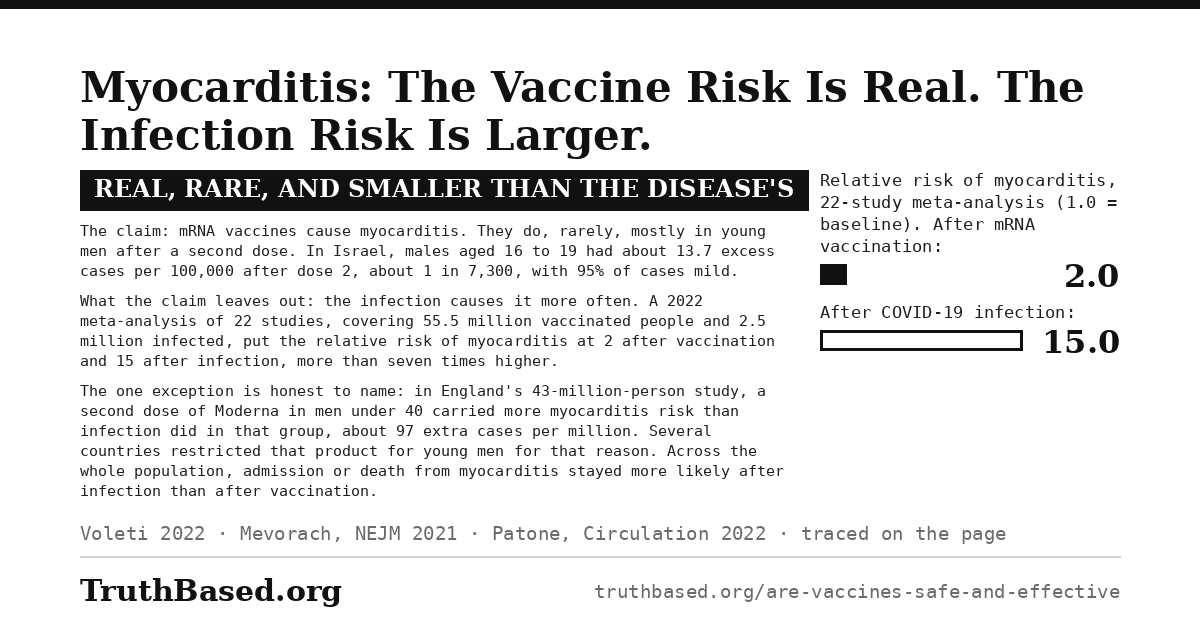
This section as one image: the vaccine risk, the infection risk, and the one exception.
Blood Clots (J&J / AstraZeneca)
Thrombosis with thrombocytopenia syndrome (TTS) was detected after adenovirus-vector vaccines:
| Exposure | Clot Risk | Context |
|---|---|---|
| J&J vaccine | ~3 per million overall; ~10/million in women 30–49 | 60 confirmed cases in 18M+ doses |
| AstraZeneca | ~1 per 100,000–250,000 | Led to age restrictions in several countries |
| Oral contraceptives | 5–12 per 10,000 women/year | 500–1,200 per million — far higher than TTS |
| COVID-19 infection | ~31% of ICU patients had thromboses | Infection clot risk exceeds vaccine risk by orders of magnitude |
Long-Term Safety (3+ Years)
Over 3+ years and billions of doses, no unexpected long-term harms have emerged. The VSD, VAERS, and V-safe systems continue monitoring. The largest long-term study, a French national cohort of 22.7 million vaccinated and 5.9 million unvaccinated adults aged 18 to 59 followed for a median of 45 months (Semenzato et al., JAMA Network Open, December 2025), found no excess all-cause mortality among the vaccinated: 25% lower after adjustment for 41 conditions, with a 74% lower risk of death from COVID-19. No confirmed links to cancer, fertility issues, or excess non-COVID deaths have been found.
Steelmanning Both Sides
The Evidence-Based Case FOR Vaccines
Disease prevention: CDC modelling estimates that routine childhood vaccination of the children born from 1994 to 2023 will have prevented about 1.1 million deaths and 32 million hospitalizations (Zhou et al., MMWR, August 2024). Measles vaccination alone is estimated to have saved about 94 million lives worldwide since 1974 (Shattock et al., The Lancet, 2024).
Antigen reduction: 95% fewer antigens despite 2–3x more diseases prevented. IOM 2013 + VSD cohorts: no causal links to chronic conditions.
Autism studies: Over 2 million children studied. Zero signal. The Danish 657K and U.S. 95K studies show no link even in the highest-risk families.
Net benefit math: Myocarditis from mRNA vaccination is 7x less common than from COVID infection. GBS from flu vaccine: ~1–3 per million doses vs. ~17 GBS admissions per million flu infections.
Self-correcting system: When problems arise, they’re detected. RotaShield was withdrawn for intussusception risk. Pandemrix was pulled for narcolepsy. J&J was deprioritized for TTS. The system works.
The Evidence-Based Case FOR Skepticism (Non-Conspiracy)
Real adverse events exist. Influenza vaccines: GBS ~1–3 extra cases per million doses. Pandemrix (2009 H1N1): narcolepsy in ~1 in 18,000 children in Finland/Sweden (HLA-linked, led to withdrawal). mRNA vaccines: myocarditis in young males (~13–70 per million in some datasets). J&J: TTS at ~3–10 per million. These are rare but real.
Surveillance limitations. VAERS is passive and subject to both under-reporting and media-driven over-reporting. Active systems like VSD cover millions but not everyone.
Regulatory structure questions. FDA receives ~45–65% of funding from industry user fees (post-1992). While independent bodies like IOM provide review, the structural concern is legitimate.
Communication missteps. Early COVID messaging sometimes framed vaccines as “risk-free” or implied sterilizing immunity. Walking these back eroded trust. Honest communication about rare risks builds more trust than minimizing them.
Individual risk varies. For specific subgroups (e.g., young males with prior myocarditis), risk-benefit may differ. ACIP already makes subgroup-specific recommendations.
Legitimate Scientific Debates (Not Fringe)
Reputable scientists disagree on: optimal dosing intervals for mRNA vaccines (longer intervals may reduce myocarditis risk); booster frequency for low-risk young adults; aluminum adjuvant cumulative exposure in preterm infants; how to best distinguish true signals from background noise in passive systems; and whether certain vaccines have beneficial or harmful non-specific effects beyond their target diseases.
None of these debates dispute the overall conclusion that vaccines’ benefits vastly outweigh risks. The disagreements are on fine points of scheduling, specific subgroups, and program priorities.
The verdict: what the evidence shows
Claims and evidence
Claim“Vaccines cause autism”
ContradictedThe 1998 paper was fraudulent and retracted. Cohorts of 657,461 and 537,303 children and a meta-analysis of 1.26 million find autism no more common in the vaccinated (hazard ratios 0.92 to 0.93, pooled about 1.0). Diagnoses kept rising after thimerosal was removed.
Claim“VAERS proves vaccines are killing people”
MisreadVAERS is an unverified report system with no denominator, designed to raise signals, not to count deaths. The signals it raised (TTS, myocarditis) were confirmed and quantified by active systems, which is the system working.
Claim“Too many vaccines overload a child’s immune system”
ContradictedThe schedule covers more diseases with about 95% fewer antigens than in the 1980s. The Institute of Medicine’s 2013 review found no evidence of major safety concerns with the schedule, and cumulative antigen exposure was unrelated to later infections in a VSD study.
Claim“mRNA vaccines cause myocarditis”
True, rarely, and smaller than the infection’sAbout 1 in 7,300 males aged 16 to 19 after dose 2, mostly mild. Relative risk 2.0 after vaccination against 15.0 after infection across 22 studies, with one product-and-dose exception in young men that several countries acted on.
Claim“Vaccines are risk-free”
ContradictedFebrile seizures after MMR (about 1 in 1,150 to 1 in 1,700 doses), TTS after adenovirus vaccines (a few per million), narcolepsy after Pandemrix, intussusception after RotaShield. Rare, real, and detected.
Download the conclusion
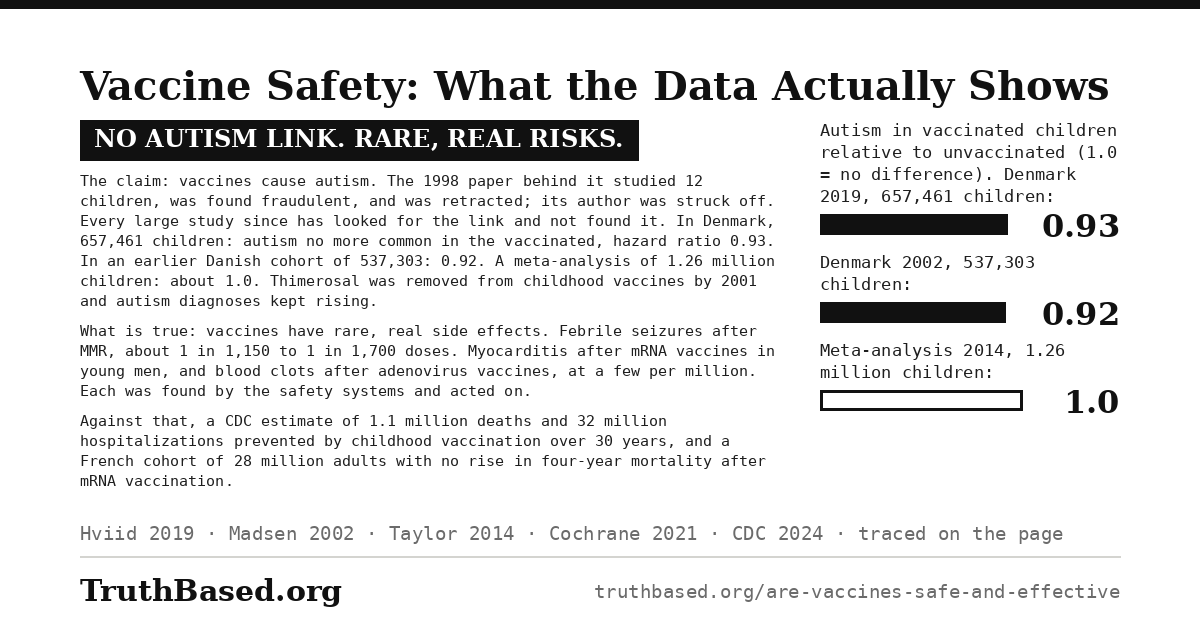
The verdict above as one image, with the three largest autism cohorts as its chart. It is 1,200 by 630 pixels, the size social networks use for link previews, and anyone may download it and post it.
What Would Change the Conclusion?
Science must be falsifiable. Here is exactly what evidence would prove vaccines do more harm than good:
Evidence That Would Overturn the Consensus
All-cause mortality excess. Large, well-controlled studies showing vaccinated groups have higher all-cause mortality or serious morbidity than comparable unvaccinated groups, not explained by confounders. Current data shows the opposite.
Consistent adverse-event excess. Replicated findings across multiple independent surveillance systems that serious adverse events exceed severe outcomes prevented by the vaccine.
Biological mechanism. A plausible, experimentally verified pathway by which vaccines cause the alleged harm, rather than a temporal association alone.
Risk calculation reversal. If the number needed to harm becomes lower than the number needed to prevent one case of disease.
What Readers Should Watch
VAERS with context: When you see VAERS numbers, ask: what’s the denominator? What’s the background rate? Have the reports been verified?
Active vs. passive data: V-safe and VSD data provide rates. VAERS provides signals. Treat them differently.
Brighton levels: Level 1 (definite) cases are more meaningful than unclassified reports.
Cochrane reviews and meta-analyses: These synthesize multiple studies and provide the most reliable estimates.
Ongoing surveillance: Watch VSD rapid-cycle analyses for new formulations; global excess-mortality trends; long-term (5–10 year) mRNA cohort follow-up; and any reversal in autism/VPD trends tied to schedule changes.
What would change this conclusion
A large cohort or linkage study, with vaccination status recorded prospectively rather than by recall, that finds a higher autism rate in vaccinated children after controlling for birth year and diagnostic criteria. For the safety findings: post-licensure surveillance showing adverse-event rates materially above those reported in the trials and in VSD, or a long-term cohort like the French one finding higher all-cause mortality among the vaccinated.
Sources
Patone M, et al. Risk of myocarditis after sequential doses of COVID-19 vaccine and SARS-CoV-2 infection by age and sex. Circulation, 2022. English national study of nearly 43 million people. Source for the finding that vaccine-associated myocarditis risk was lower than post-infection risk after every dose studied except a second dose of Moderna, which in men under 40 was associated with roughly 97 extra cases per million, and for the conclusion that admission or death from myocarditis remained more likely after infection across the overall population. newsroom.heart.org
American College of Cardiology — Vaccine-Associated Myocarditis Risk in Context (2022). Source for the finding that across the general population COVID-associated myocarditis exceeds vaccine-associated myocarditis, while vaccine-associated rates of up to about 107 per million exceed the post-infection rate for adolescent males specifically. acc.org
Offit PA, et al. (2002), as cited in IOM/National Academies, The Childhood Immunization Schedule and Safety (2013). Source for the antigen counts: 3,041 antigens in the 1980 schedule falling to 123–126 by 2000, a decline of about 96%, with the current schedule at roughly 165. nationalacademies.org
Di Pietrantonj C, et al. Vaccines for measles, mumps, rubella, and varicella in children. Cochrane Database of Systematic Reviews, 22 November 2021, CD004407.pub5. Source for the 138 studies and 23,480,668 participants, the absence of an association with autism or encephalitis, and the small increased risk of febrile seizure. cochranelibrary.com
Hviid A, et al. Measles, Mumps, Rubella Vaccination and Autism: A Nationwide Cohort Study. Annals of Internal Medicine, 2019. Source for the Danish cohort of 657,461 children and the fully adjusted autism hazard ratio of 0.93 (95% CI 0.85 to 1.02). acpjournals.org
Madsen KM, et al. A Population-Based Study of Measles, Mumps, and Rubella Vaccination and Autism. New England Journal of Medicine, 2002. Source for the 537,303-child Danish cohort and the adjusted relative risk of 0.92. nejm.org
Taylor LE, Swerdfeger AL, Eslick GD. Vaccines are not associated with autism: an evidence-based meta-analysis of case-control and cohort studies. Vaccine, 2014. Source for the pooled analysis of 1,256,407 children. sciencedirect.com
Jain A, et al. Autism Occurrence by MMR Vaccine Status Among US Children With Older Siblings With and Without Autism. JAMA, 2015. Source for the 95,727-child cohort. jamanetwork.com
The Lancet. Retraction: Ileal-lymphoid-nodular hyperplasia, non-specific colitis, and pervasive developmental disorder in children, February 2010. Source for the full retraction of the 1998 Wakefield paper. thelancet.com
Voleti N, et al. Myocarditis in SARS-CoV-2 infection vs. COVID-19 vaccination: a systematic review and meta-analysis. Frontiers in Cardiovascular Medicine, 2022. 22 studies, 55.5 million vaccinated and 2.5 million infected; relative risk 15 after infection against 2 after vaccination. frontiersin.org
Semenzato L, et al. COVID-19 mRNA Vaccination and 4-Year All-Cause Mortality Among Adults Aged 18 to 59 Years in France. JAMA Network Open, December 2025 (EPI-PHARE). 22.7 million vaccinated and 5.9 million unvaccinated, median 45 months: 74% lower risk of death from COVID-19, 25% lower all-cause mortality, no excess. epi-phare.fr
Zhou F, et al. Health and Economic Benefits of Routine Childhood Immunizations in the Era of the Vaccines for Children Program, United States, 1994–2023. MMWR, August 2024; and Shattock AJ, et al. Contribution of vaccination to improved survival and health: modelling 50 years of the Expanded Programme on Immunization. The Lancet, 2024. Sources for the 1.1 million deaths and 32 million hospitalizations, and the 94 million lives saved by measles vaccination.
CDC. Vaccine Adverse Event Reporting System (VAERS) and V-safe. Source for the description of passive versus active surveillance and the statutory penalty for knowingly filing a false report. vaers.hhs.gov
CDC. Autism and Developmental Disabilities Monitoring (ADDM) Network prevalence reports. Source for the autism prevalence series cited in the diagnostic-criteria section. cdc.gov
Cite This Article
TruthBased.org. “Vaccine Safety & Efficacy: What the Data Actually Shows.” Updated September 2026. https://www.truthbased.org/are-vaccines-safe-and-effective