Science & Perception
The Dress: White & Gold or Blue & Black?
The neuroscience of why people saw different colors.
Science & Physics
The Mpemba Effect: Does Hot Water Freeze Faster Than Cold?
Does hot water freeze faster? 60 years of contested research.
Science & Medicine
Social Media & Youth Mental Health
CDC survey data, meta-analyses, and where the evidence is thin.
The Mandela Effect: Mass False Memory or Something Else?
Millions of people share the same vivid, confident, wrong memories. Berenstain or Berenstein? Did the Monopoly man have a monocle? The cognitive science behind why is more unsettling than any supernatural explanation.
Jump to the verdict ↓
The short answer
The misremembering is real. The explanation people reach for is not. Large numbers of strangers do share the same false memory, and every well-known example maps onto a documented feature of how memory reconstructs rather than records.
What Is Actually Being Asked
Fiona Broome coined the term “Mandela Effect” in 2009 after discovering that many people shared her false memory of Nelson Mandela dying in prison in the 1980s. The phenomenon has since expanded to dozens of shared false memories: the Berenstain Bears spelled “Berenstein,” the Monopoly man wearing a monocle, Darth Vader saying “Luke, I am your father,” Fruit of the Loom having a cornucopia in its logo, and others.
The question the Mandela Effect poses is not trivially “can people misremember?” We have known for over a century that memory is fallible. The interesting question is: Why do tens of thousands of unrelated people share identical false memories, complete with the same incorrect detail, the same confidence, and often the same emotional conviction?
This is a question about the fundamental architecture of human memory: how it stores experience, how it reconstructs the past on demand, and how errors propagate across social networks into collective certainties. The answer from cognitive science is both complete and deeply unsettling.
The Most Compelling Examples
| Example | What people remember | What actually happened | Likely mechanism |
|---|---|---|---|
| Nelson Mandela | Died in prison in the 1980s; news coverage, funeral | Released Feb 11, 1990; President 1994–1999; died Dec 5, 2013 (Nelson Mandela Foundation) | Source confusion with Steve Biko (died in custody 1977); narrative blending |
| Berenstain Bears | “Berenstein Bears” with -ein ending | Always “Berenstain” (first book 1962); all publisher records confirm -ain (Berenstain family) | Phonological prototype effect: -stein far more common in English surnames than -stain |
| Darth Vader quote | “Luke, I am your father” | Actual line: “No. I am your father.” (Empire Strikes Back screenplay, 1980) | Fuzzy trace: gist (villain reveals parentage) preserved; verbatim lost; culturally portable version dominates |
| Monopoly man | Rich Uncle Pennybags wears a monocle | The character first appeared on Chance and Community Chest cards in 1936 and has never worn a monocle in any official Parker Brothers or Hasbro artwork (Snopes) | Schema-driven reconstruction: “wealthy vintage man” prototype includes monocle (cf. Mr. Peanut, Penguin) |
| Fruit of the Loom | Cornucopia (horn of plenty) behind the fruit | Company confirms no cornucopia in logo history (Fruit.com FAQ) | Category-consistent object added to complete schema; Thanksgiving imagery association |
| Looney Tunes | “Looney Toons” (cartoon reference) | Always “Looney Tunes” — named for musical “tunes,” parallel to Disney’s Silly Symphonies (Warner Bros.) | Semantic neighbor substitution: “toons” is more conceptually natural for cartoons |
| Queen song ending | “We Are the Champions” ends with “of the world” | The phrase appears earlier in the song but the studio recording does not end with it; live performances often did (Snopes) | Source confusion between studio and live versions; social reinforcement via sports events |
| Pikachu’s tail | Black tip on yellow tail | Official design shows entirely yellow tail with brown base patch (Game Freak/Nintendo) | Pikachu’s ears are black-tipped and the detail migrates to the tail in memory; fan art repeats the error; source monitoring failure |
How to read it: each bar is the share of the 1,000 adults polled who picked the false version when shown it beside the true one; a longer bar means a more widely shared false memory. The first four are majority errors; the namesake is the exception. Source: YouGov, Measuring the Mandela Effect, August 2022 (the Fruit of the Loom figure as reported from the same poll).
A 2022 YouGov survey of 1,000 U.S. adults found that 61% remembered “Berenstein,” 62% recalled the “Luke” misquote and 58% remembered the Monopoly monocle. A further 55% remembered a cornucopia in the Fruit of the Loom logo, against 21% who did not. These are not fringe errors. They are mainstream ones. The exception is the case the effect is named after: only 13% placed Mandela dying in prison, against 57% who correctly said 2013, making it the weakest of the nine examples YouGov tested.
The Primary Science of False Memory
False memory is one of the most replicated findings in cognitive psychology, with thousands of peer-reviewed studies spanning five decades. This is not a niche finding. It is a fundamental property of how memory works.
Loftus & Palmer (1974). In the first experiment, 45 participants watched car accident films, and questions using “smashed into” produced higher speed estimates than “hit” or “bumped.” A second experiment with a separate 150 participants asked again a week later, and the “smashed” group was significantly more likely to report broken glass that was not in the film. A single word changed what people reported seeing seven days on. Replicated hundreds of times.
Loftus & Pickrell (1995), “Lost in the Mall”, 24 participants received four childhood stories from relatives, three real and one fabricated (getting lost in a mall at age 5). After repeated interviews, 25% developed partial or full false memories with fabricated details. A 2023 replication with five times the sample (Murphy et al., N=123) coded 35%. That figure is disputed: Andrews and Brewin recoded the same transcripts in 2024 and put it at 4%, arguing that none of the reports was an entirely false memory and that half of the people counted had really been lost at some other time; Wade, Loftus and colleagues replied in 2025 that partial, reconstructed reports are what a reconstructive memory predicts, and that even low rates matter. Both are in the sources. Across implantation studies generally, Scoboria and colleagues put the typical rate near 30%. Entire events can be implanted.
How to read it: each bar is the share of people in a study who were counted as having a false memory of a childhood event that never happened; the third bar is the same 2023 participants counted again under a stricter rule by different researchers, which is why the range on this question runs from 4% to 35%. Sources: Loftus and Pickrell 1995; Murphy et al. 2023; Andrews and Brewin 2024; Scoboria et al. 2017.
DRM Paradigm — Roediger & McDermott (1995)
Journal of Experimental Psychology: Learning, Memory, and Cognition
ProcedureParticipants study lists of associated words (bed, rest, awake, tired, dream…) without seeing the critical lure “sleep”
False recall rateThe absent word was falsely recalled on 40–55% of lists (Experiments 1 and 2)
False recognitionOn the later recognition test the absent word drew false alarms at a rate comparable to the hit rate for words actually studied (Experiment 2), and “remember” judgments, meaning a claimed recollection of hearing it, about as often as for studied words
ConfidenceThe absent word was recognised with high confidence, comparable to words actually heard
ReplicationsHundreds of studies across cultures, ages and materials. One of the most consistent findings in psychology
Source monitoring errors (Johnson, Hashtroudi & Lindsay, 1993): We remember information correctly but misattribute where we learned it, a movie, a friend, our own imagination. When sources share features, confusion is inevitable.
Fuzzy-trace theory (Brainerd & Reyna): The brain stores two parallel representations: verbatim traces (exact details, precise wording) and gist traces (meaning, patterns, essence). Verbatim traces fade faster. When we retrieve a memory, we access the gist and reconstruct the surface details based on what typically fits. The reconstruction feels like remembering because it draws on the same neural systems as genuine recall.
Social contagion (Roediger, Meade & Bergman, 2001): When people discuss events, they adopt each other’s errors. Confederates in experiments who mentioned items not in a scene caused participants to incorporate those false details into their own memories at rates far above baseline. A 2025 study in Cognitive Science (Valle et al.) built small networks in the lab, had people recall DRM word lists to one another, and found that non-clustered networks produced more false memories through widespread cross-activation while clustered networks reinforced true ones. It tested word lists among strangers, not online communities, so the parallel to Mandela Effect forums is an inference rather than something the study measured.
The key finding most people miss
High-confidence false memories recruit much the same brain regions as high-confidence true ones, which is why they feel identical from the inside. Imaging work can pull the two apart on average, and Kim and Cabeza did exactly that, but the differences are statistical rather than something a person can sense while remembering. There is no “falseness” signal available to the rememberer. This is not a rare glitch. It is how memory operates.
Download this conclusion: the laboratory evidence
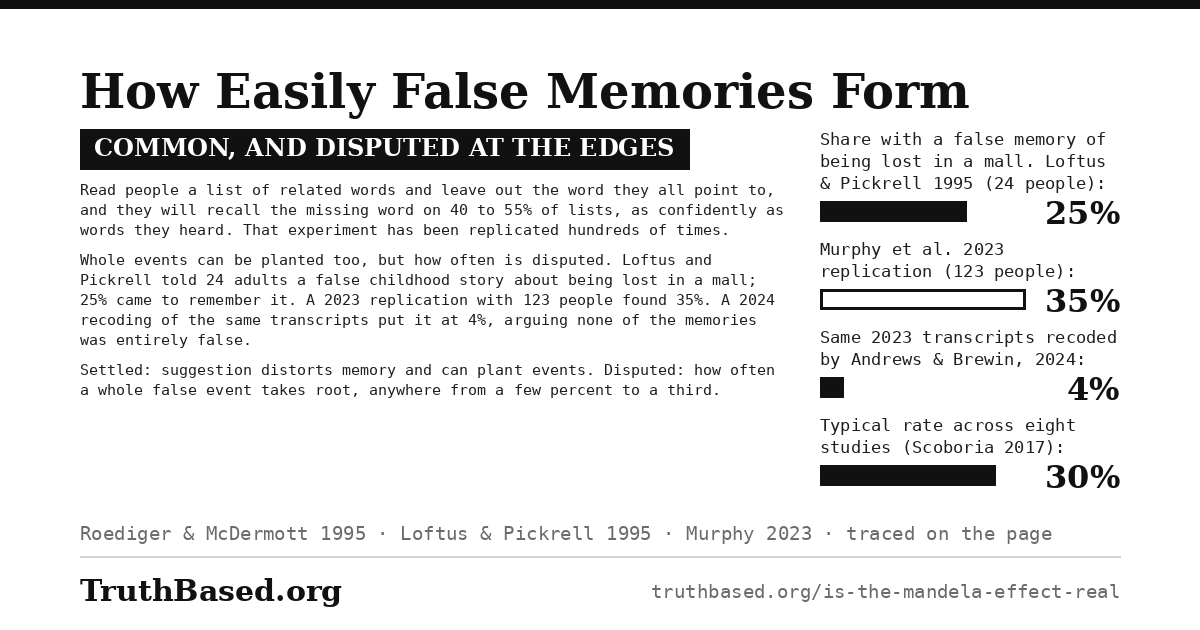
This section as one image: the word-list experiment, the lost-in-the-mall studies, and the live dispute over how often a whole false event takes root.
Steelmanning Both Sides
The cognitive science case is not “people are dumb.” It is the most complete account available. Every Mandela Effect example maps cleanly onto established mechanisms:
Berenstain/Berenstein: English-speaking countries have thousands of -stein surnames (Einstein, Goldstein, Bernstein) and almost none ending in -stain. Phonological prototype research shows that when the exact spelling fades, the brain fills in the most statistically common pattern. The error is predictable. It is the only common error.
Monopoly monocle: The prototype for “wealthy 1930s capitalist caricature” is extremely strong in English-speaking culture. Mr. Peanut (1916) has a monocle. The Penguin (Batman, 1941) has a monocle. Early 20th-century cartoons of rich men almost universally included one. Schema-driven reconstruction supplies the detail automatically. The memory feels complete because the schema is complete.
Nelson Mandela: Other anti-apartheid figures did die in custody, Steve Biko in 1977 the most famously, while Mandela was the most famous imprisoned activist of all. Narrative compression assigns the most prominent name to the most memorable event. Source confusion between Mandela and those who died is exactly what memory psychology predicts.
The “mass” part is explained by shared cultural exposure: people in the same culture have the same prototypes, hear the same parody versions of movie quotes, and encounter the same unofficial merchandise with the same errors. Social amplification via internet communities then hardens private errors into collective certainties. No paranormal mechanism required.
The strongest case that something else may be going onThe most intellectually serious alternative argument is not about parallel universes. It is a legitimate scientific puzzle: why do specific errors converge so precisely across millions of non-interacting people? If memory were simply filling gaps with prototypes, we might expect more variation, some people remembering “Berensteen,” others “Berenstine,” others getting it right. Instead, one specific wrong answer dominates.
A related puzzle: many Mandela Effect reports include specific multi-modal visual detail, seeing the exact cover of the Berenstain Bears book with the wrong spelling in gold foil, seeing the monocle clearly. The laboratory can implant rich false memories of whole events, as the Lost in the Mall studies show, but it does so one person at a time, with a relative's false story and repeated suggestive interviews. No procedure like that operates on the thousands of strangers who describe the same gold-foil cover, and the misinformation effect on its own alters details within an event rather than supplying whole scenes.
These are genuine puzzles. They do not require supernatural explanations, but they do demand more research into how culturally shared schemas interact with individual reconstruction to produce such consistent, specific collective errors.
Cognitive claim
“It’s just false memory” is sometimes said as if this is simple or dismissible. It is not. The fact that the brain reliably generates vivid, confident false memories that feel identical to real ones is one of the most important and underappreciated findings in science. The mechanism being known does not make the phenomenon less profound.
Supernatural claim
The parallel universe and simulation explanations are unfalsifiable. There is no observation that could count against them. Any evidence can be explained as “another glitch.” Physics offers no mechanism for memory crossover between quantum branches. The quantum many-worlds interpretation describes mathematical formalism, not brand logos and movie quotes. These explanations satisfy emotional needs but fail empirical testing.
What the Evidence Actually Shows
The evidence overwhelmingly supports false memory as the complete explanation for the Mandela Effect. Every mechanism required has been demonstrated in controlled laboratory conditions. No physical evidence supports timeline shifts, simulation edits, or parallel universe crossover.
But stating this as “it’s just false memory” misses the actual significance. The findings are:
1. False memories are not rare pathological events. In the DRM paradigm, healthy adults falsely recall the absent word on 40–55% of the lists they study, under standard laboratory conditions. They are a feature of how associative memory encodes meaning rather than surface detail.
2. False memories are hard to tell from true ones, and not just subjectively. High-confidence false memories activate largely the same brain regions as high-confidence true memories, though imaging studies can separate them statistically. The subjective experience of remembering is generated by the brain in the present moment. It does not carry an authenticity stamp.
3. Confidence is not a reliable marker of accuracy. The confidence paradox (that people can be more confident in false memories than true ones) is well-documented. Confidence tracks fluency and schema-fit, not correspondence to reality.
4. Social networks amplify and stabilize errors. The 2025 Cognitive Science study shows experimentally that how a group is wired changes what it misremembers, with non-clustered networks producing more false memories than clustered ones. It did this with word lists in a lab, so it establishes the mechanism rather than its scale online.
5. Correction often fails. The “continued influence effect” means that even after false information is corrected, it continues to influence reasoning. For many people, being shown the -stain spelling adds a fact without dislodging the remembered one.
The practical implication that matters most
What we do not know
Eyewitness misidentification is involved in 69% of the 375 convictions later overturned by DNA evidence (Innocence Project). The same mechanisms that produce the Mandela Effect (source confusion, misinformation integration, confidence inflation) operate in courtrooms with devastating consequences. Elizabeth Loftus, whose experiments opened this field, has testified or consulted as an expert in hundreds of cases.
Several genuine uncertainties remain. We do not have a complete predictive model of which cultural details will generate widespread collective false memories versus remaining idiosyncratic. We do not fully understand how individual susceptibility factors (schema strength, network position, sleep quality, suggestibility) interact to determine who is most affected. And the degree to which warnings can reduce Mandela Effect errors in real-world (as opposed to laboratory) settings is still being researched.
What This Means
False memories look much like real ones in the brain. Popular coverage says “the brain can’t tell the difference” and underestimates how unsettling the accurate version is: the overlap during recall is extensive, and while imaging can separate true from false on average, no internal signal of falseness is available to the person doing the remembering.
Stronger memory ability does not protect you. In some paradigms, people with higher semantic memory and richer associative networks are more susceptible to certain false memories because they generate stronger predictions. The very abilities that make memory powerful also make it prone to gist-driven errors.
Sleep does not sort true from false. Sleep deprivation makes people more susceptible to misinformation (Frenda et al., 2014). A full night is no safeguard either: Payne and colleagues (2009) found that sleep increased both true and false recall in the DRM paradigm, and that the false memories were the ones preferentially preserved. Later studies have split on the size and even the direction of that effect. None finds that sleep removes false memories.
The confidence paradox applies in both directions. People can be highly confident in false memories and uncertain about accurate ones. The match between how something feels to remember and whether it actually happened is weaker than almost everyone believes.
Personal identity is built on a reconstructive system. If your clearest, most certain memories can be wrong, and can feel no different from ones that are, then the self-narrative you built from those memories is partly fictional. This is not a matter of honesty. Memory was never designed to be a perfect archive. It was designed to preserve meaning and enable prediction.
The verdict: what the evidence shows
Claims and evidence
Misconception“People who believe in the Mandela Effect are confused or irrational”
EvidenceFalse. Every major example maps onto well-documented cognitive mechanisms. These are normal people experiencing the normal operation of a reconstructive memory system. The experience is real; the memory is not.
Misconception“It must be parallel universes. Too many people are too specific”
EvidenceNot supported. Physics provides no mechanism for memory crossover between quantum branches while every physical archive in the current branch remains unchanged. The specificity is explained by shared cultural schemas and social contagion.
Misconception“It’s just people misremembering, nothing interesting here”
EvidenceUnderclaims. The Mandela Effect reveals that memory is not a recording device, false memories are hard to separate from true ones even in the brain, confidence does not track accuracy, and social networks can propagate identical errors across millions. That is profound.
Misconception“High-confidence memories are reliable memories”
EvidenceFalse. Research shows confidence tracks ease of retrieval and schema-fit, not accuracy. In the DRM paradigm, the absent word is recognised with confidence comparable to words actually heard. This is one of the most replicated findings in cognitive psychology.
Download the conclusion
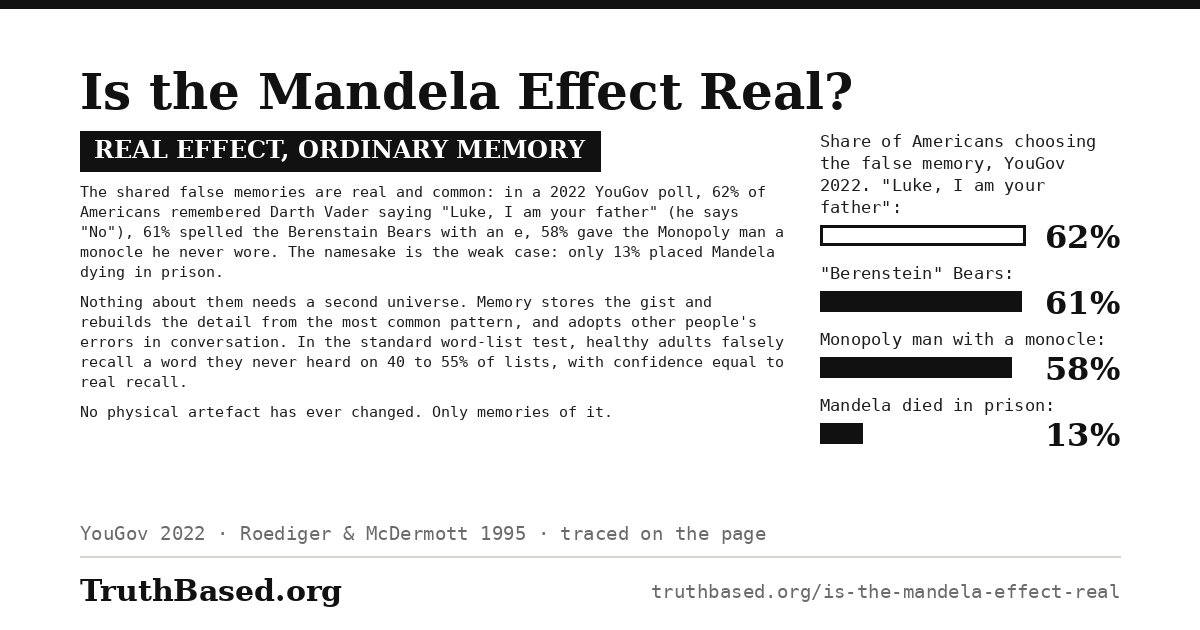
The verdict above as one image, with the YouGov poll shares as its chart. It is 1,200 by 630 pixels, the size social networks use for link previews, and anyone may download it and post it.
What would change this conclusion
This article concludes that false memory fully explains the Mandela Effect. This would change if:
1. Physical evidence emerged showing an object or document had verifiably different properties at one point in time, not remembered differently, but physically different in ways measurable by independent instruments.
2. A controlled study demonstrated that Mandela Effect false memories were systematically different in their neural correlates from laboratory-induced DRM false memories, suggesting a different mechanism.
3. A mechanism were proposed for how quantum decoherence (which makes parallel branches permanently inaccessible) could be violated in ways that selectively affect human memory while leaving all physical artifacts unchanged.
None of these conditions currently apply.
Full Sources & References
Loftus E.F. & Palmer J.C. (1974) — Reconstruction of automobile destruction: An example of the interaction between language and memory. Journal of Verbal Learning and Verbal Behavior, 13, 585–589. Full text
Loftus E.F. & Pickrell J.E. (1995) — The formation of false memories (“Lost in the Mall”). Psychiatric Annals, 25(12), 720–725. Full text
Roediger H.L. & McDermott K.B. (1995) — Creating false memories: Remembering words not presented in lists (DRM paradigm). Journal of Experimental Psychology: Learning, Memory, and Cognition, 21, 803–814. Full text
Johnson M.K., Hashtroudi S. & Lindsay D.S. (1993) — Source monitoring. Psychological Bulletin, 114(1), 3–28. PubMed
Brainerd C.J. & Reyna V.F. (2002) — Fuzzy-trace theory and false memory. Current Directions in Psychological Science, 11(5), 164–169. Primary source for gist vs. verbatim encoding model.
Roediger H.L., Meade M.L. & Bergman E.T. (2001) — Social contagion of memory. Psychonomic Bulletin & Review, 8(2), 365–371. Full text
Valle T. et al. (2025) — Social Network Structure Shapes the Formation of True and False Memories at the Collective Level. Cognitive Science 49(4), e70060. DOI 10.1111/cogs.70060. doi.org
Murphy G., Dawson C.A., Huston C. et al. (2023) — Lost in the mall again: a preregistered replication and extension of Loftus & Pickrell (1995). Memory, 31(6), 818–830. N=123; 35% coded as reporting a false memory. doi.org
Andrews B. & Brewin C.R. (2024) — Lost in the mall? Interrogating judgements of false memory. Applied Cognitive Psychology, 38(6), e70012. The recoding of the 2023 transcripts that puts the rate at 4%. doi.org
Wade K.A., Riesthuis P., Bücken C., Otgaar H. & Loftus E.F. (2025) — Still lost in the mall: false memories happen and that’s what matters. Applied Cognitive Psychology, 39(1), e70028. The reply. doi.org
Scoboria A., Wade K.A., Lindsay D.S. et al. (2017) — A mega-analysis of memory reports from eight peer-reviewed false memory implantation studies. Memory, 25(2), 146–163. doi.org
Patihis L. et al. (2013) — False memories in highly superior autobiographical memory individuals. PNAS, 110, 20947–20952. Full text
Frenda S.J. et al. (2014) — Sleep deprivation and false memories. Psychological Science, 25, 1674–1681. Full text
Payne J.D., Schacter D.L., Propper R.E. et al. (2009) — The role of sleep in false memory formation. Neurobiology of Learning and Memory, 92(3), 327–334. DOI 10.1016/j.nlm.2009.03.007
YouGov Survey (2022) — Measuring the Mandela Effect. N=1,000 U.S. adults. YouGov
Nelson Mandela Foundation — Official timeline: released Feb 11, 1990; died Dec 5, 2013. nelsonmandela.org
Berenstain Bears official site — Spelling always “Berenstain”. The first book, The Big Honey Hunt (1962), was published by Beginner Books, a division of Random House; later titles by Random House and HarperCollins. berenstainbears.com
Snopes fact-checks — Monopoly monocle, Looney Tunes, Fruit of the Loom cornucopia. Snopes
Fruit of the Loom FAQ — Official statement: no cornucopia in logo history. fruit.com
Kim H. & Cabeza R. (2007) — Trusting our memories: Dissociating the neural correlates of confidence in veridical vs. illusory memories. Journal of Neuroscience, 27(45), 12190–12197. Mnemology Lab
Innocence Project — DNA Exonerations in the United States, 1989 to 2020. 375 DNA exonerees, of whom 69% involved eyewitness misidentification. innocenceproject.org
Stanford Encyclopedia of Philosophy — Many-Worlds Interpretation of Quantum Mechanics. plato.stanford.edu
Cite this article
TruthBased.org. “The Mandela Effect: Mass False Memory or Something Else?” September 2026. https://www.truthbased.org/is-the-mandela-effect-real